
| 👁 Image TDRS-F being deployed from Endeavour | |
| Mission type | Communication |
|---|---|
| Operator | NASA |
| COSPAR ID | 1993-003B 👁 Edit this at Wikidata |
| SATCAT no. | 22314 |
| Mission duration | Planned: 10 years Elapsed: 33 years, 2 months, 17 days |
| Spacecraft properties | |
| Bus | TDRS |
| Manufacturer | TRW |
| Launch mass | 2,108 kg (4,647 lb)[1] |
| Dimensions | 17.3 × 14.2 m (57 × 47 ft) |
| Power | 1700 watts |
| Start of mission | |
| Launch date | 13 January 1993, 13:59:30 (1993-01-13UTC13:59:30) UTC |
| Rocket | Space Shuttle Endeavour STS-54 / IUS |
| Launch site | Kennedy Space Center LC-39B |
| Contractor | Rockwell International |
| Orbital parameters | |
| Reference system | Geocentric |
| Regime | Geostationary |
| Longitude | 46.0° West (1994–1996) 47.0° West (1996–2005) 174.0° West (2005–) |
| Epoch | 14 January 1993 [2] |


TDRS-6, known before launch as TDRS-F, is an American communications satellite, of first generation, which is operated by NASA as part of the Tracking and Data Relay Satellite System. It was constructed by TRW, and is based on a custom satellite bus which was used for all seven first generation TDRS satellites.[3]
History
[edit]

TDRS-F was deployed from Space Shuttle Endeavour during the STS-54 mission in 1993. Endeavour was launched from Launch Complex 39B at the Kennedy Space Center, at 13:59:30 UTC on 13 January 1993.[4] TDRS-F was deployed from Endeavour around six hours after launch, and was raised to geosynchronous orbit by means of an Inertial Upper Stage.[4]
Deployment
[edit]The two-stage solid-propellent Inertial Upper Stage made two burns. The first stage burn occurred shortly after deployment from Endeavour, and placed the satellite into a geosynchronous transfer orbit (GTO). At 02:26 UTC on 14 January 1993, it reached apogee, and the second stage fired, placing TDRS-F into geosynchronous orbit.[5] At this point, it received its operational designation, TDRS-6.
Operation
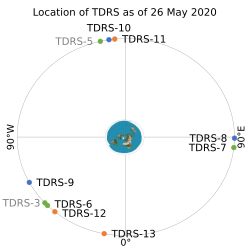
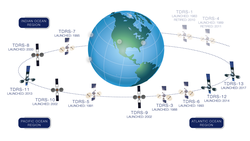
[edit]In 1994, it was placed at a longitude 46.0° West of the Greenwich Meridian, to serve as an on-orbit spare.[6] In 1996, it was moved to 47.0° West, where it remained until 2005, when it was repositioned to 174.0° West,[6] where, as of August 2009[update], it was used to provide communications with spacecraft in Earth orbit, such as the International Space Station (ISS) and spacecraft bringing astronauts to the ISS.


See also
[edit]
References
[edit]- ^ "UCS Satellite Database". Union of Concerned Scientists. 1 July 2009. Retrieved 9 August 2009.
- ^ "NASA - NSSDCA - Spacecraft - Trajectory Details". nssdc.gsfc.nasa.gov. Retrieved 2 May 2018. 👁 Public Domain
This article incorporates text from this source, which is in the public domain. - ^ Krebs, Gunter. "TDRS 1, 2, 3, 4, 5, 6". Gunter's Space Page. Retrieved 9 August 2009.
- ^ a b McDowell, Jonathan. "Launch Log". Jonathan's Space Page. Retrieved 9 August 2009.
- ^ McDowell, Jonathan. "Index". Geostationary Orbit Catalog. Jonathan's Space Page. Archived from the original on 6 April 2010. Retrieved 9 August 2009.
- ^ a b "TDRS 6". TSE. Retrieved 9 August 2009.


- Source attribution
- Articles with short description
- Short description is different from Wikidata
- Use American English from June 2020
- All Wikipedia articles written in American English
- Use dmy dates from July 2020
- Articles containing potentially dated statements from August 2009
- All articles containing potentially dated statements