
| Tellus | |
|---|---|
Goddess of the earth, earthquakes, fertility, nature, marriage and agriculture
personification of the Earth | |
| Member of the di selecti | |
| 👁 Image | |
| Other names | Terra or Tierra |
| Abode | Earth |
| Symbol | Fruit, flowers, cornucopia, cattle |
| Genealogy | |
| Parents | Aether and Dies |
| Siblings | Caelus |
| Consort | Caelus |
| Children | Saturn, Ops, Janus |
| Equivalents | |
| Greek | Gaia |


In ancient Roman religion and mythology, Tellus or Terra[a] ("Mother Earth") is the personification of the Earth. Although Tellus and Terra are hardly distinguishable during the Imperial era,[1] Tellus was the name of the original earth goddess in the religious practices of the Republic or earlier.[2][3] The scholar Varro (1st century BC) lists Tellus as one of the di selecti, the twenty principal gods of Rome, and one of the twelve agricultural deities.[4][5]: 7.2 She is regularly associated with Ceres in rituals pertaining to the earth and agricultural fertility.
The attributes of Tellus were the cornucopia, bunches of flowers, or fruit. She was typically depicted reclining, or rising, waist high from a hole in the ground.[6] Her male complement was a sky god such as Caelus (Uranus) or a form of Jupiter. Her Greek counterpart is Gaia,[7] and among the Etruscans, her name was Cel. Michael Lipka has argued that the Terra Mater who appeared during the reign of Augustus, is a direct transfer of the Greek Ge Mater into Roman religious practice, while Tellus, whose ancient temple was within Rome's sacred boundary (pomerium), represents the original earth goddess cultivated by the state priests.[8]: 151–152 ff
Name
[edit]

The two words terra and tellus are thought to derive from the formulaic phrase tersa tellus, meaning "dry land".[citation needed] The etymology of tellus is uncertain; it is perhaps related to Sanskrit talam, "plain ground". [10]
The 4th century AD Latin commentator Servius distinguishes between use of tellus and terra. Terra, he says, is properly used of the elementum, earth as one of the four classical elements with air (Ventus), water (Aqua), and fire (Ignis). Tellus is the goddess, whose name can be substituted (ponimus ... pro) for her functional sphere the earth, just as the name Vulcanus is used for fire, Ceres for produce, and Liber for wine.[11]: 1.171 Tellus thus refers to the guardian deity of Earth and by extension the globe itself.[12] Tellus may be an aspect of the spirit called Dea Dia by the Arval priests,[14] or at least a close collaborator with her as "divinity of the clear sky."[15]: 114
Varro identifies Terra Mater with Ceres:
Not without cause was the Earth (Terra) called Mater and Ceres. It was believed that those who cultivated her led a pious and useful life (piam et utilem ... vitam), and that they were the sole survivors from the line of King Saturn.[17]
Ovid distinguishes between Tellus as the locus ("site, location") of growth, and Ceres as its causa ("cause, agent").[18]: 1.671–674 [19] Mater, the Latin word for "mother," is often used as an honorific for goddesses, including Vesta, who was represented as a virgin. "Mother" therefore is an honorific that expresses the respect one would owe any good mother. Tellus and Terra are both regarded as mothers in both the literal and honorific sense; Vesta in the honorific only.
Temple
[edit]The Temple of Tellus was the most prominent landmark of the Carinae,[20][11]: 8.361 a fashionable neighborhood on the Oppian Hill.[21]: 71, 378 [23] It was near homes (domūs) belonging to Pompey[25][26][27][21]: 133, 378 and to the Cicero family.[28][29]: 2.3.7 [21]: 378
The temple was the result of a votum made in 268 BC by Publius Sempronius Sophus when an earthquake struck during a battle with the Picenes.[30][21]: 378 Others[31] say it was built by the Roman people. It occupied the former site of a house belonging to Spurius Cassius, which had been torn down when he was executed in 485 BC for attempting to make himself king.[32][33][34][35] The temple constructed by Sophus more than two centuries later was most likely a rebuilding of the people's.[21]: 378 The anniversary (dies natalis) of its dedication was December 13.
A mysterious object called the magmentarium was stored in the temple,[36][37][21]: 379 which was also known for a representation of Italy on the wall, either a map or an allegory.[4]: 1.2.1 [38][21]: 378–379
A statue of Quintus Cicero, set up by his brother Marcus, was among those that stood on the temple grounds.[29]: 3.1.6, 3.1.14 [39][40] Cicero claims that the proximity of his property caused some Romans to assume he had a responsibility to help maintain the temple.[41]
Festivals
[edit]

Festivals celebrated for Tellus were mainly concerned with agriculture and often connected with Ceres. In January, both goddesses were honored as "mothers of produce"[42] at the moveable feast (feriae conceptivae) of Sementivae, a festival of sowing.[44] On December 13, the anniversary of the Temple of Tellus was celebrated along with a lectisternium (banquet) for Ceres, who embodied "growing power" and the productivity of the earth.[45]
Tellus received the sacrifice of a pregnant cow at the Fordicidia, a festival pertaining to fertility and animal husbandry[46]: 45 held April 15, in the middle of the Cerialia (April 12–19).[16]: 163 Festivals for deities of vegetation and the earth cluster in April on the Roman calendar.[13]: 67 The institution of the Fordicidia was attributed to Numa Pompilius, the Sabine second king of Rome. During a time when Rome was struggling with harsh agricultural conditions, Numa was instructed by the rustic god Faunus in a dream that a sacrifice to Tellus was needed. As is often the case with oracles, the message required interpretation:
"By the death of cattle, oh King, Tellus must be placated: two cows, that is. Let a single heifer yield two lives (animae) for the rites."[47]
Numa solved the riddle by instituting the sacrifice of a pregnant cow.[48] The purpose of the sacrifice, as suggested by the Augustan poet Ovid and by the 6th-century antiquarian John Lydus, was to assure the fertility of the planted grain already growing in the womb of Mother Earth in the guise of Tellus.[18]: 4.633 ff [49][46]: 53 This public sacrifice was conducted in the form of a holocaust on behalf of the state at the Capitol, and also by each of the thirty curiae, the most ancient divisions of the city made by Romulus from the original three tribes.[13]: 71, 303 [50] The state sacrifice was presided over by the Vestals, who used the ash from the holocaust to prepare suffimen, a ritual substance used later in April for the Parilia.[18]: 4.731–734 [51][13]: 71 [46]: 53, 383
During the Secular Games held by Augustus in 17 BC, Terra Mater was among the deities honored in the Tarentum in the Campus Martius. Her ceremonies were conducted by "Greek rite" (ritus graecus), distinguishing her from the Roman Tellus whose temple was within the pomerium. She received the holocaust of a pregnant sow.[8]: 151–152, 157 The Secular Games of 249 BC had been dedicated to the underworld deities Dis pater and Proserpina, whose underground altar was in the Tarentum. Under Augustus, the Games (ludi) were dedicated to seven other deities, invoked as the Moerae, Iuppiter, Ilithyia, Iuno, Terra Mater, Apollo and Diana.[8]: 150
Prayers and rituals
[edit]The sacrum ceriale ("cereal rite") was carried out for Tellus and Ceres by a flamen, probably the Flamen Cerialis, who also invoked twelve male helper gods.[52][53][8]: 57, 69 According to Varro,[54] the two goddesses jointly received the porca praecidanea, a pig sacrificed in advance of the harvest.[57] Some rites originally pertaining to Tellus may have been transferred to Ceres, or shared with her, as a result of her identification with Greek Demeter.[58]
Tellus was felt to be present during rites of passage, either implicitly, or invoked. She was perhaps involved in the ceremonies attending the birth of a child, as the newborn was placed on the ground immediately after coming into the world.[citation needed] Tellus was also invoked at Roman weddings.[59][60]
Dedicatory inscriptions to either Tellus or Terra are relatively few,[22]: 304 but epitaphs during the Imperial period sometimes contain formulaic expressions such as "Terra Mater, receive me."[61] In the provincial mining area of Pannonia, at present-day Ljubija, votive inscriptions record dedications to Terra Mater from vilici, imperial slave overseers who ran operations at ore smelting factories (ferrariae).[62][63]: 58–59
These are all dated April 21, when the founding day (dies natalis, "birthday") of Rome was celebrated, perhaps reflecting the connection between the Parilia on April 21 and the Fordicidia as a feast of Tellus.[63]: 59–60 The emperor Septimius Severus restored a temple of Terra Mater at Rudnik, a silver mining area of Moesia Superior.[64][63]: 59 (note 29), 78 Measuring 30 by 20 meters, the temple was located at the entrance to the work zone.[63]: 78
Iconography
[edit]
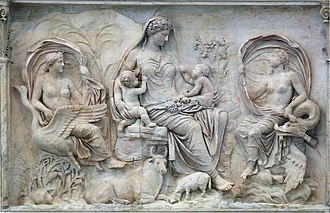
Tellus is often identified as the central figure on the so-called Italia relief panel of the Ara Pacis, which is framed by bucrania (ornamental ox heads) and motifs of vegetative and animal fertility and abundance.[65][66] Terra long remained common as a personification, if not exactly treated as a goddess. She often formed part of sets of the personified Four Elements, typically identified by a cornucopia, farm animals, and vegetable products.
Tellumo
[edit]Male counterparts named Tellumo or Tellurus are mentioned, although rarely. Augustine of Hippo identified Tellumo as the male counterpart of Tellus.[5]: 7.23 A Tellurus is named by Capella[67] but by no other source.[68][69]
In science
[edit]In several modern Romance languages, Terra or Terre is the name of planet Earth. Earth is sometimes referred to as "Terra" by speakers of English to match post-classical Latin astronomical naming conventions, and to distinguish the planet from the soil covering part of it. It is also, rarely, called "Tellus", mainly via the adjective "tellurian".[70]
In the arts
[edit]Tellus was the inspiration for the name of the Tellus Audio Cassette Magazine.[71]
See also
[edit]

Notes
[edit]- ^ This article preserves the nomenclature Tellus or Terra as used by individual ancient sources.
References
[edit]- ^ a b Augoustakis, Antony (2010). Motherhood and the Other: Fashioning female power in Flavian epic. Oxford University Press. p. 124. ISBN 978-0-19-958441-3.
- ^ Forsythe, Gary (2012). Time in Roman Religion: One thousand years of religious history. Routledge. p. 73.
- ^ McDonough, Christopher M. (2010). "Roman Religion". The Oxford Encyclopedia of Ancient Greece and Rome. Vol. 1. Oxford University Press. p. 97.
- ^ a b c Marcus Terentius Varro. Rerum rusticarum libri tres [Agricultural Topics in Three Books].
- ^ a b Augustine of Hippo. De civitate Dei.
- ^ Lawrence, Marion (1965). "The Velletri Sarcophagus". American Journal of Archaeology. 69 (3): 212. doi:10.2307/502285. JSTOR 502285. S2CID 193124610.
- ^ Haydock (1995). Larousse Desk Reference Encyclopedia. The Book People. p. 215.[full citation needed]
- ^ a b c d Lipka, Michael (2009). Roman Gods: A conceptual approach. Brill.
- ^ Ernout-Meillet (ed.). Dictionnaire Etymologique De La Langue Latine [Etymological Dictionary of the Latin Language] (in French).[full citation needed]
- ^ Augoustakis (2010)[1] citing the entry on tellus in Ernout-Meillet[9]
- ^ a b Maurus Servius Honoratus. note on [Virgil's] Aeneid.
- ^ "Tellus". The Oxford Classical Dictionary. Oxford University Press. 1996. p. 1480.
- ^ a b c d e Fowler, William Warde (1908). The Roman Festivals of the Period of the Republic. London.
{{cite book}}: CS1 maint: location missing publisher (link) - ^ Fowler (1908),[13]: 74 who concurs with Ludwig Preller
- ^ a b c Schilling, Robert (1992) [1981]. "Rome". Roman and European Mythologies. University of Chicago Press. from the French edition of 1981.
- ^ a b c Wagenvoort, Hendrik (1956). "Initia Cereris". Studies in Roman Literature, Culture and Religion. Brill.
- ^ Varro[4]: 3.1.5 cited by Wagenvoort (1956).[16]: 153
- ^ a b c d e Publius Ovidius Naso. Fastorum Libri Sex (Fasti) [Six Books on the Calendar].
- ^ Dumézil, Georges (1980). Camillus. edited and translated by Udo Strutynski. University of California Press. p. 77. ISBN 9780520028418.
- ^ Suetonius, Grammatici 15
- ^ a b c d e f g Richardson, Lawrence (1992). A New Topographical Dictionary of Ancient Rome. Baltimore, MD: Johns Hopkins University Press.
- ^ a b Taylor, Lily Ross (1925). "The Mother of the Lares". American Journal of Archaeology. 29 (3): 299–313. doi:10.2307/497560. JSTOR 497560. S2CID 192992171.
- ^ According to Taylor[22]: 306 it was on the lower slopes of the Esquiline Hill.
- ^ Suetonius, Grammatici, 15
- ^ Pompey's domus rostrata, the house that was ornamented with the prows (rostra) from the so-called Cilician pirates.[24]
- ^ Appian, Bellum Civile, 2.126
- ^ Kuttner, Ann (1999). "Culture and history at Pompey's museum". Transactions of the American Philological Association. 129: 349.
- ^ Plutarch, Life of Cicero, 8.3
- ^ a b Marcus Tulius Cicero. Letters to My Brother Quintus.
- ^ Florus, 1.14.2
- ^ Valerius Maximus 6.3.1b; Dionysius of Halicarnassus 8.79.3.
- ^ Cicero, De domo sua 101
- ^ Livy, 2.41.11
- ^ Dionysius of Halicarnassus, 8.79.3
- ^ Valerius Maximus, 6.3.1b.
- ^ Cicero, De haruspicum responsis 31
- ^ Stambaugh, John E. (1978). "The functions of Roman temples". Aufstieg und Niedergang der römischen Welt. II.16.1, p. 571.
- ^ Hölkeskamp, Karl-J. (1993). "Conquest, competition, and consensus: Roman expansion in Italy and the rise of the nobilitas". Historia. 42 (1): 28.
- ^ Wiseman, T.P. (1966). "The ambitions of Quintus Cicero". Journal of Roman Studies. 56 (1–2): 110. doi:10.2307/300137. JSTOR 300137. S2CID 163483058.
- ^ McDermott, William C. (1971). "Q. Cicero". Historia. 20: 107.
- ^ Cicero, De haruspicum responsis, 31.
- ^ Frugum matres, Ovid[18]: 1.671
- ^ Scullard, H.H. (1981). Festivals and Ceremonies of the Roman Republic. Ithaca, NY: Cornell University Press. p. 68. ISBN 9780801414022.
- ^ Scullard (1981)[43] considers January 24–26 to be the regular date of the feriae conceptivae.
- ^ Wagenvoort (1956)[16]: 159ff argues that Ceres herself originated as the generative aspect of Tellus.
- ^ a b c Beard, Mary; North, J.A.; Price, S.R.F. (1998). Religions of Rome: A history. Vol. 1. Cambridge University Press. ISBN 9780521316828 – via Google Books.
- ^ Morte boum tibi, rex, Tellus placanda duarum: / det sacris animas una iuvenca duas.[18]: 4.641–666
- ^ Ivanov, Vyacheslav V. (1994). "Fundamentals of Diachronic Linguistics". In de Gruyter, Mouton (ed.). Semiotics around the World: Synthesis in Diversity. Vol. 1. pp. 64–66. – discusses Vedic and Hittite parallels.
- ^ John Lydus, De Mensibus, 4.49, drawing on Varro, as noted by Fowler (1908).[13]: 71
- ^ Smith, Christopher John (2006). The Roman Clan: The gens from ancient ideology to modern anthropology. Cambridge University Press. p. 207.
- ^ Harmon, Daniel P. (1986). "Religion in the Latin elegists". Aufstieg und Niedergang der römischen Welt. 2.16.3, p. 1958.
- ^ Varro, Antiquitates frg. 266 (edition of Cardauns), Servius Danielis, note to Georgics "1.21", citing Fabius Pictor[clarification needed]
- ^ Rüpke, Jörg (2012). Religion in Republican Rome: Rationalization and ritual change. University of Pennsylvania Press. p. 181.
- ^ As cited by Nonius, p. 240 in the edition of Wallace Lindsay, as cited by Schilling[15]: 122
- ^ Cato. On Agriculture. 134.
- ^ Gellius. Attic Nights. 4.6.8.
- ^ Cato[55] and Gellius[56] name Ceres as the sole recipient.
- ^ Schilling[15]: 124 "Cicero as Theologian"
- ^ Servius, note to Aeneid 4.166
- ^ Spaeth. The Roman Goddess Ceres. p. 5.[full citation needed]
- ^ Fowler, William Warde (1922). The Religious Experience of the Roman People. London. p. 122.
{{cite book}}: CS1 maint: location missing publisher (link) - ^ Hirt, Alfred Michael (2010). Imperial Mines and Quarries in the Roman World: Organizational aspects 27 BC–AD 235. Oxford University Press. sect. 6.2.
- ^ a b c d Dušanić, Slobodan (1977). "Aspects of Roman Mining in Noricum, Pannonia, Dalmatia and Moesia Superior". Aufstieg und Niedergang der Römischen Welt. 2 (6).
- ^ CIL 3.8333
- ^ Feeney, Denis (2004). "Interpreting sacrificial ritual in Roman poetry: Disciplines and their models". In Steiner, Franz (ed.). Rituals in Ink: A conference on religion and literary production in ancient Rome. p. 12.
- ^ For more on the iconography of Tellus, see Lexicon Iconographicum Mythologiae Classicae, 7.1.879–889.
- ^ Martianus Minneus Felix Capella. De nuptiis Philologiae et Mercurii [On the Marriage of Philology and Mercury]. 1.49.
- ^ Woodard, Roger D. (2006). Indo-European sacred space: Vedic and Roman cult. University of Illinois Press. p. 115.
- ^ Stahl, William Harris; Bruge, E.L. (1977). Martianus Capella and the Seven Liberal Arts: The marriage of philology and Mercury. Columbia University Press. p. 23.
- ^ Nabodus, Valentinus (1573). Primae de coelo et terra institutiones ... [The main precepts for understanding the celestial and terrestrial ...]. Venete. pp. 33, 41–42 – via Google Books.
- ^ [1] Joseph Nechvatal at Monoskop


- All articles with incomplete citations
- Articles with incomplete citations from December 2019
- CS1 French-language sources (fr)
- CS1 maint: location missing publisher
- Wikipedia articles needing clarification from December 2019
- Articles with short description
- Short description is different from Wikidata
- Articles containing Latin-language text
- All articles with unsourced statements
- Articles with unsourced statements from June 2012
- Articles with unsourced statements from July 2012
- Commons category link is locally defined
- Commons category link is on Wikidata