

| The Astronomer | |
|---|---|
| 👁 Image | |
| Artist | Johannes Vermeer |
| Year | 1668 |
| Medium | Oil on canvas |
| Movement | Dutch Golden Age painting |
| Dimensions | 51 cm × 45 cm (20 in × 18 in) |
| Location | Musée du Louvre, Paris |

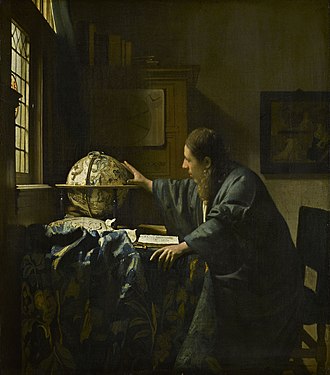
The Astronomer (Dutch: De astronoom) is a painting finished in 1668 by the Johannes Vermeer, a painter of the Dutch Golden Age. It is in oil on canvas with dimensions 51 cm × 45 cm (20 in × 18 in). The Astronomer is now in the collection of the Louvre in Paris.[1]
Description
[edit]

Portrayals of scientists were a favourite topic in 17th-century Dutch painting[2] and Vermeer's oeuvre includes both this astronomer and the slightly later The Geographer. Both are believed to portray the same man,[3][4][5] possibly Antonie van Leeuwenhoek.[6] A 2017 study indicated that the canvas for the two works came from the same bolt of material, confirming their close relationship.[7] It has been proposed that Vermeer used a camera obscura as an aid to reconstruct the geometry of the rooms and the objects in his paintings.[8] Both paintings portray the same room and furniture, slightly rearranged.[9]
The painting shows an astronomer looking at a globe. The astronomer's profession is shown by the celestial globe (version by Jodocus Hondius) and the book on the table, the 1621 edition of Adriaan Metius's Institutiones Astronomicae Geographicae.[3][4][5][10] Symbolically, the volume is open to Book III, a section advising the astronomer to seek "inspiration from God," and the painting on the wall shows the Finding of Moses—Moses may represent knowledge and science ("learned in all the wisdom of the Egyptians").[11] It is notable that a telescope is absent from the scene; Jacob Metius is credited by his brother, Adriaan Metius, as the inventor of the telescope. Art historian Julian Jason Haladyn has suggested that this conveys interiority.[12]
Provenance
[edit]

The provenance of The Astronomer can be traced back to 27 April 1713, when it was sold at the Rotterdam sale of an unknown collector (possibly Adriaen Paets [nl] or his father, of Rotterdam) together with The Geographer. The presumed buyer was Hendrik Sorgh, whose estate sale held in Amsterdam on 28 March 1720 included both The Astronomer and The Geographer, which were described as 'Een Astrologist: door Vermeer van Delft, extra puyk' ('An Astrologist by Vermeer of Delft, top-notch') and 'Een weerga, van ditto, niet minder' ('Similar by ditto, no less').
Between 1881 and 1888 it was sold by the Paris art dealer Léon Gauchez to the banker and art collector Alphonse James de Rothschild, after whose death it was inherited by his son, Édouard Alphonse James de Rothschild. In 1940 it was seized from his hotel in Paris by the Nazi Einsatzstab Reichsleiter Rosenberg for the occupied territories after the German invasion of France. A small swastika was stamped on the back in black ink. The painting was returned to the Rothschilds after the war, and was acquired by the French state as giving in payment of inheritance taxes in 1983[13][14] and then exhibited at the Louvre since 1983.[14][15][16] In 1997, The Astronomer was displayed alongside its pendant piece, The Geographer, for a temporary exhibition first at the Louvre, then later at the Städel Museum.[17] This exhibition was the first time the two pieces had been reunited since their separation in 1797.
See also
[edit]- List of paintings by Johannes Vermeer
- The Astronomer and his Wife, earlier painting by Gonzales Coques
References
[edit]- ^ "Johannes ou Jan Vermeer: L'Astronome ou plutôt L'Astrologue". Louvre. Archived from the original on 3 March 2016.
- ^ "L'Astronome ou plutôt L'Astrologue". Atlas: the database of the exhibited works of art (in French). Musée du Louvre. Archived from the original on 2011-10-23. Retrieved 2006-10-14.
- ^ a b Bailey, Anthony (2001). Vermeer: A View of Delft. pp. 165–170. ISBN 0-8050-6930-5.
- ^ a b Bailey, Martin (1995). Vermeer. pp. 102–104. Archived from the original on 2007-10-11. Retrieved 2006-07-24.
- ^ a b van Berkel, Klaas (1996). "Vermeer and the Representation of Science". The Scholarly World of Vermeer. Waanders Publishers. pp. 13–14. ISBN 90-400-9825-5. Archived from the original on 2007-10-11. Retrieved 2006-07-24.
- ^ Van Berkel, K. (February 24, 1996). Vermeer, Van Leeuwenhoek en De Astronoom. Vrij Nederland (Dutch magazine), p. 62–67.
- ^ Johnson, C. Richard Jr; Sethares, W.A. (2017). "Canvas Weave Match Supports Designation of Vermeer's Geographer and Astronomer as a Pendant Pair". Journal of Historians of Netherlandish Art. 9. doi:10.5092/jhna.2017.9.1.17. Archived from the original on 2021-02-13. Retrieved 2017-03-08.
- ^ Steadman, Philip (2005). "Allegory, Realism, and Vermeer's Use of the Camera Obscura". Early Science and Medicine. 10 (2): 287–314. doi:10.1163/1573382054088123.
- ^ Steadman, Philip (2002). Vermeer's Camera: Uncovering the Truth behind the Masterpieces. Oxford University Press. p. 71. ISBN 978-0192803023. Retrieved 5 May 2025.
- ^ Welu, James (1986). "Vermeer's Astronomer: Observations on an Open Book". Art Bulletin. 68 (2): 263–267. doi:10.1080/00043079.1986.10788338.
- ^ Acts 7:22
- ^ Haladyn, Julian Jason (Winter 2022). "The Missing Telescope in Vermeer's The Astronomer". Source: Notes in the History of Art. 41 (2): 128–138. doi:10.1086/719460.
- ^ Lottman, Herbert R (1995). Return of the Rothschilds: the great banking dynasty through two turbulent centuries. London: Tauris. p. 312. ISBN 9781850439141.
- ^ a b Feliciano, Hector (1998). The Lost Museum: The Nazi Conspiracy to Steal the World's Greatest Works of Art. Basic Books. ISBN 0-465-04191-4.
- ^ "L'Astronome" [The Astronomer]. Communauté Louvre [Louvre Community] (in French). Archived from the original on 27 December 2010. Retrieved 25 January 2025.
- ^ Abbe, Mary (15 October 2009). "Louvre show at MIA has Hitler's favorite painting". Star Tribune. Minneapolis.
- ^ Pays-Bas; Vermeer, Johannes (1668), L'Astronome, archived from the original on 13 June 2021, retrieved 10 October 2025
Further reading
[edit]- Liedtke, Walter A. (2001). Vermeer and the Delft School. Metropolitan Museum of Art. ISBN 978-0-87099-973-4.
- Metius, Adriaan (1621). Institutiones Astronomicae Geographicae (in Dutch). Amsterdam.
External links
[edit]- 👁 Wikimedia Commons logo
Media related to The Astronomer by Johannes Vermeer at Wikimedia Commons


- Genre paintings by Johannes Vermeer
- 1668 paintings
- Paintings in the Louvre by Dutch artists
- Books in art
- Paintings of maps
- Astronomy in the Dutch Republic
- Cartography in the Dutch Republic
- Early modern Netherlandish cartography
- Science and technology in the Dutch Republic
- Oil paintings on canvas
- Paintings of men
- CS1 French-language sources (fr)
- Articles with short description
- Short description is different from Wikidata
- Pages using infobox mapframe with missing coordinates
- Articles containing Dutch-language text
- Articles containing Latin-language text
- CS1 Dutch-language sources (nl)
- Commons category link from Wikidata
- Articles with hAudio microformats
- Spoken articles