
This article relies largely or entirely on a single source. Relevant discussion may be found on the talk page. Please help improve this article by introducing citations to additional sources. Find sources: "Crescentina modenese" – news · newspapers · books · scholar · JSTOR (March 2024) |


| 👁 Image A dish of crescentine | |
| Alternative names | Crescenta, tigella |
|---|---|
| Type | Bread |
| Place of origin | Italy |

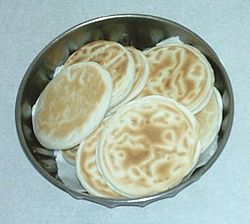


Crescentine (sg.: crescentina), crescente (sg.: crescenta) or tigelle (sg. tigella) are thin, 10 centimetres (3.9 in) round breads from the Apennine Mountains in the Modena area of Emilia-Romagna, Italy. They are made with flour, water, salt, and yeast, and traditionally eaten filled with cunza, a spread made from pork lard and flavoured with garlic and rosemary or with cold cuts, boar, rabbit, cheese, salty dressings or sweet spreads. In the Apennines, crescente have long been eaten at home or enjoyed in traditional restaurants, but in the last decade some fast food and casual restaurants have added crescente to their menus. Similar breads such as piadina, borlengo, gnocco fritto, and panigaccio are made in neighbouring areas.
Originally, crescente were baked between tiles called tigelle, a term derived from a Latin word for 'cover'. Later, the name tigella came to be used for the bread itself. Nowadays, crescente are baked in restaurants using electric griddles, while at home a special aluminium pan called a tigelliera or cottola over a gas cooker is used.


Crescentine is a prodotto agroalimentare tradizionale (PAT).[1]
See also
[edit]👁 Wikimedia Commons logo
Media related to Crescentina modenese at Wikimedia Commons


References
[edit]- ^ "Quattordicesima revisione dell'elenco nazionale dei prodotti agroalimentari tradizionali" (PDF). 5 June 2014. Archived from the original (PDF) on 18 May 2015. Retrieved 4 November 2017.
- Articles with short description
- Short description matches Wikidata
- Articles needing additional references from March 2024
- All articles needing additional references
- Use British English from May 2024
- All Wikipedia articles written in British English
- Articles containing Italian-language text
- Commons category link from Wikidata