
This article needs additional citations for verification. Please help improve this article by adding citations to reliable sources. Unsourced material may be challenged and removed. Find sources: "Tritiated water" – news · newspapers · books · scholar · JSTOR (May 2013) (Learn how and when to remove this message) |


| Names | |
|---|---|
| IUPAC name
[3H]2-water
| |
| Systematic IUPAC name
(3H2)Water | |
Other names
| |
| Identifiers | |
3D model (JSmol)
|
|
| ChEBI | |
| ChemSpider | |
| MeSH | tritium+oxide |
PubChem CID
|
|
CompTox Dashboard (EPA)
|
|
| |
| Properties | |
| T2O or 3H2O | |
| Molar mass | 22.0315 g·mol−1 |
| Appearance | Colorless liquid[1] |
| Density | 1.21 g/mL |
| Melting point | 4.48 °C (40.06 °F; 277.63 K)[3] |
| Boiling point | 101.51 °C (214.72 °F; 374.66 K) |
| Acidity (pKa) | 15.21[2] |
Except where otherwise noted, data are given for materials in their standard state (at 25 °C [77 °F], 100 kPa).
| |



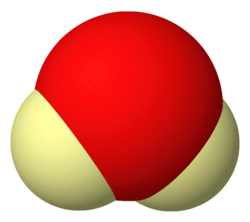


Tritiated water is a radioactive form of water in which the usual protium atoms are replaced with tritium atoms. In its pure form it may be called tritium oxide (T2O or 3H2O) or super-heavy water. Pure T2O is a colorless liquid,[1] and it is corrosive due to self-radiolysis. Diluted, tritiated water is mainly H2O plus some HTO (3HOH). It is also used as a tracer for water transport studies in life-science research. Furthermore, since it naturally occurs in minute quantities, it can be used to determine the age of various water-based liquids, such as vintage wines.
The name super-heavy water helps distinguish the tritiated material from heavy water, which contains deuterium instead.
Self-radiolysis
[edit]Tritiated water is primarily studied as a dilute solution within light water. Here, the proportion of the light, hydrogen tritium oxide is strongly favoured versus the more negligible heavy, double tritium oxide, as the conversion reaction has an equilibrium constant of 3.42 at room temperature.[6]
The molecules then experience beta decay and formation of the hydroxyl or tritoxyl radical via:
The average electron energy of the beta decay is 5.7 keV. The energy required to break hydrogen-oxygen bonds in water is three orders of magnitude lower at 5.2 eV. This leads to many radiolysis events:
Many subsequent reactions occur, but primarily result in recombination to water, or the escape of molecular hydrogen and oxygen gas, alongside the helium-3.
Studies of tritiated water often prefer to describe the concentration by the measurable radiation level in curies per liter (Ci/L) or terabecquerels per liter (TBq/L), rather than the species proportion.
In one CEA study, relatively highly tritiated water at 1,800 Ci/L or 74 TBq/L (0.12% HTO, negligible T2O) was left to self-radiolyze for 56 days in three volumes. In the 300 mL volume, the primary gases collected were H2 at 2.54 mmol, O2 at 1.31 mmol, and 3He at 0.13 mmol. Thus in this geometry, for each tritium decay, roughly twenty water molecules were permanently dissociated.[6]
Applications
[edit]Tritiated water can be used to measure an organism's total body water (TBW). Unlike doubly labeled water this method relies on scintillation counting. Tritiated water distributes itself into all body compartments relatively quickly. The concentration of tritiated water in urine is assumed to be similar to the concentration of tritiated water in the body. TBW is determined from the following relation:
Health risks
[edit]This section needs additional citations for verification. Please help improve this article by adding citations to reliable sources in this section. Unsourced material may be challenged and removed. Find sources: "Tritiated water" – news · newspapers · books · scholar · JSTOR (September 2023) (Learn how and when to remove this message) |
Tritium is radioactive and a low energy beta emitter.
While HTO is produced naturally by cosmic ray interactions in the stratosphere, it is also produced by human activities and can increase local concentrations and be considered an air and water pollutant. Anthropogenic sources of tritiated water include nuclear weapons testing, nuclear power plants, nuclear reprocessing and consumer products such as self-illuminating watches and signs.
HTO has a short biological half-life in the human body of 7 to 14 days, which both reduces the total effects of single-incident ingestion and precludes long-term bioaccumulation of HTO from the environment. The biological half life of tritiated water in the human body, which is a measure of body water turn-over, varies with the season. Studies on the biological half life of occupational radiation workers for free water tritium in a coastal region of Karnataka, India, show that the biological half life in the winter season is twice that of the summer season.
If tritium exposure is suspected or known, drinking uncontaminated water will help replace the tritium from the body. Increasing sweating, urination or breathing can help the body expel water and thereby the tritium contained in it. However, care should be taken that neither dehydration nor a depletion of the body's electrolytes results as the health consequences of those things (particularly in the short term) can be more severe than those of tritium exposure.[citation needed]
References
[edit]- ^ a b "Tritium oxide".
- ^ Perrin, D. D., ed. (1982) [1969]. Ionisation Constants of Inorganic Acids and Bases in Aqueous Solution. IUPAC Chemical Data (2nd ed.). Oxford: Pergamon (published 1984). Entry 252. ISBN 0-08-029214-3. LCCN 82-16524.
- ^ W. M. Jones (1952). "The Triple Point Temperature of Tritium Oxide". Journal of the American Chemical Society. 74 (23): 6065–6066. Bibcode:1952JAChS..74.6065J. doi:10.1021/ja01143a070.
- ^ "hydrogen (H) - chemical element". 6 June 2023.
- ^ Paesani, Francesco; Yoo, Soohaeng; Bakker, Huib J.; Xantheas, Sotiris S. (5 August 2010). "Nuclear Quantum Effects in the Reorientation of Water". J. Phys. Chem. Lett. 1 (15): 2316–2321. Bibcode:2010JPCL....1.2316P. doi:10.1021/jz100734w.
- ^ a b Heinze, Sylver; Stolz, Thibaut; Ducret, Didier; Colson, Jean-Claude (2005-08-01). "Self-Radiolysis of Tritiated Water: Experimental Study and Simulation". Fusion Science and Technology. 48 (1): 673–679. Bibcode:2005FuST...48..673H. doi:10.13182/FST05-A1014. Retrieved 2025-02-09.


- Articles with short description
- Short description is different from Wikidata
- Articles needing additional references from May 2013
- All articles needing additional references
- Articles without InChI source
- Articles without KEGG source
- Articles without UNII source
- Articles with changed CASNo identifier
- Articles with changed EBI identifier
- Articles with changed ChemSpider identifier
- Articles with changed InChI identifier
- Articles containing unverified chemical infoboxes
- Chembox image size set
- Short description matches Wikidata
- Articles needing additional references from September 2023
- All articles with unsourced statements
- Articles with unsourced statements from October 2023
- Commons category link from Wikidata
- Pages that use a deprecated format of the chem tags