VOOZH about

URL: https://en.wikipedia.org/wiki/UROD

⇱ Uroporphyrinogen III decarboxylase - Wikipedia


Jump to content
From Wikipedia, the free encyclopedia
(Redirected from UROD)
Mammalian protein found in Homo sapiens
UROD
👁 Image
Available structures
PDBOrtholog search: PDBe RCSB
List of PDB id codes

1JPH, 1JPI, 1JPK, 1R3Q, 1R3R, 1R3S, 1R3T, 1R3V, 1R3W, 1R3Y, 1URO, 2Q6Z, 2Q71, 3GVQ, 3GVR, 3GVV, 3GVW, 3GW0, 3GW3

Identifiers
AliasesUROD, PCT, UPD, uroporphyrinogen decarboxylase
External IDsOMIM: 613521; MGI: 98916; HomoloGene: 320; GeneCards: UROD; OMA:UROD - orthologs
Gene location (Human)
👁 Chromosome 1 (human)
Chr.Chromosome 1 (human)[1]
Band1p34.1Start45,010,950 bp[1]
End45,015,575 bp[1]
Gene location (Mouse)
👁 Chromosome 4 (mouse)
Chr.Chromosome 4 (mouse)[2]
Band4 D1|4 53.41 cMStart116,847,162 bp[2]
End116,851,610 bp[2]
RNA expression pattern
Bgee
HumanMouse (ortholog)
Top expressed in
  • trabecular bone

  • parotid gland

  • right adrenal gland

  • right adrenal cortex

  • parietal pleura

  • left adrenal cortex

  • endothelial cell

  • middle temporal gyrus

  • Brodmann area 23

  • bone marrow
Top expressed in
  • fetal liver hematopoietic progenitor cell

  • internal carotid artery

  • endocardial cushion

  • human fetus

  • external carotid artery

  • facial motor nucleus

  • atrioventricular valve

  • Epithelium of choroid plexus

  • medullary collecting duct

  • renal corpuscle
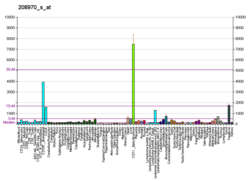
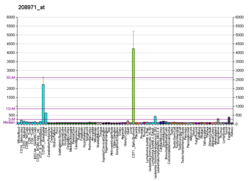
More reference expression data
BioGPS
👁 Image


👁 Image
More reference expression data
Gene ontology
Molecular function
Cellular component
Biological process
Sources:Amigo / QuickGO
Orthologs
SpeciesHumanMouse
Entrez

7389

22275

Ensembl

ENSG00000126088

ENSMUSG00000028684

UniProt

P06132

P70697

RefSeq (mRNA)

NM_000374

NM_009478

RefSeq (protein)

NP_000365

NP_033504

Location (UCSC)Chr 1: 45.01 – 45.02 MbChr 4: 116.85 – 116.85 Mb
PubMed search[3][4]
Wikidata
View/Edit HumanView/Edit Mouse

Uroporphyrinogen III decarboxylase (uroporphyrinogen decarboxylase, or UROD) is an enzyme (EC 4.1.1.37) that in humans is encoded by the UROD gene.[5]

Function

[edit]

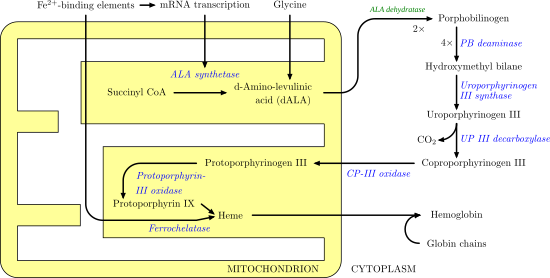
Uroporphyrinogen III decarboxylase is a homodimeric enzyme (PDB: 1URO​) that catalyzes the fifth step in heme biosynthesis, which corresponds to the elimination of carboxyl groups from the four acetate side chains of uroporphyrinogen III to yield coproporphyrinogen III:[6]


Clinical significance

[edit]

Mutations and deficiency in this enzyme are known to cause familial porphyria cutanea tarda and hepatoerythropoietic porphyria.[5] At least 65 disease-causing mutations in this gene have been discovered.[7]

Mechanism

[edit]

At low substrate concentrations, the reaction is believed to follow an ordered route, with the sequential removal of CO2 from the D, A, B, and C rings, whereas at higher substrate/enzyme levels a random route seems to be operative. The enzyme functions as a dimer in solution, and both the enzymes from human and tobacco have been crystallized and solved at good resolutions.

👁 Image
The reaction catalyzed by UroD

UroD is regarded as an unusual decarboxylase, since it performs decarboxylations without the intervention of any cofactors, unlike the vast majority of decarboxylases. Its mechanism has been proposed to proceed through substrate protonation by an arginine residue.[8] A 2008 report demonstrated that the uncatalyzed rate for UroD's reaction is 10−19 s−1, so at pH 10 the rate acceleration of UroD relative to the uncatalyzed rate, i.e. catalytic proficiency, is the largest for any enzyme known, 6 × 1024 M−1.[6]

👁 Image
Proposed reaction mechanism of uroporphyrinogen III decarboxylase

References

[edit]
  1. ^ a b c GRCh38: Ensembl release 89: ENSG00000126088Ensembl, May 2017
  2. ^ a b c GRCm38: Ensembl release 89: ENSMUSG00000028684Ensembl, May 2017
  3. ^ "Human PubMed Reference:". National Center for Biotechnology Information, U.S. National Library of Medicine.
  4. ^ "Mouse PubMed Reference:". National Center for Biotechnology Information, U.S. National Library of Medicine.
  5. ^ a b "Entrez Gene: UROD uroporphyrinogen decarboxylase".
  6. ^ a b Lewis CA, Wolfenden R (November 2008). "Uroporphyrinogen decarboxylation as a benchmark for the catalytic proficiency of enzymes". Proc. Natl. Acad. Sci. U.S.A. 105 (45): 17328–33. Bibcode:2008PNAS..10517328L. doi:10.1073/pnas.0809838105. PMC 2582308. PMID 18988736.
  7. ^ Šimčíková D, Heneberg P (December 2019). "Refinement of evolutionary medicine predictions based on clinical evidence for the manifestations of Mendelian diseases". Scientific Reports. 9 (1) 18577. Bibcode:2019NatSR...918577S. doi:10.1038/s41598-019-54976-4. PMC 6901466. PMID 31819097.
  8. ^ Silva PJ, Ramos MJ (2005). "Density-functional study of mechanisms for the cofactor-free decarboxylation performed by uroporphyrinogen III decarboxylase". J Phys Chem B. 109 (38): 18195–200. doi:10.1021/jp051792s. PMID 16853337.

Further reading

[edit]

External links

[edit]
  • Overview of all the structural information available in the PDB for UniProt: P06132 (Uroporphyrinogen decarboxylase) at the PDBe-KB.
👁 Image
Heme synthesis—note that some reactions occur in the cytoplasm and some in the mitochondrion (yellow)