
This article needs additional citations for verification. Please help improve this article by adding citations to reliable sources. Unsourced material may be challenged and removed. Find sources: "Weenusk First Nation" – news · newspapers · books · scholar · JSTOR (November 2024) (Learn how and when to remove this message) |


Weenusk First Nation (Cree: ᐐᓈᐢᑯ ᐃᓂᓂᐗᐠ (wînâsko ininiwak); unpointed: ᐧᐃᓇᐢᑯ ᐃᓂᓂᐧᐊᐠ) is a Cree First Nations band government in the Canadian province of Ontario.[1][2] Weenusk First Nation is an independent member of the Nishnawbe Aski Nation (NAN).[3]
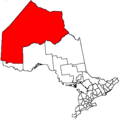
Weenusk First Nation's reserve is the 5,310 hectares (13,100 acres) Winisk Indian Reserve 90.[4] Associated with the reserve is their Winisk Indian Settlement also known as Peawanuck, which also holds reserve status. Originally, the Weenusk First Nation was located within their reserve, but they were forced to move 30 kilometres (19 mi) southwest to Peawanuck when on May 16, 1986, spring floods swept away much of the original settlement, which had been located 6 km (3.7 mi) upriver from Hudson Bay.
Demographics
[edit]In the Cree language, "Peawanuck" means "a place where flint is found," while "Weenusk" means "ground hog". The community, being primarily Swampy Cree, speaks the n-dialect of the Cree language.[citation needed] The 2021 Canadian census said that the community is composed of 247 people. Of these 220 people 220 wereFirst Nations, 10 Métis and about 25 non-Indigenous people. (Cree (120 people), Oji-Cree (10 people), and 60 First Nations not included elsewhere.[5] In addition to Cree, Anishininiimowin and Ojibwemowin are also spoken there.
Governance
[edit]Weenusk is governed by Chief Joseph (Joey) Edmund Charles Hunter and three councillors: Jeffrey Felix Hunter, Leah Carol Hunter, and Joseph (Paul) Koostachin.[6]
References
[edit]- ^ Long, John S. (2010-11-19). Treaty No. 9: Making the Agreement to Share the Land in Far Northern Ontario in 1905. McGill-Queen's Press - MQUP. ISBN 978-0-7735-8135-7.
- ^ Foster, Karen R.; Jarman, Jennifer (2022-03-03). The Right to Be Rural. University of Alberta. ISBN 978-1-77212-595-5.
- ^ "First Nations in NAN". Retrieved 24 March 2026.
- ^ Reserves, settlements or villages of the Weenusk First Nations at Indigenous and Northern Affairs Canada. Retrieved 24 March 2026.
- ^ "Census Profile, 2021 Census of Population Profile table Peawanuck, Indian settlement (S-É) Ontario [Census subdivision]". Statistics Canada. 10 December 2025. Retrieved 24 March 2026.
- ^ Governance of the Weenusk First Nations at Indigenous and Northern Affairs Canada. Retrieved 24 March 2026.
External links
[edit]- First Nation details for the Weenusk First Nations at Indigenous and Northern Affairs Canada. Retrieved 24 March 2026.
55°01′13″N 85°42′28″W / 55.02028°N 85.70778°W / 55.02028; -85.70778



- Pages using gadget WikiMiniAtlas
- Articles with short description
- Short description matches Wikidata
- Articles needing additional references from November 2024
- All articles needing additional references
- Use Canadian English from January 2023
- All Wikipedia articles written in Canadian English
- Articles containing Cree-language text
- All articles with unsourced statements
- Articles with unsourced statements from March 2026
- Coordinates on Wikidata
- All stub articles