


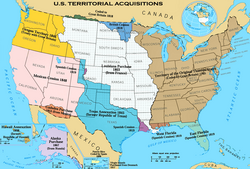
The United States of America was formed after thirteen British colonies in North America declared independence from the British Empire on July 4, 1776. In the Lee Resolution, passed by the Second Continental Congress two days prior, the colonies resolved that they were free and independent states. The union was formalized in the Articles of Confederation, which came into force on March 1, 1781, after being ratified by all 13 states. Their independence was recognized by Great Britain in the Treaty of Paris of 1783, which concluded the American Revolutionary War. This effectively doubled the size of the colonies, now able to stretch west past the Proclamation Line to the Mississippi River. This land was organized into territories and then states, though there remained some conflict with the sea-to-sea grants claimed by some of the original colonies. In time, these grants were ceded to the federal government.
The first great expansion of the country came with the Louisiana Purchase of 1803, which doubled the country's territory, although the southeastern border with Spanish Florida was the subject of much dispute until it and Spanish claims to the Oregon Country were ceded to the US in 1821. The Oregon Country gave the United States access to the Pacific Ocean, though it was shared for a time with the United Kingdom. The annexation of the Republic of Texas in 1845 led directly to the Mexican–American War, after which the victorious United States obtained the northern half of Mexico's territory, including what was quickly made the state of California.
As the development of the country moved west, however, the question of slavery became more important, with vigorous debate over whether the new territories would allow slavery and events such as the Missouri Compromise and Bleeding Kansas. This came to a head in 1860 and 1861, when the governments of the southern states proclaimed their secession from the country and formed the Confederate States of America. The American Civil War led to the defeat of the Confederacy in 1865 and the eventual readmission of the states to the United States Congress. The cultural endeavor and pursuit of manifest destiny provided a strong impetus for westward expansion in the 19th century.
The United States began expanding beyond North America in 1856 with the passage of the Guano Islands Act, causing many small and uninhabited, but economically important, islands in the Caribbean Sea and the Pacific Ocean to be claimed. Most of these claims were eventually abandoned, largely because of competing claims from other countries. The Pacific expansion culminated in the annexation of Hawaii in 1898, after the overthrow of its government five years previously. Alaska, the last major acquisition in North America, was purchased from Russia in 1867. Support for the independence of Cuba from the Spanish Empire, and the sinking of the USS Maine, led to the Spanish–American War in 1898, in which the United States gained Puerto Rico, Guam, and the Philippines, and occupied Cuba for several years. American Samoa was acquired by the United States in 1900 after the end of the Second Samoan Civil War. The United States purchased the U.S. Virgin Islands from Denmark in 1917.
Following the war, many islands were entrusted to the U.S. by the United Nations, and while the Northern Mariana Islands became a U.S. territory, the Marshall Islands, Federated States of Micronesia, and Palau emerged from the trust territory as independent nations. The last major international change was the acquisition in 1904, and return to Panama in 1979, of the Panama Canal Zone, an unincorporated US territory which controlled the Panama Canal. The final cession of formal control over the region was made to Panama in 1999.
States have generally retained their initial borders once established. Only three states (Kentucky, Maine, and West Virginia) have been created directly from area belonging to another state (although at the time of admission, Vermont agreed to a monetary payment for New York to relinquish its claim); all of the other states were created from federal territories or from acquisitions. Four states (Louisiana, Missouri, Nevada, and Pennsylvania) have expanded substantially by acquiring additional federal territory after their initial admission to the Union. In 1912, Arizona was the last state established in the contiguous United States, commonly called the "lower 48". In 1959, Hawaii was the 50th and most recent state admitted.
1776–1784 (American Revolution)
[edit]| Date | Event[a] | Change map |
|---|---|---|
| July 4, 1776 | Thirteen colonies of the Kingdom of Great Britain in North America collectively declared their independence as the United States of America,[b][i] though several colonies had already individually declared independence:
The capital was not specifically established; at the time, the Continental Congress met in Philadelphia.[45] Many states had only vaguely defined borders at the time of independence, with only the far eastern borders having been fully mapped. The borders of North Carolina were particularly poorly surveyed, its border with South Carolina having been done in several pieces, none of which truly matched the spirit of the charter,[46][47] and its border with Virginia veered several miles north of ideal. Virginia claimed the vast northwest across the Ohio River, and Connecticut, Massachusetts Bay, and New York also claimed areas west of their settled borders, overlapping with Virginia's claim.[48] The entirety of the new United States was claimed by Great Britain, including Machias Seal Island and North Rock, two small islands off the northeast coast which remain disputed up to the present.[49] |
👁 Map of the change to the United States in central North America on July 4, 1776 |
| September 21, 1776 | The Counties of New Castle, Kent, and Sussex, upon Delaware enacted a constitution, becoming the Delaware State.[o][52] | 👁 Map of the change to the United States in central North America on September 21, 1776 |
| September 28, 1776 | The State of Pennsylvania enacted a constitution, becoming the Commonwealth of Pennsylvania.[31][53] | 👁 Map of the change to the United States in central North America on September 28, 1776 |
| December 20, 1776 | To avoid British forces who were advancing on Philadelphia, the Continental Congress began meeting in Baltimore.[45] | 👁 Map of the change to the United States in central North America on December 20, 1776 |
| January 17, 1777 | The northeastern region of New York, known as the New Hampshire Grants, declared independence as New Connecticut.[p][54][56] | 👁 Map of the change to the international disputes involving the United States in central North America on January 17, 1777 |
| March 4, 1777 | The Continental Congress returned to Philadelphia after the threat to it by British forces ended.[45] | 👁 Map of the change to the United States in central North America on March 4, 1777 |
| June 4, 1777 | New Connecticut was renamed Vermont.[54][55][57] | 👁 Map of the change to the international disputes involving the United States in central North America on June 4, 1777 |
| September 27, 1777 | The Continental Congress fled Philadelphia after the American defeat at the Battle of Brandywine, and briefly met in Lancaster, Pennsylvania.[45] | 👁 Map of the change to the United States in central North America on September 27, 1777 |
| September 30, 1777 | The Continental Congress continued to move away from Philadelphia, settling in York, Pennsylvania.[45] | 👁 Map of the change to the United States in central North America on September 30, 1777 |
| June 11, 1778 | Vermont claimed what was called the "East Union", consisting of some towns in New Hampshire[q] that petitioned to join with Vermont, out of concern that their state was focusing too much on its coastal region.[59][60][61] | 👁 Map of the change to the international disputes involving the United States in central North America on June 11, 1778 |
| July 2, 1778 | The Continental Congress returned to Philadelphia following British withdrawal.[45] | 👁 Map of the change to the United States in central North America on July 2, 1778 |
| October 21, 1778 | Under pressure from the Continental Congress, Vermont rescinded the annexation of the East Union; the legislature declared on February 12, 1779, that the East Union should be considered null from its beginning.[59][60][62] | 👁 Map of the change to the international disputes involving the United States in central North America on October 21, 1778 |
| October 25, 1780 | The State of Massachusetts Bay enacted a constitution, becoming the Commonwealth of Massachusetts.[14][63] | 👁 Map of the change to the United States in central North America on October 25, 1780 |
| March 1, 1781 | The Articles of Confederation entered into force.[64] | no change to map |
| April 5, 1781 | Vermont again claimed an East Union, consisting of some towns in New Hampshire[r] that wished to join with Vermont, more than during the first attempt in 1778.[59][60][65] | 👁 Map of the change to the international disputes involving the United States in central North America on April 5, 1781 |
| June 16, 1781 | Vermont claimed what was called the "West Union", consisting of some towns in New York,[s] mainly to counterbalance Vermont's attempt at eastward expansion.[67][60][68] | 👁 Map of the change to the international disputes involving the United States in central North America on June 16, 1781 |
| February 23, 1782 | Vermont abandoned its attempts to annex the East Union from New Hampshire and the West Union from New York.[t] | 👁 Map of the change to the international disputes involving the United States in central North America on February 23, 1782 |
| October 29, 1782 | The western claim of New York was ceded to the federal government.[u][71] New York proclaimed its new western border to be a line drawn south from the western end of Lake Ontario.[72] At its maximum interpretation, the state ceded a claim bounded by Lake Erie, Lake Huron and Lake Michigan on the north; the Illinois, Mississippi, and Tennessee Rivers on the west and south; and the Appalachian Mountains and Pennsylvania on the east.[v] The cession included the tip of New York north of Pennsylvania, which would be known as the Erie Triangle.[75] | 👁 Map of the change to the United States in central North America on October 29, 1782 |
| December 30, 1782 | The Congress of the Confederation declared that the region that Connecticut claimed as Westmoreland County was part of Pennsylvania, attempting to end the Pennamite–Yankee War.[76][77] | 👁 Map of the change to the United States in central North America on December 30, 1782 |
| June 30, 1783 | The Pennsylvania Mutiny, and the state's refusal to stop it, caused the Congress of the Confederation to leave Philadelphia for Princeton.[45] | 👁 Map of the change to the United States in central North America on June 30, 1783 |
| November 26, 1783 | The Congress of the Confederation reconvened in Annapolis.[45] | 👁 Map of the change to the United States in central North America on November 26, 1783 |
| March 1, 1784 | The claim of Virginia northwest of the Ohio River was ceded to the federal government.[w][79] | 👁 Map of the change to the United States in central North America on March 1, 1784 |
| April 1, 1784 | Pennsylvania and Virginia agreed to set their border as continuing the Mason-Dixon Line to a point five degrees west of the Delaware River, then north.[x][82][83] | 👁 Map of the change to the United States in central North America on April 1, 1784 |
| May 12, 1784 | Great Britain recognized the independence of the United States, ending its claim to the country.[y][z][85] The treaty ended the American Revolutionary War, though military action had largely ended after the Franco-American victory at Yorktown on October 19, 1781.
Because of ambiguities and poor knowledge of geography, the treaty was unclear in several areas:
During the Peace of Paris, Great Britain also ceded the Floridas to Spain. During their ownership of West Florida, the British had moved its border north, and the cession to Spain appeared to apply to the full extent of the British colony. However, the British-American treaty granted the extension of West Florida to the United States, where it enlarged the country south to 31° north,[aa] indicating that only the original, smaller definition of West Florida was to be ceded to Spain.[87] |
👁 Map of the change to the United States in central North America on May 12, 1784 👁 Map of the change to the international disputes involving the United States in central North America on May 12, 1784 |


1784–1803 (Organization of territory)
[edit]| Date | Event | Change map |
|---|---|---|
| August 23, 1784 | A region in the western North Carolina frontier, unhappy with the state's governance over the area, declared independence from the state as the State of Franklin.[ab][89][90][91] Franklin petitioned for statehood, receiving support from seven of the nine states required,[x] but would only last a few years. | 👁 Map of the change to the United States in central North America on August 23, 1784 |
| November 1, 1784 | The Congress of the Confederation moved for a short time to Trenton.[45] | 👁 Map of the change to the United States in central North America on November 1, 1784 |
| January 11, 1785 | The Congress of the Confederation moved to New York, and would settle there for five years.[45] | 👁 Map of the change to the United States in central North America on January 11, 1785 |
| April 19, 1785 | The western claim of Massachusetts was ceded to the federal government.[ac][ad][79] | 👁 Map of the change to the United States in central North America on April 19, 1785 |
| September 14, 1786 | The western claim of Connecticut, except for its Western Reserve, was ceded to the federal government.[ae][af][79] | 👁 Map of the change to the United States in central North America on September 14, 1786 |
| October 4, 1786 | The survey of the Pennsylvania–Virginia border was submitted to Pennsylvania.[ag][82][95][96] | 👁 Map of the change to the United States in central North America on October 4, 1786 |
| December 16, 1786 | Massachusetts abandoned its claim to western New York.[97][98][xiii] | 👁 Map of the change to the United States in central North America on December 16, 1786 |
| July 13, 1787 | The region beyond the Ohio River ceded by several states to the federal government was organized as the Territory Northwest of the River Ohio, commonly known as the Northwest Territory.[100][xiv] | 👁 Map of the change to the United States in central North America on July 13, 1787 |
| July 21, 1787 | The survey of the Massachusetts–New York border was completed.[ah][97] | 👁 Map of the change to the United States in central North America on July 21, 1787 |
| August 9, 1787 | The western claim of South Carolina was ceded to the federal government.[ai][79] However, it was a result of inaccurate geography, and South Carolina never actually held claim to the region: the claim was of a strip between the border of North Carolina and the source of the Tugaloo River but, unknown at the time, the river originated in North Carolina. The eastern part of this cession would be given to Georgia in 1802, despite Georgia technically already having claim to the region.[105][106] | 👁 Map of the change to the United States in central North America on August 9, 1787 |
| December 7, 1787 | Delaware became the first state to ratify the United States Constitution.[107] | no change to map |
| December 12, 1787 | Pennsylvania became the second state to ratify the Constitution.[107] | |
| December 18, 1787 | New Jersey became the third state to ratify the Constitution.[107] | |
| January 2, 1788 | Georgia became the fourth state to ratify the Constitution.[107] | |
| January 9, 1788 | Connecticut became the fifth state to ratify the Constitution.[107] | |
| February 6, 1788 | Massachusetts became the sixth state to ratify the Constitution.[107] | |
| April 28, 1788 | Maryland became the seventh state to ratify the Constitution.[107] | |
| May 23, 1788 | South Carolina became the eighth state to ratify the Constitution.[107] | |
| June 21, 1788 | New Hampshire became the ninth state to ratify the Constitution; at this point, the Constitution became the active governing document of those nine states having ratified it.[107] | |
| June 25, 1788 | Virginia became the tenth state to ratify the Constitution.[107] | |
| July 26, 1788 | New York became the eleventh state to ratify the Constitution.[107] | |
| February 1789 | John Sevier, governor of the State of Franklin, pledged allegiance to North Carolina at the February term of the Greene County Court, effectively ending the claimed independence of Franklin.[89][108] | 👁 Map of the change to the United States in central North America in February 1789 |
| August 7, 1789 | The Northwest Territory was reorganized under the Constitution.[xviii] | no change to map |
| September 29, 1789 | The survey of the New York–Pennsylvania border was approved by Pennsylvania.[aj][109][110][xix] | 👁 Map of the change to the United States in central North America on September 29, 1789 |
| November 21, 1789 | North Carolina became the twelfth state to ratify the Constitution.[107] | no change to map |
| April 2, 1790 | The claim of North Carolina west of the Great Smoky Mountains was ceded to the federal government.[ak][79] | 👁 Map of the change to the United States in central North America on April 2, 1790 |
| May 26, 1790 | The region recently ceded by North Carolina was organized as the Territory South of the River Ohio, commonly known as the Southwest Territory.[112][xxi] | 👁 Map of the change to the United States in central North America on May 26, 1790 |
| May 29, 1790 | Rhode Island became the thirteenth state to ratify the Constitution.[107] | no change to map |
| October 10, 1790 | The survey of the New York–Erie Triangle border was completed.[al][109] | 👁 Map of the change to the United States in central North America on October 10, 1790 |
| December 6, 1790 | Philadelphia was established as the capital for ten years until a federal district could be prepared.[45][xxii] | 👁 Map of the change to the United States in central North America on December 6, 1790 |
| March 4, 1791 | Vermont, which had been considered part of New York despite acting independently since 1777, was admitted as the fourteenth state.[am][an][116][xxiii] | 👁 Map of the change to the United States in central North America on March 4, 1791 |
| March 30, 1791 | A federal district[ao] intended to house the government by 1800 was formed from areas ceded by Maryland and Virginia,[ap][xxii] consisting of a diamond, 10 miles on each side, with its southern tip at Jones Point and straddling the Potomac River.[121] | 👁 Map of the change to the United States in central North America on March 30, 1791 |
| March 3, 1792 | The Erie Triangle was purchased by Pennsylvania from the federal government.[aq][75] | 👁 Map of the change to the United States in central North America on March 3, 1792 |
| June 1, 1792 | The western half of Virginia was admitted as the fifteenth state, the Commonwealth of Kentucky.[ar][as][126][127][xxviii] | 👁 Map of the change to the United States in central North America on June 1, 1792 |
| June 12, 1792 | The Delaware State enacted a new constitution, becoming the State of Delaware.[50][128] | 👁 Map of the change to the United States in central North America on June 12, 1792 |
| January 1, 1793 | The survey of the federal district's boundaries was completed.[ag][129][130] | 👁 Map of the change to the United States in central North America on January 1, 1793 |
| April 25, 1796 | The northern half of West Florida was ceded by Spain, resolving the dispute over the region.[at][132] | 👁 Map of the change to the international disputes involving the United States in central North America on April 25, 1796 |
| June 1, 1796 | The Southwest Territory was admitted as the sixteenth state, Tennessee.[133][134][xxx] | 👁 Map of the change to the United States in central North America on June 1, 1796 |
| April 7, 1798 | In response to the Yazoo Land Fraud, an act authorized negotiations with Georgia about ceding its western claim; the act also created Mississippi Territory from the region recently ceded by West Florida.[135][ix] | 👁 Map of the change to the United States in central North America on April 7, 1798 |
| October 25, 1798 | Commissioners agreed on the source of the St. Croix River, setting the far eastern border with Great Britain.[136][137] | 👁 Map of the change to the United States in central North America on October 25, 1798 |
| January 13, 1800 | The survey of the Kentucky–Virginia border was approved by Virginia.[au][138][xxxi] | 👁 Map of the change to the United States in central North America on January 13, 1800 |
| April 10, 1800 | The survey of the southern border along 31° north was completed.[av][141] | 👁 Map of the change to the United States in central North America on April 10, 1800 |
| May 30, 1800 | The Connecticut Western Reserve was ceded to the federal government; it presumably was then considered part of the Northwest Territory.[aw][71][74] | 👁 Map of the change to the United States in central North America on May 30, 1800 |
| July 4, 1800 | Indiana Territory was organized from the western half of Northwest Territory.[ax][143][xxxiii] | 👁 Map of the change to the United States in central North America on July 4, 1800 |
| November 17, 1800 | The Congress of the United States moved to Washington, now built and ready to be the capital.[45] | 👁 Map of the change to the United States in central North America on November 17, 1800 |
| February 27, 1801 | The federal district was organized as the District of Columbia.[144][xxxiv] | 👁 Map of the change to the United States in central North America on February 27, 1801 |
| June 16, 1802 | The western claim of Georgia, known as the Yazoo Lands, was ceded to the federal government.[ay][az][79][74] At the same time, the federal government ceded to Georgia the eastern portion of the region previously ceded by South Carolina, though Georgia technically already held title to the region, as the cession was based on an erroneous understanding of geography.[105] | 👁 Map of the change to the United States in central North America on June 16, 1802 |
| March 1, 1803 | The southern half of the Northwest Territory, along with a thin sliver of Indiana Territory, was admitted as the seventeenth state, Ohio.[ba][bb][149][xxxviii] The remainder of the Northwest Territory was transferred to Indiana Territory.[150] The western border was a line due north from the mouth of the Great Miami River; the federal definition of the northern border was a line drawn east from the southern tip of Lake Michigan, whereas the Ohio Constitution stated the line should run from the southern tip of Lake Michigan to the most northerly cape of Maumee Bay.[151] The confusion caused by these conflicting descriptions and inaccurate knowledge of geography would lead to the conflict over the Toledo Strip.[152] | 👁 Map of the change to the United States in central North America on March 1, 1803 |
| November 3, 1803 | The survey of the Tennessee–Virginia border was approved.[bc][153][154] | 👁 Map of the change to the United States in central North America on November 3, 1803 |
| November 30, 1803 | The "Southwick Jog" was ceded by Connecticut to Massachusetts, to put to rest long-standing disagreements over their border.[bd][156] | 👁 Map of the change to the United States in central North America on November 30, 1803 |


1803–1818 (Purchase of Louisiana)
[edit]


1819–1845 (Northwest expansion)
[edit]


1845–1860 (Southwest expansion)
[edit]


1860–1865 (Civil War)
[edit]


1866–1897 (Reconstruction and western statehood)
[edit]


1898–1945 (Pacific and Caribbean expansion)
[edit]


1946–present (Decolonization)
[edit]


Bancos along the Rio Grande
[edit]

The Banco Convention of 1905 between the United States and Mexico allowed, in the event of sudden changes in the course of the Rio Grande (as by flooding), for the border to be altered to follow the new course.[556] The sudden changes often created bancos (land surrounded by bends in the river that became segregated from either country by a cutoff, often due to rapid accretion or avulsion of the alluvial channel), especially in the Lower Rio Grande Valley. When these bancos are created, the International Boundary and Water Commission investigates if land previously belonging to the United States or Mexico is to be considered on the other side of the border.[557] In all cases of these adjustments along the Rio Grande under the 1905 convention, which occurred on 37 different dates from 1910 to 1976, the transferred land was minuscule (ranging from 1-acre (4,000 m2) to 646 acres (261 ha)) and uninhabited.[558][559][560]
See also
[edit]

- List of territorial disputes
- Geography of the United States
- Territories of the United States
- Historic regions of the United States
- American frontier
- List of U.S. state partition proposals
- List of U.S. states by date of admission to the Union
- Movements for the annexation of Canada to the United States
- Manifest destiny
- National Atlas of the United States
- Ostend Manifesto (annexation of Cuba)
- List of territorial claims and designations in Colorado
- Territorial evolution of Arizona
- Territorial evolution of California
- Territorial evolution of Idaho
- Territorial evolution of Montana
- Territorial evolution of Nevada
- Territorial evolution of New Mexico
- Territorial evolution of North Dakota
- Territorial evolution of Oregon
- Territorial evolution of South Dakota
- Territorial evolution of Utah
- Territorial evolution of Washington
- Territorial evolution of Wyoming
- Territories of the United States on stamps
- List of United States treaties § U.S.–Native American treaties
Notes
[edit]- ^ Even though there were borders drawn as far as the Mississippi River, the early United States was only settled along the east coast. As the states were surveyed, these lines were solidified, though often missing their intended mark. By the time the country was surveying its western acquisitions in the mid-19th century, the process had improved and was being conducted through the United States General Land Office; the western borders were rarely controversial. Border surveys are given their own entry in this list if they were performed east of the Mississippi River, involved legislation, or were otherwise notable; the rest are detailed in footnotes in the relevant statehood or cession entries.
- ^ The boundaries of the country would be defined in the Treaty of Paris of 1783, with the general claim being everything north of the Floridas, south of Quebec, and east of the Mississippi River.[1]
- ^ The Connecticut General Assembly adopted the name "State of Connecticut" during their session beginning October 10, 1776.[2][3]
- ^ Georgia formally became the "State of Georgia" with the adoption of their constitution on February 5, 1777.[8][9]
- ^ Maryland formally became the "State of Maryland" with the adoption of their constitution around November 11, 1776.[11][12]
- ^ The Massachusetts Bay House of Representatives adopted the name "State of Massachusetts Bay" on December 7, 1776.[14][15]
- ^ New Hampshire formally adopted the name "State of New Hampshire" on September 11, 1776.[17][ii]
- ^ New Jersey formally adopted the name "State of New Jersey" on September 20, 1777.[21][iii]
- ^ New York formally became the "State of New York" with the adoption of their constitution on April 20, 1777;[24] the New York Provincial Congress adopted the name "Convention of the Representatives of the State of New-York" on July 10, 1776.[25][26]
- ^ North Carolina formally became the "State of North Carolina" with the adoption of their constitution on December 18, 1776.[28][29]
- ^ Pennsylvania was first formally referred to as the "State of Pennsylvania" on July 25, 1776.[31][32]
- ^ Rhode Island formally adopted the name "State of Rhode Island and Providence Plantations" on July 20, 1776.[34][35]
- ^ South Carolina formally became the "State of South Carolina" with the adoption of their constitution on March 19, 1778.[39][40]
- ^ Virginia formally became the "Commonwealth of Virginia" with the adoption of their constitution on June 29, 1776.[42][43]
- ^ Sources disagree on whether the constitution took effect on September 20[50] or September 21.[51]
- ^ Sources disagree on whether this formally occurred on January 15[54] or January 17.[55]
- ^ The New Hampshire towns petitioning to join Vermont were: Apthorp (now Littleton), Bath, Canaan, Cardigan (now Orange), Cornish, Dresden (now part of Hanover), Enfield, Franconia, Gunthwaite (now Lisbon), Haverhill, Landaff, Lebanon, Lyman, Lyme, Orford, and Piermont.[58]
- ^ The New Hampshire towns petitioning to join Vermont were: Acworth, Alstead, Bath, Cardigan (now Orange), Charlestown, Chesterfield, Claremont, Cornish, Croydon, Dorchester, Dresden, Franconia, "Gilsom" (likely Gilsum), Grafton, Grantham, Gunthwaite (now Lisbon), Hanover, Haverhill, Hinsdale, Landaff, Lancaster, Lebanon, "Leinster" (possibly Lempster), Lincoln, Lyman, Lyme, Marlow, Newport, Piermont, Plainfield, Richmond, Saville (now Sunapee), Surry, Walpole, and Westmoreland.[65]
- ^ The New York towns petitioning to join Vermont were: "Black-Creek" (unknown; possibly is or is near Hebron), Cambridge, Fort Edward, Granville, "Greenfield" (unknown; there is a town named Greenfield but it is west of the Hudson River, which was explicitly the western extent of the West Union), Hoosick, Kingsbury, "Little Hoosack" (unknown; presumably near Hoosick), Saratoga, "Scorticook" (possibly Schaghticoke), Skeensborough (now Whitehall), and "Upper-White-Creek" (probably White Creek).[66]
- ^ The Supreme Court noted in 1933 that this occurred on February 22,[v] but a 1823 printing of the Vermont State Papers indicates it was February 23.[69]
- ^ New York made the cession on March 1, 1781, and Congress accepted it on October 29, 1782.[vi]
- ^ It is unclear from where this claim came; many sources state that New York had surrendered it, but few elaborate on how it was obtained, beyond some saying it was a cession from the Six Nations.[73][74]
- ^ Virginia made the cession during the session beginning October 20, 1783, and Congress accepted it on March 1, 1784.[vii]
- ^ The agreement was made provisionally on August 31, 1779;[80] approved by Virginia on June 23, 1783; and approved by Pennsylvania on April 1, 1784.[81]
- ^ The treaty was signed September 3, 1783, ratified January 14, 1784, and entered into force May 12, 1784.[viii]
- ^ The treaty established the boundaries of the new country, from the Bay of Fundy: up the "St. Croix River" (which river this referred to was disputed) to its source; north to the height of the land (the "Northwest Angle of Nova Scotia"); along the height of the land to the "northwesternmost Head" of the Connecticut River (which source this referred to was disputed); down that to 45° north; west to the St. Lawrence River; up that to the Great Lakes, through Lake Ontario, the Niagara River, Lake Erie, the Detroit River, Lake St. Clair, the St. Clair River, Lake Huron, and Lake Superior; to "Long Lake" (which lake this referred to was disputed) towards the Lake of the Woods; to the northwest angle of the Lake of the Woods; then west to the Mississippi River. However, the Lake of the Woods was north of the source of the Mississippi River; maps universally show this undefined boundary as a straight line, nearly straight south, between the two points. From there, it followed the Mississippi River down to 31° north; east to the Chattahoochee River; down that to the confluence of the Chattahoochee and Flint rivers; a line from there to the source of the St. Mary's River; then down that to the Atlantic Ocean.[viii]
- ^ All sources show Georgia enlarging to fill the new borders,[86] but an act in 1798 referred to the federal and Georgia governments having "interfering claims" over the region.[ix]
- ^ There is some confusion over if the state was named Franklin or Frankland, complicated by another attempt at a state in the region using the name Frankland.[88]
- ^ Massachusetts made the cession on November 13, 1784, and Congress accepted it on April 19, 1785.[xi]
- ^ Massachusetts' ceded claim was a strip west of New York and Pennsylvania stretching to the Mississippi River, bounded by the latitudes of Massachusetts Bay Colony's original charter: on the north by a line west from one league north of Lake Winnipesaukee, and on the south by a line west from Massachusetts' southwest corner.[74]
- ^ Connecticut made the cession on May 11, 1786, and Congress accepted it on September 14, 1786.[xii]
- ^ Connecticut's ceded claim was a strip west of 120 miles west of Pennsylvania (the western border of its Western Reserve) stretching to the Mississippi River, bounded by 41° north and the southern edge of Massachusetts' western claim, roughly 42°2′ north.[74]
- ^ a b c d e f g h i j This is the date used to consider the border as formally surveyed, as no dates of government approval are known.
- ^ Massachusetts noted in a resolve passed on November 21, 1787, that the surveyors agreed on their report on July 21, 1787.[xv]
- ^ South Carolina made the cession on March 8, 1787,[xvi] and Congress accepted it on August 9, 1787.[xvii]
- ^ No date of approval by New York is known.
- ^ North Carolina made the cession on December 22, 1789,[74] and the federal government accepted it on April 2, 1790.[xx]
- ^ Surveyor Andrew Ellicott wrote several letters on October 11, 1790, referring to his work having been completed the previous day,[113][114] but no dates of government approval are known.
- ^ Vermont ratified the United States Constitution on January 10, 1791.[115]
- ^ The New York–Vermont border was Lake Champlain, the Poultney River, then south following borders of townships.[116]
- ^ The district did not have a formal name; in September 1791, the commissioners in charge of planning the city would term it the "Territory of Columbia".[117]
- ^ Maryland made the cession on December 23, 1788,[xxiv] and, after the district's borders were set, formally ceded the specific parcel on December 19, 1791.[xxv] Virginia made the cession on December 3, 1789.[120]
- ^ The act approving the sale was approved on January 3, 1792.[xxvi] President George Washington presented the deed to Pennsylvania on March 3, 1792,[122] and most sources use this date for the formal transfer;[52][123] however, some use April 23.[124][125]
- ^ Virginia agreed to cede the territory to the federal government on December 18, 1789.[xxvii]
- ^ The new Kentucky–Virginia border was, from the south: north along the Cumberland Mountains and Pine Mountain to the Russell Fork; northeast to the Tug Fork; then down that to the Big Sandy River and to the Ohio River.[126]
- ^ The treaty was signed October 27, 1795, ratified March 7, 1796, and entered into force April 25, 1796.[xxix]
- ^ No date of approval by Kentucky is known.
- ^ Surveyor Andrew Ellicott wrote, "The reports with the maps... being completed on the 10th of April;"[140] no dates of government approval are known.
- ^ The act accepting the cession was approved on April 28, 1800,[xxxii] and Connecticut approved on May 30, 1800.[142]
- ^ The new Indiana Territory–Northwest Territory border was a line from the mouth of the Kentucky River to Fort Recovery, then north.[143]
- ^ Georgia's commissioners agreed to cede the region on April 24, 1802, and the legislature approved on June 16, 1802.[xxxv]
- ^ The new Georgia–federal border was: up the Chattahoochee River to its great bend (near West Point), then a line from there towards and past Nickajack until it reached the Tennessee River, and up that to Tennessee.[146]
- ^ On February 19, 1803, the president signed an act approving Ohio's boundaries and constitution;[xxxvi] however, Congress never passed a formal resolution admitting it as a state. When this was noticed in 1953, Congress retroactively set the date of statehood to March 1, 1803,[xxxvii] the date the state legislature first met.[147]
- ^ The western border of Ohio had been surveyed in 1799 as far north as Fort Recovery.[148]
- ^ The survey was approved by Virginia on January 22, 1803, and by Tennessee on November 3, 1803.[xxxix]
- ^ The final report of the commissioners was delivered on November 30, 1803;[155] no dates of government approval are known.
- ^ The treaty was signed April 30, and ratified and entered into force October 21, 1803.[xl] The formal turnover occurred in New Orleans on December 20, 1803,[158] and would be recognized in St. Louis in Upper Louisiana on March 10, 1804, which would be known as known as Three Flags Day.[159]
- ^ There was some question as to whether the purchase also included the basins of the Missouri River and the Red River of the North,[161] but the question was not relevant before the Treaty of 1818 definitively settled the border.
- ^ The western border of West Florida was a series of waterways, mainly the Mississippi, Iberville, and Amite Rivers, and Lakes Pontchartrain and Maurepas.[162]
- ^ The new Illinois Territory–Indiana Territory border was, up the Wabash River to Post Vincennes, then north.[166]
- ^ The northern border of Louisiana had been surveyed in 1806.[171]
- ^ The cession was approved by the federal government on April 14, 1812,[xlviii] and accepted by Louisiana on August 4, 1812.[xlix]
- ^ Indiana was defined as the territory north of the Ohio River and east of the Wabash River, but while the territory's line turned north at Post Vincennes, the state's border continued up the Wabash until it reached the point where a line drawn north from Post Vincennes would last intersect the river as it weaved back and forth. The northern border of the state was a line east from 10 miles north of the southern tip of Lake Michigan, until it reached the meridian that formed Ohio's western border, which was a line drawn north from the mouth of the Great Miami River.[150]
- ^ The new Alabama Territory–Mississippi Territory border was, from the north: up the Tennessee River to Bear Creek (around today's Pickwick Lake); a line to the northwestern corner of Washington County, Mississippi Territory; then south.[171]
- ^ The Kingdom of Great Britain united with the Kingdom of Ireland on January 1, 1801, becoming the United Kingdom.
- ^ The treaty was signed October 20, 1818, ratified January 28, 1819, and entered into force January 30, 1819.[lv]
- ^ Oregon Country had no defined northern limit; it can be assumed that it did not encroach upon Russian-held lands, and 54°40′ north would be established as the border in 1825.
- ^ The new Arkansaw Territory–Missouri Territory border was, from where the Mississippi River meets 36° north: west to the St. Francis River, up that to 36°30′ north, then west.[185]
- ^ The compact between the states was signed on February 2, 1820; approved by Kentucky on February 11, 1820;[lxi] and approved by the federal government on May 12, 1821.[lxii]
- ^ Alabama's southwestern border was defined as a north-south line, but the statehood act called for a survey to confirm if this encroached on counties established by Mississippi; it was found to do so, and the southern terminus of the border was moved about 3.8 miles to the east.[89]
- ^ The treaty was signed February 22, 1819, and ratified and entered into force February 22, 1821.[lxiii]
- ^ The new border was, from the Gulf of Mexico: up the Sabine River to 32° north; north to the Red River; up that to 100° west; north to the Arkansas River; up that to its source; north to 42° north; then west to the Pacific Ocean.[162]
- ^ The new Missouri–federal border was, from the mouth of the Des Moines River: up the river to a point west of the Des Moines Rapids on the Mississippi River, west to a point north of the mouth of the Kansas River, then south.[174] The northern border had been surveyed in 1816,[202] and the survey of the western border south of the Kansas River would be completed on October 16, 1823.[202][203]
- ^ The survey was approved by North Carolina during the session beginning November 19, 1821;[lxv] no date of approval by Tennessee is known.
- ^ The survey was approved by Kentucky on November 13, 1821, and by Tennessee on November 22, 1821.[194]
- ^ The treaty was signed April 17, 1824, ratified January 7, 1825, and entered into force January 11, 1825.[lxviii]
- ^ The treaty was signed May 6, and ratified May 28, 1828.[lxix]
- ^ The new Arkansas Territory–federal border was, from the north: a line from the southwestern corner of Missouri to a point on the Arkansas River "100 paces east" of Fort Smith, as the border of the lands of the Eastern Choctaw, then south.[185] However, the Arkansas Supreme Court determined in 1909 that the "100 paces east" was a clerical error, and that logically it should have said "100 paces west".[lxx] The western border of Arkansas Territory south of Fort Smith had been surveyed in 1825.[210]
- ^ The survey was approved by Maine on February 28, 1829, and by New Hampshire on July 1, 1829.[211]
- ^ The survey was approved by Kentucky on February 9, 1828, and by Tennessee on December 20, 1831.[213]
- ^ Authorities with Indian Stream communicated to the British government on August 5, 1835, that they had accepted New Hampshire jurisdiction;[216] a resolution to this effect was approved by the citizens of Indian Stream on April 2, 1836.[215]
- ^ The western border north of Fort Smith had been surveyed in 1831.[210]
- ^ The northern half of the Indiana–Ohio border was surveyed in 1817 along with the northern border.[152]
- ^ The new Michigan Territory–Wisconsin Territory border was, from Lake Superior: up the Montreal River to Lac Vieux Desert; a line to the source of the Menominee River; then down that to Green Bay. However, this definition was impossible, as the Montreal River ended long before it reached Lac Vieux Desert.[218]
- ^ The cession was approved by the federal government on June 7, 1836,[lxxvii] accepted by Missouri on December 16, 1836,[lxxviii] and proclaimed by the president on March 28, 1837.[lxxix]
- ^ No date of approval by Mississippi is known.
- ^ The survey was approved by Georgia on December 8, 1826,[227] and by Alabama on January 27, 1840.[228]
- ^ The treaty was signed August 9, ratified August 22, and entered into force October 13, 1842.[lxxxiv]
- ^ The new northeastern border was, from Passamaquoddy Bay: up the St. Croix River to its source; north to the St. John River; up that to the St. Francis River; up that to its source outlet at Lake Pohenegamook; southwest to the northwest branch of the St. John River; a line from there to where the St. John River crosses 46°25′ north; up the river to its source; along the highlands to the source of Halls Stream, then down that to 45° north.[231]
- ^ The new northern border was, from Lake Superior: up the Pigeon River to the many lakes and rivers of the Boundary Waters, eventually reaching the Rainy River; then down that to the Lake of the Woods.[231]
- ^ Texas formally handed over sovereignty to the United States in a ceremony on February 19, 1846.[233]
- ^ While many sources state that Mexico recognized the independence of the eastern portion of Texas, the treaties were rejected by the Mexican government.
- ^ The treaty was signed June 15, ratified June 19, and entered into force July 17, 1846.[lxxxvii]
- ^ The survey of the northern border would be completed on August 9, 1852.[237][238]
- ^ The retrocession act was approved on July 9, 1846,[lxxxix] residents of Alexandria County were proclaimed by the president on September 7, 1846, to have agreed to it,[xc] and Virginia took possession on March 20, 1847.[xci]
- ^ Article III of the Treaty of 1908 noted that the survey was completed on June 28, 1847.[xcii]
- ^ The new Wisconsin–Wisconsin Territory border was, from Lake Superior: up the St. Louis River to its first rapids; south to the St. Croix River; then down that to the Mississippi River.[242]
- ^ The treaty was signed February 2, ratified March 16, and entered into force May 30, 1848.[xcvi]
- ^ The new international border was, from the Rio Grande: along the southern and western border of New Mexico until it met the Gila River; down that to the Colorado River; then a line to a point one league south of the port of San Diego. However, the southern border of New Mexico was in question, with the American claim being 31°52′ north, and the Mexican claim being 32°22′ north.[247]
- ^ The federal government consented on July 5, 1848,[c] and Texas approved on November 24, 1849.[251]
- ^ The new California–federal border was, from the north: south along 120° west to 39° north; a line to where the Colorado River intersects 35° north; then down the Colorado River.[253]
- ^ Part of Utah Territory overlapped with the portion of Texas that would be purchased on December 13, 1850.
- ^ The new Texas–federal border was, from the south: up the Rio Grande to 32° north; east to 103° west; north to 36°30′ north; then east.[257]
- ^ The new New Mexico Territory–federal border was, from 36°30′ north and 103° west: north to 38° north; then west to the summit of the San Juan Mountains (called then the Sierra Madre).[258]
- ^ The treaty was signed December 30, 1853, ratified June 29, 1854, and entered into force June 30, 1854.[cviii]
- ^ The new international border was, starting from where the Rio Grande crosses 31°47′ north: west 100 miles; south to 31°20′ north; west to 111° west; a line to a point on the Colorado River 20 miles below the mouth of the Gila River; then up the Colorado River.[267]
- ^ Massachusetts made the cession on May 14, 1853, New York accepted it on July 21, 1853, the federal government consented on January 8, 1855,[cx] and the cession was proclaimed on January 11, 1855.[269]
- ^ The new Minnesota–federal border was, from the north: up the Red River to the Bois de Sioux River; up that to Lake Traverse and its southern tip; a line to Big Stone Lake and through that to its southern tip; then south.[237]
- ^ Haiti claimed the island by name in its 1874 constitution,[cxiv] and had considered it included in the "adjacent islands" claimed since the 1801 constitution.[cxv]
- ^ The new Oregon–Washington Territory border was, from the north, up the Snake River to the mouth of the Owyhee River, then south.[262] The border with California would be surveyed in 1870.[253]
- ^ The claimed borders of Jefferson Territory were between 37° north, 43° north, 102° west, and 110° west.[282]
- ^ Forty-six islands were claimed on February 8, 1860, with varying degrees of accuracy and provenance:[271]
- The islands that were accurately described and named: Birnie Island, Caroline Island, Flint Island, Gardner Island, Nassau, Palmyra Atoll, Penrhyn, Sydney Island, and Washington Island.
- The islands that were accurately described, with less common names: Atafu (recorded as "Duke of York Island"[284]); Butaritari (recorded as "Mackin or Makin"); Canton Island (recorded as "Mary's Island"[285]); Fanning Island (recorded as "America Islands"[286]); Kingman Reef (recorded as "Danger Rock"[287]); Manihiki (recorded as "Ganges Island" and "Humphrey's Island"[288]); Marakei (recorded as "Mathews Island"[289]); Nukunonu (recorded as "Clarence Island"[290]); Pukapuka (recorded as "Dangerous Islands"[291]); Rakahanga (recorded as "Rierson's Island"[292]); Swains Island (recorded as "Quiros Island"[293]); and Vostok Island (recorded as "Staver's Island"[294]).
- The rest appear to be phantom islands; Sarah Ann Island was sighted in 1917, but has since disappeared.[295]
- Enderbury Island, Phoenix Island, and Starbuck Island were re-bonded to the United States Guano Company, having been bonded to the Phoenix Guano Company on December 27, 1859.[296]
- ^ The northern Kansas border had been surveyed by 1859.[298]
- ^ The borders of Colorado Territory were parallels 37° north and 41° north, and Washington meridians 25° west and 32° west.[283]
- ^ The new Nebraska Territory–Dakota Territory border was, from the east: up the Missouri River to the Niobrara River; up that to the Keya Paha River; up that to 43° north; then west.[302]
- ^ The law admitting the state required a presidential proclamation before it was to take effect,[cxxiv] which sources say took place on May 21, 1861;[311] the closest known primary document is a statement from Jefferson Davis on July 20 stating that the proclamation had been made.[312]
- ^ The treaty was signed October 2,[cxxix] and ratified December 21, 1861.[322]
- ^ The treaty was signed October 4,[cxxx] and ratified December 21, 1861.[324]
- ^ The full description of the native party to the treaty was, "the Seneca tribe of Indians, formerly known as the Senecas of Sandusky, and the Shawnees of the tribe or confederacy of Senecas and Shawnees, formerly known as the Senecas and Shawnees of Lewistown, or the mixed bands of Senecas and Shawnees."[325]
- ^ The treaty was signed October 7,[cxxxi] and ratified December 23, 1861.[328]
- ^ The treaty was signed August 1,[cxxxii] and ratified December 23, 1861.[330]
- ^ The treaty was signed July 12,[cxxxiii] and ratified December 31, 1861.[332]
- ^ The full description of the native party to the treaty was, "The Pen-e-tegh-ca Band of the Ne-um or Comanches, and the tribes and bands of the Wich-i-tas, Cado-Ha-da-chos, Hue-cos, Ta-hua-ca-ros, A-na-dagh-cos, Ton-ca-wes, Ai-o-nais, Ki-chais, Shawnees and Delawares, residing in the said leased country."[334]
- ^ The full description of the native party to the treaty was, "The No-co-ni, Ta-ne-i-weh, Ya-pa-rih-ca and Co-cho-tih-ca bands of the Ne-um, called by the white men the Comanches of the Prairies and the Staked Plain."[336]
- ^ There were two treaties with the Comanche, one with the "Comanches and other Tribes and Bands"[cxxxiv][ds] and one with the "Comanches of the Prairies and Staked Plain."[cxxxv][dt] Both were signed on August 12, 1861, and ratified on December 31, 1861.[337]
- ^ The treaty was signed July 10,[cxxxvi], and ratified December 31, 1861.[332]
- ^ The treaty was signed October 4,[cxxxvii] and ratified December 31, 1861.[340]
- ^ The decree transferred land from the left bank of the Blackstone River to Rhode Island, including what is now East Providence, in exchange for land around Fall River being transferred to Massachusetts.[341]
- ^ The Restored Government of Virginia gave its consent on May 13, 1862, the act admitting West Virginia was approved on December 31, 1862,[cxli] and the president proclaimed on April 20, 1863, that it would become a state in sixty days.[cxlii]
- ^ The Virginia counties that became West Virginia were: Barbour, Boone, Braxton, Brooke, Cabell, Calhoun, Clay, Doddridge, Fayette, Gilmer, Greenbrier, Hampshire, Hancock, Hardy, Harrison, Jackson, Kanawha, Lewis, Logan, McDowell, Marion, Marshall, Mason, Mercer, Monongalia, Monroe, Morgan, Nicholas, Ohio, Pendleton, Pleasants, Pocahontas, Preston, Putnam, Raleigh, Randolph, Ritchie, Roane, Taylor, Tucker, Tyler, Upshur, Wayne, Webster, Wetzel, Wirt, Wood, and Wyoming.[153]
- ^ The Restored Government of Virginia gave its consent on January 31, 1863,[cxliii] West Virginia accepted on August 5, 1863,[cxliv], and the federal government consented after-the-fact on March 10, 1866.[cxlv]
- ^ The Restored Government of Virginia gave its consent on February 4, 1863,[cxlvi] West Virginia accepted on November 2, 1863,[cxlvii] and the federal government consented after-the-fact on March 10, 1866.[cxlv]
- ^ The new Idaho Territory–Montana Territory border was, from the north: south along 39° west from Washington to the crest of the Bitterroot Range and the Rocky Mountains; then along that to the new tripoint with Dakota Territory.[352]
- ^ The new Dakota Territory–Idaho Territory border was, from the south: north along 33° west from Washington to the crest of the Rocky Mountains, then northwest along that to the new tripoint with Montana Territory.[302]
- ^ The northern border with Oregon would be surveyed in 1873 by the General Land Office.[304]
- ^ The cession was approved by the federal government on May 5, 1866;[cl] the receipt of this specific grant was pre-approved in the Nevada constitution.[cli]
- ^ The survey was approved by Florida on February 8, 1861,[cliii] and by Georgia on December 13, 1866.[cliv] The federal government would acknowledge the surveyed border on April 9, 1872.[clv]
- ^ The cession was approved by the federal government on May 5, 1866,[cl] and accepted by Nevada on January 18, 1867.[clvi]
- ^ The survey of the full eastern border would be completed on December 26, 1870.[249][361]
- ^ The treaty was signed March 30, ratified May 28, and entered into force June 20, 1867.[clix] The cession was formally handed over on October 18, 1867.[364]
- ^ The borders of the Department of Alaska were, from the Dixon Entrance: Up the Portland Channel to 56° north; then along the "summit of the mountains situated parallel to the coast" (the definition of which was disputed) to 141° west; then north.[267]
- ^ The readmission was contingent on Florida ratifying the Fourteenth Amendment to the United States Constitution;[clxi] they were proclaimed on July 11, 1868, to have done so before the readmission act's passage.[clxii]
- ^ The readmission was contingent on North Carolina ratifying the Fourteenth Amendment to the United States Constitution;[clxi] they were proclaimed on July 11, 1868, to have done so on July 4, 1868.[clxii]
- ^ The readmissions were contingent on the states ratifying the Fourteenth Amendment to the United States Constitution;[clxi] they were proclaimed on July 18, 1868, to have done so on July 9, 1868.[clxiii]
- ^ The readmission was contingent on Alabama ratifying the Fourteenth Amendment to the United States Constitution;[clxi] they were proclaimed on July 20, 1868, to have done so on July 13, 1868.[clxiv]
- ^ The readmission was contingent on Georgia ratifying the Fourteenth Amendment to the United States Constitution;[clxi] they were proclaimed on July 27, 1868, to have done so on July 21, 1868.[clxv]
- ^ The organic act specified it would take effect after the territorial government was organized;[clxvi] while this would not occur until May 19, 1869,[367] all sources use July 25, 1868, as the creation date.
- ^ The borders of Wyoming Territory were parallels 41° north and 45° north, and Washington meridians 27° west and 34° west.[368]
- ^ Pedro Cays was bonded under the name "Petrel Island."[373]
- ^ Additional requirements had been made of Georgia to complete Reconstruction, including ratifying the Fifteenth Amendment to the United States Constitution;[clxx] having done so, they were readmitted.[clxxi]
- ^ The cession was approved by the federal government on April 28, 1870,[clxxii] and accepted by Nebraska on February 9, 1871.[clxxiii]
- ^ Articles 34 and 35 of the Treaty of Washington[clxxv] provided for the dispute to be arbitrated by Wilhelm I, who delivered his decision on October 21, 1872.[236]
- ^ The General Land Office surveyed the border with Nebraska in 1869,[263] and with Kansas in 1872.[298]
- ^ Two other islands were bonded on September 13, 1880: "De Anes", with the coordinates of Isla de Aves, but which was acknowledged by the United States in 1859 to belong to Venezuela, so it is assumed nothing ever came of this bond, and no further claim was ever made by the United States;[386] and Serranilla Bank, being bonded a second time.[371]
- ^ The cession was approved by the federal government on March 18, 1882,[clxxxi] and accepted by Nebraska on May 23, 1882.[clxxxii]
- ^ Scorpion Reef was bonded under the name "Alacrans Islands, viz, Perez Island, Chica Island, and Pajoras Island."[370]
- ^ This is the date the protectorate was proclaimed on Rakahanga;[393] Bryan says the islands were annexed on August 9, 1889.[394]
- ^ The General Land Office had surveyed the eastern border with Minnesota in 1860,[237] and the southern border with Nebraska west of the Keya Paha River in 1874;[263] and would survey east of the river in 1893,[263] and the border between the new states in 1892.[302]
- ^ The General Land Office had surveyed the eastern border in 1885.[369]
- ^ The General Land Office had surveyed the southern border in 1864.[262]
- ^ The new Oklahoma Territory–federal border was, from where the Red River meets 98° west: north to the Canadian River; down that to Seminole land; north along that border to the North Canadian River; down that to Creek land; north and east along that border to 96° west; then north. This omits the Cherokee Outlet, whose complex borders separated the main portion of Oklahoma Territory from the former Public Land Strip.[400]
- ^ The General Land Office had surveyed the border with Oregon in 1868;[262] the border with Nevada in 1873;[304] the border with Washington in 1873, though it stopped short by one mile and would be completed in 1908;[401] the eastern border with Wyoming in 1874;[352] and would survey the linear border with Montana in 1899,[402] and the montane border in 1906.[402]
- ^ The General Land Office had surveyed the border with Nebraska in 1869;[263] the southern border in 1873;[352] the western border in 1874;[352] the eastern border in 1877;[264] and the northern border in 1880.[352]
- ^ The ship that proclaimed the protectorates voyaged from May to July 25, 1892;[406] it is unknown what specific date the proclamations occurred on.
- ^ The Oklahoma Organic Act provided that when the "interest of the Cherokee" in the land was extinguished, and proclaimed by the president, then the land would automatically become part of Oklahoma Territory.[clxxxix] This was done via treaty, signed on December 19, 1891,[408] and ratified on March 3, 1893.[cxciii] It was proclaimed by the president on August 19, 1893, to take effect on September 16, 1893.[cxciv]
- ^ The General Land Office had surveyed the border with Idaho in 1871;[411] the east-west border with Wyoming in 1873 and the north-south border in 1874;[352] and the eastern border in 1879.[412]
- ^ The Newlands Resolution to annex Hawaii was approved on July 7, 1898,[cxcviii] and the formal turnover occurred on August 12, 1898.[413]
- ^ The treaty was signed December 10, 1898, ratified February 6, 1899, and entered into force April 11, 1899.[cxcix]
- ^ The treaty was signed December 2, 1899, ratified February 13, 1900, and entered into force February 16, 1900.[cc] The chiefs of the two island groups signed their own treaties with the United States, formally ceding themselves: Tutuila on April 17, 1900,[cci] and Manuʻa on July 16, 1904.[ccii] The treaties would not be ratified until February 20, 1929.[cciii]
- ^ The cession was made by Tennessee on January 28, 1901,[ccviii] accepted by Virginia on February 9, 1901,[ccix] and approved by the federal government on March 3, 1901.[ccx]
- ^ The treaty was signed November 7, 1900, ratified January 30, 1901, and entered into force March 23, 1901.[ccxi]
- ^ The borders specified in 1898 had excluded these islands; the new treaty simply ceded "any and all islands belonging to the Philippine Archipelago" which Spain controlled at the time.
- ^ The survey was approved by California on March 1, 1901,[ccxiii] and by Nevada on February 27, 1903.[ccxiv]
- ^ The treaty was signed May 22, 1903, ratified June 25, 1904, and entered into force July 1, 1904.[ccxv] The formal handover occurred on December 10, 1903.[430]
- ^ The treaty was signed November 18, 1903, ratified February 25, 1904, and entered into force February 26, 1904.[ccxvi] The agreement on the boundaries of the zone, signed June 15, 1904, stated that Panama had delivered the zone on May 19, 1904.[433]
- ^ Only the basic borders were defined: a zone extending five miles from the middle of the canal on each side, excluding the cities of Colón and Panama City.[433]
- ^ Notes were exchanged on December 3, 1904, and the agreement became effective on December 12, 1904.[435]
- ^ The General Land Office had surveyed the border with Kansas in 1857,[298] and with Colorado in 1859.[283]
- ^ The treaty was signed May 21, ratified July 13, and entered into force August 20, 1910.[ccxxi]
- ^ No primary documentation has been found; secondary sources indicate this happened on July 7[446][447][448][449] or July 17, 1911.[450][451]
- ^ The General Land Office had surveyed the northern border in 1868,[452] and the border with Oklahoma in 1874.[283]
- ^ The General Land Office had surveyed the eastern border in 1875,[268] and the northern border in 1901.[259]
- ^ The treaty was signed September 2, 1914, ratified January 4, 1915, and entered into force February 11, 1915;[ccxxvi] one contemporary news source says that ownership was formally transferred on May 1, 1915.[455]
- ^ The treaty concretely defined the previous simple borders, with the main changes being: a slice of Canal Zone was ceded to Panama so Panama City would be connected with the rest of the country; the middle island of the Las Tres Hermanas Islands, which marked the edge of Panama City's harbor, was made wholly part of Canal Zone; and Gatun Lake and other surrounding waters were annexed, as well as an area of northwest Colón.[ccxxvi][455]
- ^ The treaty was signed August 5, 1914, ratified June 19, 1916, and entered into force June 22, 1916.[ccxxvii]
- ^ The treaty was signed August 4, 1916, ratified January 16, 1917, and entered into force January 17, 1917;[ccxxx] the payment was proclaimed to have been made on March 31, 1917.[ccxxxi]
- ^ Water Island was privately owned at the time, and was purchased by the federal government in 1944 for defensive use.[465] It was transferred to the Department of the Interior in 1952, and to local territorial jurisdiction in phases beginning December 12, 1996.[466]
- ^ The cession was approved by Pennsylvania on June 22, 1897;[ccxxxiii] accepted by Delaware on March 28, 1921;[ccxxxiv] and approved by the federal government on June 30, 1921.[ccxxxv]
- ^ The treaty was signed April 6, 1914, ratified January 11, 1922, and entered into force March 1, 1922.[ccxxxvi]
- ^ The treaty was signed February 24, ratified April 9, and entered into force July 17, 1925.[ccxxxviii]
- ^ The only change to a land border redefined how the border between the Lake of the Woods and the Rocky Mountains should be considered; previously, the border followed the curve of the parallel between each border monument, while the treaty changed this to straight lines between each monument. There was also a change to the border in the Lake of the Woods; a surveying anomaly caused the previous border to intersect itself several times in the lake, creating enclaves of United States water surrounded by Canadian water. The treaty changed the border to use the southernmost intersection as the northwestern point of the Lake of the Woods. Finally, the maritime border in the Bay of Fundy was adjusted.[486]
- ^ The treaty was signed January 2, 1930, ratified February 21, 1930, and entered into force December 13, 1932.[ccxliv]
- ^ Malden Island had been mined by the British since the early 1860s,[495] but was apparently never formally annexed; a British ship left a message on the island on August 17, 1936, proclaiming that it "belong[ed] to His Britannic Majesty."[496]
- ^ The treaty was signed March 2, 1936, ratified July 26, 1939, and entered into force July 27, 1939.[ccl]
- ^ The provisional agreement was signed on July 4, 1946,[ccli] and the final treaty was signed on July 4, 1946, ratified on August 16, 1946, and entered into force on October 22, 1946.[cclii]
- ^ The territory was entrusted by the United Nations on April 2, 1947,[ccliv] and accepted by the United States on July 18, 1947.[cclv]
- ^ The exchange was approved by Kansas on February 22, 1949, by Missouri on December 19, 1949,[cclviii] and by the federal government on August 3, 1950.[cclix]
- ^ The border was approved by Alabama on August 28, 1953,[cclxi] by Florida on June 12, 1953,[cclxii] and by the federal government on May 6, 1954.[cclxiii]
- ^ The cession was accepted by North Dakota on February 4, 1961,[cclxix] approved by Minnesota on April 10, 1961,[cclxx] and approved by the federal government on August 25, 1961.[cclxxi]
- ^ The convention was signed on August 29, 1963, ratified on Decmeber 20, 1963, and entered into force on January 14, 1964.[cclxxii]
- ^ The convention was signed on July 14, 1970, ratified on February 26, 1971, and entered into force on April 25, 1971.[cclxxiv]
- ^ The treaty was signed November 22, 1971, ratified July 1, 1972, and entered into force September 1, 1972.[cclxxv]
- ^ The minute was signed on May 18, 1977, and approved by the parties on May 26, 1977.[524]
- ^ Other changes included settling the border around the towns of Presidio, Texas, and Hidalgo, Texas, as well as Beaver Island near Roma, Texas.[525]
- ^ The treaty was signed December 16, 1977, and provisionally entered into force January 1, 1978,[527] but has not been ratified.
- ^ The treaty was signed September 7, 1977, ratified June 15, 1978, and entered into force October 1, 1979.[cclxxvi]
- ^ The treaty was signed March 28, 1978, ratified October 10, 1980, and entered into force November 24, 1980.[cclxxvii]
- ^ The treaty was signed September 8, 1972, ratified August 24, 1981, and entered into force September 17, 1981.[cclxxviii]
- ^ The treaty was signed December 2, 1980, ratified August 16, 1983, and entered into force September 3, 1983.[cclxxx]
- ^ The treaty was signed June 11, 1980, ratified August 16, 1983, and entered into force September 8, 1983.[cclxxxi]
- ^ The treaty was signed September 20, 1979, ratified August 16, 1983, and entered into force September 23, 1983.[cclxxxii]
- ^ The treaty was signed February 7, 1979, ratified August 16, 1983, and entered into force September 23, 1983.[cclxxxiii]
- ^ The compact of free association was signed on June 25, 1983, approved on January 14, 1986,[cclxxxv] and entered into force on October 21, 1986.[cclxxxvi]
- ^ The compact of free association was signed on October 1, 1982, approved on January 14, 1986,[cclxxxv] and entered into force on November 3, 1986.[cclxxxvi]
- ^ The covenant was signed on February 15, 1975, approved on March 24, 1976,[cclxxxvii] and entered into force on November 3, 1986.[cclxxxvi]
- ^ The treaty was signed June 1, 1990, and ratified September 16, 1991.[cclxxxviii] While never ratified by the Soviet Union or its successor state, Russia, the parties agreed to abide by the terms pending entry into force, effective June 15, 1990.[cclxxxix]
- ^ The Federal Register mentions an exchange of notes with Japan on July 5, 1994,[ccxci] but no primary sourcing as been found.
- ^ The compact of free association was signed on January 10, 1986, approved on November 14, 1986,[ccxcii] and entered into force on October 1, 1994.[ccxciii]
- ^ The treaties were signed on November 5, 1993, ratified by the Senate on October 7, 1994,[ccxcv] and entered into force on June 1, 1995.[ccxcvi]
- ^ The treaty was signed May 4, 1978, ratified October 23, 1997, and entered into force November 13, 1997.[ccxcvii]
- ^ The treaty was signed June 9, 2000, ratified January 12, 2001, and entered into force January 17, 2001.[ccxcix]
- ^ The minute was signed on November 5, 2009,[547] and approved by the parties on November 24, 2009.[524]
- ^ The treaty was signed May 13, 1997, ratified November 26, 2003, and entered into force October 7, 2014.[ccc]
- ^ The treaty was signed August 1, 2014, ratified March 27, 2019, and entered into force July 18, 2019.[ccci]
- ^ The treaty was signed September 6, 2013, ratified March 27, 2019, and entered into force July 19, 2019.[cccii]
References
[edit]Legal citations
[edit]- ^ United States Declaration of Independence, 1 Stat. 1
- ^ An act to adopt and take the name, stile, and title of State, in liew of Colony, in New Hampshire, 1776 N.H. Laws chp. 1, p. 37[18]
- ^ An act to ascertain the punishment for high treason, and to establish the word State instead of Colony in commissions, writs, and other process; and for other purposes therein mentioned, 1777 N.J. Laws chp. 41, p. 92[22]
- ^ An act repealing an act entitled "An act for the effectual securing to His Majesty the allegiance of his subjects in this his Colony and Dominion of Rhode Island and Providence Plantations;" and altering the form of commissions, of all writs and processes in the courts, and of the oaths prescribed by law, May 1776 R.I. Acts & Resolves p. 22[38]
- ^ Vermont v. New Hampshire, 289 U.S. 593, 611 (1933)
- ^ JCC 23:694[70]
- ^ JCC 26:112–117[78]
- ^ a b Definitive Treaty of Peace, with Great Britain, T.S. 104,[84] 8 Stat. 80
- ^ a b An act for an amicable settlement of limits with the State of Georgia, and authorizing the establishment of a government in the Mississippi Territory, Pub. L. 5–28, 1 Stat. 549
- ^ JCC 28:381–383[92]
- ^ JCC 28:280–283[93]
- ^ JCC 31:654–655[94]
- ^ Agreement entered into by the commissioners, appointed to settle the controversy between the Commonwealth of Massachusetts and the State of New York, respecting lands lying westward of Hudson's River, Jan. 1786 Mass. Acts pp. 460–467[99]
- ^ An ordinance for the government of the territory of the United States North West of the river Ohio, JCC 32:334[101]
- ^ Resolve directing the secretary to record the agreement entered into by the agents of this commonwealth, and the State of New-York, Oct. 1787 Mass. Acts chp. 101, p. 794[102]
- ^ An act to authorize the delegates of this state in Congress to convey to the United States in Congress assembled, all the rights of this state to the territory herein described, 1787 S.C. Acts no. 1346, p. 5[103]
- ^ JCC 33:466–477[104]
- ^ An act to provide for the government of the Territory Northwest of the river Ohio, Pub. L. 1–8, 1 Stat. 50
- ^ An act to establish and confirm the boundary line between this state and the State of New-York, 1789 Pa. Laws chp. 76, p. 177[111]
- ^ An act to accept a cession of the claims of the state of North Carolina to a certain district of western territory, Pub. L. 1–6, 1 Stat. 106
- ^ An act for the government of the territory of the United States, south of the river Ohio, Pub. L. 1–14, 1 Stat. 123
- ^ a b
- ^ An act for the admission of the State of Vermont into this Union, Pub. L. 1–10, 1 Stat. 191
- ^ An act to cede to Congress a district of ten miles square in this state for the seat of the government of the United States, Nov. 1788 Md. Laws chp. 46, p. 1516[118]
- ^ An act concerning the Territory of Columbia and the City of Washington, Nov. 1791 Md. Laws chp. 45, p. 1633[119]
- ^ An act for carrying into effect a contract between the United States and the State of Pennsylvania, Pub. L. 2–4, 1 Stat. 229
- ^ Compact and boundary with Kentucky, Va. Code § 1-307
- ^ An act declaring the consent of Congress, that a new state be formed within the jurisdiction of the Commonwealth of Virginia, and admitted into this Union, by the name of the State of Kentucky, Pub. L. 1–4, 1 Stat. 189
- ^ Pinckney's Treaty, with Spain, T.S. 325,[131] 8 Stat. 138
- ^ An act for the admission of the State of Tennessee into the Union, Pub. L. 4–47, 1 Stat. 491
- ^ An act for confirming and establishing the boundary line between this state and the State of Kentucky, ascertained and fixed by certain commissioners appointed by both states, and for other purposes, Dec. 1779 Va. Acts chp. 46, p. 234[139]
- ^ An act to authorize the President of the United States to accept, for the United States, a cession of jurisdiction of the territory west of Pennsylvania, commonly called the Western Reserve of Connecticut, Pub. L. 6–38, 2 Stat. 56
- ^ An act to divide the territory of the United States northwest of the Ohio, into two separate governments, Pub. L. 6–41, 2 Stat. 58
- ^ An act concerning the District of Columbia, Pub. L. 6–15, 2 Stat. 103
- ^ An act to ratify and confirm certain articles of agreement and cession entered into on the 24th day of April, 1802, between the commissioners of the State of Georgia on the one part, and the commissioners of the United States on the other part, 1802 Ga. Laws, no. 35, p. 48[145]
- ^ An act to provide for the due execution of the laws of the United States, within the State of Ohio, Pub. L. 7–7, 2 Stat. 201
- ^ Joint Resolution for admitting the State of Ohio into the Union, Pub. L. 83–204, 67 Stat. 407
- ^ An act to enable the people of the eastern division of the territory northwest of the river Ohio to form a constitution and state government, and for the admission of such state into the Union, on an equal footing with the original States, and for other purposes, Pub. L. 7–40, 2 Stat. 173
- ^ Virginia v. Tennessee, 148 U.S. 503, 517 (1893)
- ^ Treaty for the Cession of Louisiana, with France, T.S. 86,[157] 8 Stat. 200
- ^ An act supplementary to the act intituled "An act regulating the grants of land, and providing for the disposal of the lands of the United States, south of the State of Tennessee," Pub. L. 8–61, 2 Stat. 303
- ^ An act erecting Louisiana into two territories, and providing for the temporary government thereof, Pub. L. 8–38, 2 Stat. 283
- ^ An act to divide the Indiana Territory into two separate governments, Pub. L. 8–5, 2 Stat. 309
- ^ An act further providing for the government of the District of Louisiana, Pub. L. 8–31, 2 Stat. 331
- ^ An act for dividing the Indiana Territory into two separate governments, Pub. L. 10–13, 2 Stat. 514
- ^
- An act to enable the people of the Territory of Orleans to form a constitution and state government, and for the admission of such state into the Union, on an equal footing with the original states, and for other purposes, Pub. L. 11–21, 2 Stat. 641;
- An act for the admission of the State of Louisiana into the Union, and to extend the laws of the United States to the said state, Pub. L. 12–50, 2 Stat. 701
- ^ An act to enlarge the boundaries of the Mississippi Territory, Pub. L. 12–84, 2 Stat. 734
- ^ An act to enlarge the limits of the State of Louisiana, Pub. L. 12–57, 2 Stat. 708
- ^ A resolution giving the assent of the Legislature to an enlargement of the limits of the State of Louisiana, 1812 La. Acts chp. 1, p. 4[173]
- ^ An act providing for the government of the Territory of Missouri, Pub. L. 12–95, 2 Stat. 743
- ^
- ^ An act to establish a separate territorial government for the eastern part of the Mississippi Territory, Pub. L. 14–59, 3 Stat. 371
- ^
- An act to enable the people of the western part of the Mississippi Territory to form a constitution and state government, and for the admission of such state into the union, on an equal footing with the original states, Pub. L. 14–23, 3 Stat. 348;
- Resolution for the admission of the State of Mississippi into the Union, 3 Stat. 472
- ^
- An act to enable the people of the Illinois Territory to form a constitution and state government, and for the admission of such state into the Union on an equal footing with the original states, Pub. L. 15–67, 3 Stat. 428;
- Resolution declaring the admission of the State of Illinois into the Union, 3 Stat. 536
- ^ Convention on Fisheries, Boundary, and Restoration of Slaves, with the United Kingdom, T.S. 112,[183] 8 Stat. 248
- ^ An act establishing a separate territorial government in the southern part of the Territory of Missouri, Pub. L. 15–49, 3 Stat. 493
- ^ An act ratifying and confirming the line run and marked by commissioners between the States of Tennessee and Georgia, in the year 1818, 1819 Tenn. Acts chp. 18, p. 475[188]
- ^
- An act to enable the people of the Alabama Territory to form a constitution and state government, and for the admission of such state into the Union on an equal footing with the original states, Pub. L. 15–47, 3 Stat. 489;
- Resolution declaring the admission of the State of Alabama into the Union, 3 Stat. 608
- ^ An act for the admission of the State of Maine into the Union, Pub. L. 16–19, 3 Stat. 544
- ^ An act relative to the Arkansas Territory, Pub. L. 16–48, 3 Stat. 565
- ^ An act to ratify and confirm the adjustment of the boundary line between this state and the State of Tennessee, according to the articles of stipulation entered into by the commissioners appointed by both states, 1819 Ky. Acts chp. 546, p. 922–923[192]
- ^ Resolution giving the consent of Congress to a compact concluded between the States of Kentucky and Tennessee, for the settlement of their boundary line, 3 Stat. 609
- ^ Treaty of Amity, Settlement, and Limits, with Spain, T.S. 327,[198] 8 Stat. 252
- ^
- An act to authorize the people of the Missouri Territory to form a constitution and state government, and for the admission of such state into the Union on an equal footing with the original states, and to prohibit slavery in certain territories, Pub. L. 16–22, 3 Stat. 545;
- Resolution providing for the admission of the State of Missouri into the Union, on a certain condition, 3 Stat. 645;
- Proclamation admitting Missouri as a State, 3 Stat. 797
- ^ An act to confirm the boundary line between this state and the State of Tennessee, and for other purposes, 1821 N.C. Acts chp. 41, p. 38[205]
- ^ An act for the establishment of a territorial government in Florida, Pub. L. 17–13, 3 Stat. 654
- ^ An act to fix the western boundary line of the Territory of Arkansas, and for other purposes, Pub. L. 18–155, 4 Stat. 40
- ^ Convention on Navigation, Fishing, Trading, and the Northwest Coast of America, with Russia, T.S. 298,[207] 8 Stat. 302
- ^ Treaty with the Western Cherokee, Ratified Indian Treaty 152, 7 Stat. 311
- ^ Bowman v. State, 93 Ark. 168, 129 S.W. 80[209]
- ^ H. Misc. Doc. 53-212, p. 119
- ^ An act to attach the territory of the United States west of the Mississippi river, and north of the state of Missouri, to the Territory of Michigan, Pub. L. 23–98, 4 Stat. 701
- ^ An act for the admission of the State of Arkansas into the Union, and to provide for the due execution of the laws of the United States, within the same, and for other purposes, Pub. L. 24–100, 5 Stat. 50
- ^ An act to settle and establish the northern boundary line of the State of Ohio, Pub. L. 24–117, 5 Stat. 56
- ^ An act establishing the territorial government of Wisconsin, Pub. L. 24–54, 5 Stat. 10
- ^
- An act to establish the northern boundary line of the State of Ohio, and to provide for the admission of the State of Michigan into the Union upon the conditions therein expressed, Pub. L. 24–99, 5 Stat. 49;
- An act to admit the State of Michigan into the Union, upon an equal footing with the original states, Pub. L. 24–6, 5 Stat. 144
- ^ An act to extend the western boundary of the State of Missouri to the Missouri River, Pub. L. 24–86, 5 Stat. 34
- ^ Missouri v. Kansas, 213 U.S. 78, 84 (1909)
- ^ Proclamation issued by the President of the United States, under the act of June 7, 1836, chap. 86, 5 Stat. 802
- ^ 1837 Tenn. Priv. Acts chp. 7[224]
- ^ An act to divide the Territory of Wisconsin and to establish the territorial government of Iowa, Pub. L. 25–96, 5 Stat. 235
- ^ S. Doc. 26-4, p. 3
- ^ H. Doc. 27-52, p. 78
- ^ Webster–Ashburton Treaty, with the United Kingdom, T.S. 119,[230] 8 Stat. 572
- ^ An act for the admission of the States of Iowa and Florida into the Union, Pub. L. 28–48, 5 Stat. 742
- ^
- ^ Oregon Treaty, with the United Kingdom, T.S. 120,[235] 9 Stat. 869
- ^ An act for the admission of the State of Iowa into the Union, Pub. L. 29–1, 9 Stat. 117
- ^ An act to retrocede the County of Alexandria, in the District of Columbia, to the State of Virginia, Pub. L. 29–35, 9 Stat. 35
- ^ Proclamation declaring Alexandria County to be retroceded to Virginia, 9 Stat. 1000
- ^ An act to extend the jurisdiction of the Commonwealth of Virginia over the County of Alexandria, 1847 Va. Acts chp. 53, p. 41[239]
- ^ a b c Treaty on the Canadian Boundary, with the United Kingdom, T.S. 497,[241] 35 Stat. 2003
- ^ S. Ex. Docs. 30th Cong., 1st sess., volume 2, Serial Set 504, pp. 73-75
- ^ An act to confirm the boundary line between Missouri and Arkansas, Pub. L. 30–10, 9 Stat. 211
- ^
- ^ Treaty of Guadalupe Hidalgo, with Mexico, T.S. 207,[246] 9 Stat. 922
- ^ An act to establish the territorial government of Oregon, Pub. L. 30–177, 9 Stat. 323
- ^ Missouri v. Iowa, 48 U.S. 660 (1849)
- ^ An act to establish the territorial government of Minnesota, Pub. L. 30–121, 9 Stat. 403
- ^ An act giving the consent of the government of the United States to the State of Texas to extend her eastern boundary, so as to include within her limits one half of Sabine Pass, Sabine Lake, and Sabine River, as far north as the thirty-second degree of north latitude, Pub. L. 30–94, 9 Stat. 245
- ^ United States v. Louisiana, 394 U.S. 1, F2 (1969)
- ^ An act for the admission of the State of California into the Union, Pub. L. 31–50, 9 Stat. 452
- ^ An act to establish a territorial government for Utah, Pub. L. 31–51, 9 Stat. 453
- ^
- An act proposing to the State of Texas the establishment of her northern and western boundaries, the relinquishment by the said state of all territory claimed by her exterior to said boundaires, and of all her claims upon the United States, and to establish a territorial government for New Mexico, Pub. L. 31–49, 9 Stat. 446;
- Proclamation declaring Act of 1850, ch. 49, respecting the boundaries of Texas, to be in force, 9 Stat. 1005
- ^ Missouri v. Iowa, 51 U.S. 1 (1850)
- ^ An act to establish the territorial government of Washington, Pub. L. 32–90, 10 Stat. 172
- ^ An act to organize the Territories of Nebraska and Kansas, Pub. L. 33–59, 10 Stat. 277
- ^ Gadsden Treaty, with Mexico, T.S. 208,[266] 10 Stat. 1031
- ^ An act declaring the southern boundary of New Mexico, Pub. L. 33–245, 10 Stat. 575
- ^ An act giving the consent of Congress to the cession by the State of Massachusetts to the State of New York, of the district of Boston Corner, Pub. L. 33–20, 10 Stat. 602
- ^ Florida v. Georgia, 58 U.S. 478, 480 (1854)
- ^ H. Ex. Doc. 34-135
- ^
- An act to authorize the people of the Territory of Minnesota to form a constitution and state government, preparatory to their admission in the union on an equal Footing with the original states, Pub. L. 34–60, 11 Stat. 166;
- An act for the admission of the State of Minnesota into the Union, Pub. L. 35–31, 11 Stat. 285
- ^ 1874 Haiti Constitution, art. 2[275]
- ^ 1801 Haiti Constitution, art. 1[276]
- ^ An act for the admission of Oregon into the Union, Pub. L. 35–33, 11 Stat. 383
- ^ An act for the admission of Kansas into the Union, Pub. L. 36–20, 12 Stat. 126
- ^ An act to provide a temporary government for the Territory of Colorado, Pub. L. 36–59, 12 Stat. 172
- ^ An act to admit Texas as a member of the Confederate States of America, Provisional Confederate Cong., sess. 1, chp. 24, p. 44[301]
- ^ An act to provide a temporary government for the Territory of Dakota, and to create the Office of Surveyor General therein, Pub. L. 36–86, 12 Stat. 239
- ^ An act to organize the Territory of Nevada, Pub. L. 36–83, 12 Stat. 209
- ^ An act to admit the Commonwealth of Virginia as a member of the Confederate States of America, Provisional Confederate Cong., sess. 2, chp. 4, p. 104[306]
- ^ An act to admit the State of Arkansas into the Confederacy, Provisional Confederate Cong., sess. 2, chp. 30, p. 120[307]
- ^ An act to admit the State of North Carolina into the Confederacy, on a certain condition, Provisional Confederate Cong., sess. 2, chp. 25, p. 118[310]
- ^
- ^ Resolution in relation to the withdrawal of Confederate troops from Kentucky soil, 1861 Ky. Acts Res. 8, p. 110[318]
- ^ An act to admit the State of Missouri into the Confederacy, as a member of the Confederate States of America, Provisional Confederate Cong., sess. 5, chp. 1, p. 221[319]
- ^ An act for the admission of the State of Kentucky into the Confederate States of America, as a member thereof, Provisional Confederate Cong., sess. 5, chp. 5, p. 222[320]
- ^ Treaty with the Osages, signed October 2, 1861[321]
- ^ Treaty with the Senecas and Senecas and Shawnees, signed October 4, 1861[323]
- ^ Treaty with the Cherokees, signed October 7, 1861[327]
- ^ Treaty with the Seminole Nation, signed August 1, 1861[329]
- ^ Treaty with Choctaws and Chickasaws, signed July 12, 1861[331]
- ^ Treaty with the Comanches and other Tribes and Bands, signed August 12, 1861[333]
- ^ Treaty with the Comanches of the Prairies and Staked Plain, signed August 12, 1861[335]
- ^ Treaty with the Creek Nation, signed July 10, 1861[338]
- ^ Treaty with the Quapaws, signed October 4, 1861[339]
- ^ An act to extend the territorial Limits of the Territory of Nevada, Pub. L. 37–173, 12 Stat. 575
- ^ An act to provide a temporary government for the Territory of Arizona, and for other purposes, Pub. L. 37–56, 12 Stat. 664
- ^ An act to provide a temporary government for the Territory of Idaho, Pub. L. 37–117, 12 Stat. 808
- ^ An act for the admission of the State of "West Virginia" into the Union, and for other purposes, Pub. L. 37–6, 12 Stat. 633
- ^ Proclamation admitting West Virginia as a State, 13 Stat. 731
- ^ An act giving the consent of the State of Virginia to the County of Berkeley being admitted into and becoming part of the State of West Virginia, Restored 1862 Va. Acts, Dec. sess., chp. 54, p. 38[348]
- ^ An act admitting the County of Berkeley into, and making the same part of, this state, 1863 W.V. Acts chp. 35, p. 33[349]
- ^ a b Joint Resolution giving the consent of Congress to the transfer of the Counties of Berkeley and Jefferson to the State of West Virginia, H.J. Res 12, 14 Stat. 350
- ^ An act giving consent to the admission of certain counties into the new State of West Virginia, upon certain conditions, Restored 1862 Va. Acts, Dec. sess., chp. 78, p. 65[350]
- ^ An act admitting the County of Jefferson into, and making the same part of, this state, 1863 W.V. Acts chp. 90, p. 103[351]
- ^ An act to provide a temporary government for the Territory of Montana, Pub. L. 38–95, 13 Stat. 85
- ^
- ^ a b An act concerning the boundaries of the State of Nevada, Pub. L. 39–73, 14 Stat. 43
- ^ Nev. Const. art. XIV[355]
- ^ Joint Resolution restoring Tennessee to her relations to the Union, 14 Stat. 364
- ^ Resolution relating to the Florida and Georgia boundary line, 1860 Fla. Res. no. 16, p. 237[356]
- ^ Resolution in relation to the Florida boundary line, 1866 Ga. Res. no. 19, p. 221[357]
- ^ An act to settle and quiet the titles to lands along the boundary line between the States of Georgia and Florida, Pub. L. 42–91, 17 Stat. 52
- ^ Joint Resolution in relation to the boundaries of the State of Nevada, and the acceptance of additional territory, ceded by the United States to this State, 1867 Nev. Stat. no. 9, p. 145[360]
- ^
- An act to enable the people of Nebraska to form a constitution and state government, and for the admission of such state into the Union on an equal footing with the original states, Pub. L. 38–59, 13 Stat. 47;
- An act for the admission of the State of Nebraska into the Union, Pub. L. 39–36, 14 Stat. 391;
- Proclamation admitting Nebraska as a State, 14 Stat. 820
- ^ S. Rept. 40-194, p. 1
- ^ Treaty on the Cession of Alaska, with Russia, T.S. 301,[363] 15 Stat. 539
- ^ An act to admit the State of Arkansas to representation in Congress, Pub. L. 40–69, 15 Stat. 72
- ^ a b c d e An act to admit the States of North Carolina, South Carolina, Louisiana, Georgia, Alabama, and Florida, to representation in Congress, Pub. L. 40–70, 15 Stat. 73
- ^ a b Proclamation no. 7 readmitting Florida and North Carolina, 15 Stat. 703
- ^
- ^ Proclamation no. 10 readmitting Alabama, 15 Stat. 705
- ^ Proclamation no. 12 readmitting Georgia, 15 Stat. 708
- ^ An act to provide a temporary government for the Territory of Wyoming, Pub. L. 40–235, 15 Stat. 178
- ^ An act to admit the State of Virginia to representation in the Congress of the United States, Pub. L. 41–10, 16 Stat. 62
- ^ An act to admit the State of Mississippi to representation in the Congress of the United States, Pub. L. 41–19, 16 Stat. 67
- ^ An act to admit the State of Texas to representation in the Congress of the United States, Pub. L. 41–39, 16 Stat. 80
- ^ An act to promote the reconstruction of the State of Georgia, Pub. L. 41–3, 16 Stat. 59
- ^ An act relating to the State of Georgia, Pub. L. 41–299, 16 Stat. 363
- ^ An act to re-define a portion of the boundary line between the State of Nebraska and the Territory of Dakota, Pub. L. 41–64, 16 Stat. 93
- ^ An act to approve an act to re-define a portion of the boundary line between the State of Nebraska, and the Territory of Dakota, 1871 Neb. Laws p. 131–132[375]
- ^ An act to provide a government for the District of Columbia, Pub. L. 41–62, 16 Stat. 419
- ^ Treaty of Amity (Treaty of Washington), T.S. 133,[379] 17 Stat. 863
- ^ An act to readjust the western boundary of Dakota Territory, Pub. L. 42–147, 17 Stat. 464
- ^
- ^ Western Pacific Order in Council 1877[384]
- ^ An act giving the consent of Congress to an agreement or compact entered into between the States of Virginia and Maryland respecting the boundary between said states, Pub. L. 45–196, 20 Stat. 481
- ^ An act giving the consent of Congress to an agreement or compact entered into between the States of New York and Vermont respecting the boundary between said states, Pub. L. 46–49, 21 Stat. 72
- ^ An act to extend the northern boundary of the State of Nebraska, Pub. L. 47–52, 22 Stat. 35
- ^ An act declaring the assent of the State of Nebraska to an act of Congress of the United States, entitled, "An act to extend the northern boundary of the State of Nebraska," approved March 28, 1882, 1882 Neb. Laws chp. 4, p. 56[388]
- ^ Letters Patent, dated March 3, 1882, for the annexation for Morant and Pedro Cays to the Island of Jamaica[389]
- ^ An act providing a civil government for Alaska, Pub. L. 48–53, 23 Stat. 24
- ^ a b c An act to provide for the division of Dakota into two states and to enable the people of North Dakota, South Dakota, Montana, and Washington to form constitutions and state governments and to be admitted into the Union on an equal footing with the original states, and to make donations of public lands to such states, Pub. L. 50–180, 25 Stat. 676
- ^
- ^ Proclamation admitting Montana as a State, 26 Stat. 1551
- ^ Proclamation admitting Washington as a State, 26 Stat. 1552
- ^ a b An act to provide a temporary government for the Territory of Oklahoma, to enlarge the jurisdiction of the United States Court in the Indian Territory, and for other purposes, Pub. L. 51–182, 26 Stat. 81
- ^ An act to provide for the admission of the State of Idaho into the Union, Pub. L. 51–656, 26 Stat. 215
- ^ An act to provide for the admission of the State of Wyoming into the Union, and for other purposes, Pub. L. 51–664, 26 Stat. 222
- ^
- An act to authorize the President of the United States, in conjunction with the State of Texas, to run and mark the boundary lines between the territories of the United States and the State of Texas, Pub. L. 35–92, 11 Stat. 310;
- An act making appropriations for sundry civil expenses of the government for the fiscal year ending June 30th, 1892, and for other purposes, Pub. L. 51–542, 26 Stat. 971;
- Joint Resolution reaffirming the boundary line between Texas and the Territory of New Mexico, 36 Stat. 1454
- ^ An act making appropriations for current and contingent expenses, and fulfilling treaty stipulations with Indian tribes, for fiscal year ending June 30th, 1894, Pub. L. 52–209, 27 Stat. 640
- ^ Proclamation opening Cherokee Outlet to settlement, 28 Stat. 1222
- ^
- ^ United States v. Texas, 162 U.S. 1 (1896)
- ^ An act to give the consent of Congress to a compact entered into between the States of South Dakota and Nebraska respecting the boundary between said states, Pub. L. 55–12, 30 Stat. 214
- ^ Joint Resolution to provide for annexing the Hawaiian Islands to the United States, 30 Stat. 750
- ^ Treaty of Peace, with Spain, T.S. 343,[416] 30 Stat. 1754
- ^ Convention on Adjustment of Jurisdiction in Samoa, with Germany and the United Kingdom, T.S. 314,[419] 31 Stat. 1878
- ^ Treaty of Cession of Tutuila and Aunuʻu, signed April 17, 1900[420]
- ^ Treaty of Cession of Manu’a Islands, signed July 16, 1904[420]
- ^ Joint Resolution to provide for accepting, ratifying, and confirming the cessions of certain islands of the Samoan group to the United States, and for other purposes, Pub. Res. 70–89, 45 Stat. 1253
- ^ Executive Order no. 125-A, Placing Certain Islands of the Samoan Group Under the Control of the Navy Department, February 19, 1900[420]
- ^ General Order Navy Department no. 540, February 19, 1900[420]
- ^ An act temporarily to provide revenues and a civil government for Porto Rico, and for other purposes, Pub. L. 56–191, 31 Stat. 77
- ^ An act to provide a government for the Territory of Hawaii, Pub. L. 56–339, 31 Stat. 141
- ^ An act to cede to the State of Virginia a certain narrow strip of territory belonging to the State of Tennessee lying between the northern boundary line of the City of Bristol, in the County of Sullivan, and the southern boundary line of the City of Bristol, in the County of Washington, State of Virginia, being the northern half of Main Street, of the said two cities, 1901 Tenn. Acts chp. 85, p. 128[422]
- ^ An act to accept the cession by the State of Tennessee to the State of Virginia, of a certain narrow strip of territory claimed as belonging to the State of Tennessee, and described as lying between the northern boundary line of the City of Bristol, in the County of Sullivan, State of Tennessee, and the southern boundary line of the City of Bristol, in the County of Washington, State of Virginia, being the northern half of the Main Street of the said two cities, 1901 Va. Acts chp. 59, p. 57[423]
- ^ Joint Resolution ratifying agreement between Tennessee and Virginia with reference to the boundary line of said states, 31 Stat. 1465
- ^ Treaty on the Cession of Outlying Islands of the Philippines, with Spain, T.S. 345,[424] 31 Stat. 1942
- ^ An act temporarily to provide for the administration of the affairs of civil government in the Philippine Islands, and for other purposes, Pub. L. 57–235, 32 Stat. 691
- ^ An act to define and establish a portion of the eastern boundary of the State of California, 1901 Cal. Acts chp. 73, p. 89[426]
- ^ An act to define and establish a portion of the western boundary of the State of Nevada, 1903 Nev. Acts chp. 15, p. 38[427]
- ^ Treaty of Relations, with Cuba, T.S. 437,[429] 33 Stat. 2248
- ^ Isthmian Canal Convention, with Panama, T.S. 431,[432] 33 Stat. 2234
- ^ An act to extend the western boundary line of the State of Arkansas, Pub. L. 58–67, 33 Stat. 714
- ^
- An act to enable the people of Oklahoma and of the Indian Territory to form a constitution and state government and be admitted into the Union on an equal footing with the original states; and to enable the people of New Mexico and of Arizona to form a constitution and state government and be admitted into the Union on an equal footing with the original states, Pub. L. 59–234, 34 Stat. 267;
- Proclamation admitting Oklahoma as a State, 35 Stat. 2160
- ^ a b c Michigan v. Wisconsin, 270 U.S. 295 (1926)
- ^ Maryland v. West Virginia, 217 U.S. 1 (1918)
- ^ Treaty of Boundaries in Passamaquoddy Bay, with the United Kingdom, T.S. 551,[442] 36 Stat. 2477
- ^ a b
- An act to enable the people of New Mexico to form a constitution and state government and be admitted into the Union on an equal footing with the original States; and to enable the people of Arizona to form a constitution and state government and be admitted into the union on an equal footing with the original States, Pub. L. 61–219, 36 Stat. 557;
- Joint Resolution to admit the Territories of New Mexico and Arizona as states into the Union upon an equal footing with the original states, 37 Stat. 39
- ^ Proclamation admitting New Mexico as a State, 37 Stat. 1723
- ^ Proclamation admitting Arizona as a State, 37 Stat. 1728
- ^ An act to create a legislative assembly in the Territory of Alaska, to confer legislative power thereon, and for other purposes, Pub. L. 62–334, 37 Stat. 512
- ^ a b Canal Zone Boundary Convention, with Panama, T.S. 610,[454] 38 Stat. 1893
- ^ Bryan–Chamorro Treaty, with Nicaragua, T.S. 624,[462] 39 Stat. 1661
- ^ An act to declare the purpose of the people of the United States as to the future political status of the people of the Philippine Islands, and to provide a more autonomous government for those islands, Pub. L. 64–240, 39 Stat. 545
- ^ An act to provide a civil government for Porto Rico, and for other purposes, Pub. L. 64–368, 39 Stat. 951
- ^ Treaty of Cession of Danish West Indies, with Denmark, T.S. 629,[464] 39 Stat. 1706
- ^ Proclamation of payment for cession of the Danish West Indies, 40 Stat. 1649
- ^ An act to approve mutual cessions of territory by the States of Wisconsin and Minnesota and the consequent changes in the boundary line between said states, Pub. L. 65–214, 40 Stat. 959
- ^ An act providing for the acceptance, approval and confirmation of the report of the commission appointed in pursuance of the act approved [May 4, 1889], authorizing the examination, survey and re-establishment of the circle of New Castle, as the boundary line between Pennsylvania and Delaware, 1897 Pa. Laws no. 152, p. 182[477]
- ^ An act providing for the acceptance, approval, and confirmation of the report of the commission appointed in pursuance of the act of the General Assembly of the State of Delaware, approved [April 25, 1889], authorizing the examination, survey, and reestablishment of the circle of New Castle as the boundary line between Pennsylvania and Delaware, 1921 Del. Laws chp. 4, p. 7[478]
- ^ Joint Resolution ratifying the reestablishment of the boundary line between the States of Pennsylvania and Delaware, 42 Stat. 104
- ^ Treaty for the settlement of differences arising out of the events which took place on the Isthmus of Panama in November 1903, with Colombia, T.S. 661,[481] 42 Stat. 2122, 9 LNTS 301[482]
- ^ Joint Resolution extending the sovereignty of the United States over Swains Island and making the island a part of American Samoa, 43 Stat. 1357
- ^ Treaty on the Lake Superior–Lake of the Woods Boundary, with Canada, T.S. 720,[485] 44 Stat. 2102
- ^ Michigan v. Wisconsin, 272 U.S. 398 (1926)
- ^ New Mexico v. Texas, 275 U.S. 279 (1927)
- ^ Oklahoma v. Texas, 281 U.S. 109 (1930)
- ^ An act to authorize the modification of the boundary line between the Panama Canal Zone and the Republic of Panama, and for other purposes, Pub. L. 72–117, 47 Stat. 145
- ^ Joint Resolution to change the name of the island of "Porto Rico" to "Puerto Rico", 47 Stat. 158
- ^ Treaty on Boundaries of the Philippines and North Borneo, with the United Kingdom, T.S. 856,[493] 47 Stat. 2198
- ^
- An act to provide for the complete independence of the Philippine Islands, to provide for the adoption of a constitution and a form of government for the Philippine Islands, and for other purposes, Pub. L. 73–127, 48 Stat. 456;
- Proclamation 2148 on the establishment of the Commonwealth of the Philippines, 49 Stat. 3481
- ^ Wisconsin v. Michigan, 297 U.S. 547 (1936)
- ^ Executive Order no. 7368, Placing Certain Islands in the Pacific Ocean Under the Control and Jurisdiction of the Secretary of the Interior[494]
- ^ An act to provide a civil government for the Virgin Islands of the United States, Pub. L. 74–749, 49 Stat. 1807
- ^ Executive Agreement on Joint Administration of Canton and Enderbury Islands, EAS 145,[497] 53 Stat. 2219
- ^ Treaty of Friendship and Cooperation, with Panama, T.S. 945,[498] 53 Stat. 1807
- ^ Provisional Agreement Between the United States of America and the Republic of the Philippines Concerning Friendly Relations and Diplomatic and Consular Representation, TIAS 1539,[504] 60 Stat. 1800
- ^ Treaty of General Relations Between the United States of America and the Republic of the Philippines, TIAS 1568,[505] 61 Stat. 1174
- ^ Proclamation 2695 recognizing the independence of the Philippines, 60 Stat. 1352
- ^ Trusteeship Agreement for the Former Japanese Mandated Islands, TIAS 1665,[506] 61 Stat. 3301
- ^ Joint Resolution authorizing the President to approve the trusteeship agreement for the Territory of the Pacific Islands, Pub. L. 80–204, 61 Stat. 397
- ^ Tokelau Act 1948.
- ^ An act to provide a civil government for Guam, and for other purposes, Pub. L. 81–630, 64 Stat. 384
- ^ An act authorizing the compromising and settling of a controversy between Missouri and Kansas over a part of the boundary between these states, 1949 Mo. Laws chp. 141, p. 311[508]
- ^ Joint Resolution giving the consent of Congress to an agreement between the State of Missouri and the State of Kansas establishing a boundary between said states, Pub. L. 81–637, 64 Stat. 397
- ^ 57 FR 57093
- ^ An act locating the boundary between the States of Florida and Alabama as defined by the constitution of each respective state, at the mouth of the Perdido River and adjacent thereto, 1953 Ala. Laws no. 440, p. 547[509]
- ^ An act locating the boundary between the States of Florida and Alabama, as defined by the constitutions of each respective state, at the mouth of the Perdido River and adjacent thereto, 1953 Fla. Laws chp. 28141, p. 462[510]
- ^ Joint Resolution giving the consent of Congress to an agreement between the State of Alabama and the State of Florida establishing a boundary between such states, Pub. L. 83–351, 68 Stat. 77
- ^ An act to revise the Organic Act of the Virgin Islands of the United States, Pub. L. 83–517, 68 Stat. 497
- ^ Convention regarding the Colón Corridor and certain other corridors through the Canal Zone, 6 UST 461, TIAS 3180, 241 UNTS 140, I-3430[511]
- ^ Treaty of mutual understanding and co-operation, 12 UST 301, TIAS 4716, 243 UNTS 211, I-3454[513]
- ^
- ^
- ^ An act to accept the cession by the State of Minnesota to the State of North Dakota of certain parcels of real property and declaring an emergency, 1961 N.D. Laws chp. 318, p. 517[517]
- ^ An act relating to the cession by the State of Minnesota to the State of North Dakota of certain parcels of real property located in Clay County, Minnesota, 1961 Minn. Laws chp. 236, p. 399[518]
- ^ An act granting the consent of Congress to the compact or agreement between the States of North Dakota and Minnesota with respect to the boundary between such states, Pub. L. 87–162, 75 Stat. 399
- ^ Convention for the Solution of the Problem of the Chamizal, 15 UST 21, TIAS 5515, 505 UNTS 185, I-7374[519]
- ^ Agreement on Availability of Certain Indian Ocean Islands for Defense Purposes, 18 UST 28, TIAS 6196, 603 UNTS 273, I-8737[521]
- ^ Convention terminating the Convention of August 5, 1914, respecting a Nicaraguan canal route, 22 UST 663, TIAS 7120, 791 UNTS 305, I-11243[522]
- ^ Treaty on the Swan Islands, with Honduras, 23 UST 2630, TIAS 7453, 851 UNTS 203, I-12199[523]
- ^ Panama Canal Treaty, with Panama, 33 UST 39, TIAS 10030, 1280 UNTS 3, I-21086[528]
- ^ Maritime Boundary Treaty, with Venezuela, 32 UST 3100, TIAS 9890, 1273 UNTS 25, I-20984[529]
- ^ Treaty Concerning the Status of Quita Sueño, Roncador, and Serrana, with Colombia, 33 UST 1405, TIAS 10120, 1307 UNTS 379, I-21801[530]
- ^ Proclamation 5030: Exclusive Economic Zone of the United States of America, 97 Stat. 1557
- ^ Treaty on the Delimitation of the Maritime Boundary with Tokelau, with New Zealand, 35 UST 2073, TIAS 10775, 1643 UNTS 251, I-28231[532]
- ^ Treaty on Friendship and Delimitation of the Maritime Boundary, with the Cook Islands, 35 UST 2061, TIAS 10774, 1676 UNTS 223, I-28971[533]
- ^ Treaty of Friendship, with Kiribati, 35 UST 2095, TIAS 10777, 1643 UNTS 239, I-28230[534]
- ^ Treaty of Friendship, with Tuvalu, 35 UST 2087, TIAS 10776, 2011 UNTS 79, I-34500[535]
- ^ Delimitation of the Maritime Boundary in the Gulf of Maine Area, 1984 I.C.J. 246[536]
- ^ a b Compact of Free Association Act of 1985, Pub. L. 99–239, 99 Stat. 1770
- ^ a b c Proclamation 5564: Placing into Full Force and Effect the Covenant with the Commonwealth of the Northern Mariana Islands, and the Compacts of Free Association with the Federated States of Micronesia and the Republic of the Marshall Islands, 101 Stat. 2027
- ^ Joint Resolution to approve the "Covenant to establish a Commonwealth of the Northern Mariana Islands in political union with the United States of America," and for other purposes, Pub. L. 94–241, 90 Stat. 279
- ^ Agreement on the maritime boundary, with the Soviet Union, Treaty 101-22
- ^ Agreement between the United States of America and the Union of Soviet Socialist Republics to abide by the terms of the Maritime Boundary Agreement of 1 June 1990, pending entry into force, UNTS 40300[538]
- ^ United Nations Security Council Resolution 683, UN Doc S/RES/683[539]
- ^ 88 FR 88482
- ^ Joint Resolution to approve the "Compact of Free Association" between the United States and the Government of Palau, and for other purposes, Pub. L. 99–658, 100 Stat. 3672
- ^
- Joint Resolution to authorize entry into force of the Compact of Free Association between the United States and the Government of Palau, and for other purposes, Pub. L. 101–219, 103 Stat. 1870;
- Proclamation 6726, placing into full force and effect the Compact of Free Association with the Republic of Palau, 108 Stat. 5631
- ^ United Nations Security Council Resolution 956, UN Doc S/RES/956[540]
- ^ Two treaties with the United Kingdom establishing Caribbean Maritime Boundaries, Treaty 103-23
- ^
- Treaty on the Delimitation in the Caribbean of a Maritime Boundary relating to the U.S. Virgin Islands and Anguilla, 1913 UNTS 59, I-32636[541];
- Treaty on the Delimitation in the Caribbean of a Maritime Boundary relating to Puerto Rico/U.S. Virgin Islands and the British Virgin Islands, 1913 UNTS 67, I-32637[542]
- ^ Treaty on Maritime Boundaries, with Mexico, Treaty 96-6, 2143 UNTS 405, I-37399[543]
- ^ New Jersey v. New York, 523 U.S. 767 (1998)
- ^ Treaty on the delimination of the continental shelf in the western Gulf of Mexico beyond 200 nautical miles, with Mexico, Treaty 106-39, TIAS 01-117,[545] 2143 UNTS 417, I-37400[546]
- ^ Treaty on the Delimitation of a Maritime Boundary, with Niue, Treaty 105-53, TIAS 14-1007,[548] 3016 UNTS 305, I-52440[549]
- ^ Treaty on the Delimitation of Maritime Boundaries, with Micronesia, Treaty 114-13, TIAS 19-718[552]
- ^ Treaty on the Delimitation of Maritime Boundaries, with Kiribati, Treaty 114-13, TIAS 19-719[553]
Books, journals, and websites
[edit]- ^ Van Zandt 1976, p. 1.
- ^ "Connecticut: Polity Style: 1776-2025". www.archontology.org. Archived from the original on July 11, 2025. Retrieved December 9, 2025.
- ^ The Public Records of the State of Connecticut, From October, 1776, to February, 1778. Hartford, Connecticut: Charles J. Hoadly. 1894. pp. 1–4.
- ^ Van Zandt 1976, pp. 72–74.
- ^ Van Zandt 1976, pp. 84–85.
- ^ "Delaware: Polity Style: 1682-1776". www.archontology.org. Archived from the original on August 9, 2025. Retrieved December 9, 2025.
- ^ "Delaware Government Facts & Symbols". Government of Delaware. Archived from the original on January 9, 2017. Retrieved October 19, 2025.
- ^ "Georgia: Polity Style: 1776-2025". www.archontology.org. Archived from the original on August 11, 2025. Retrieved December 9, 2025.
- ^ Thorpe 1909b, p. 777.
- ^ Van Zandt 1976, pp. 100–104.
- ^ "Maryland: Polity Style: 1776-2025". www.archontology.org. Archived from the original on August 9, 2025. Retrieved December 9, 2025.
- ^ Thorpe 1909c, p. 1686.
- ^ Van Zandt 1976, pp. 85–88.
- ^ a b "Massachusetts: Polity Style: 1776-2025". www.archontology.org. Archived from the original on August 9, 2025. Retrieved December 9, 2025.
- ^ Journals of the House of Representatives of Massachusetts, 1776-1777. Vol. 52 pt. 2. Boston: Massachusetts Historical Society. 1986. p. 189.
- ^ Van Zandt 1976, pp. 65–71.
- ^ "New Hampshire: Polity Style: 1776-2025". www.archontology.org. Archived from the original on July 11, 2025. Retrieved December 9, 2025.
- ^ Metcalf, Henry Harrison, ed. (1916). Laws of New Hampshire. Vol. 4, Revolutionary Period, 1776–1789. Bristol, New Hampshire: Musgrove Printing House. p. 37.
- ^ Van Zandt 1976, pp. 60–63.
- ^ The Laws of the State of New Hampshire, Enacted since June 1, 1815. Vol. 2. Concord, New Hampshire: Isaac Hill. 1824. pp. 239–240.
- ^ "New Jersey: Polity Style: 1776-2025". www.archontology.org. Archived from the original on December 10, 2025. Retrieved December 10, 2025.
- ^ "New Jersey Session Laws". Rutgers School of Law. Archived from the original on December 21, 2025. Retrieved December 19, 2025.
- ^ Van Zandt 1976, pp. 79–80.
- ^ Thorpe 1909e, p. 2623.
- ^ "New York: Polity Style: 1776-2025". www.archontology.org. Archived from the original on July 11, 2025. Retrieved December 9, 2025.
- ^ Journals of the Provincial Congress, Provincial Convention, Committee of Safety and Council of Safety of the State of New-York, 1775–1776–1777. Vol. 1. Albany, New York: Thurlow Weed. 1842. p. 519.
- ^ Van Zandt 1976, pp. 74–79.
- ^ "North Carolina: Polity Style: 1776-2025". www.archontology.org. Archived from the original on July 13, 2025. Retrieved December 9, 2025.
- ^ Thorpe 1909e, p. 2787.
- ^ Van Zandt 1976, pp. 96–99.
- ^ a b "Pennsylvania: Polity Style: 1776-2025". www.archontology.org. Archived from the original on July 11, 2025. Retrieved December 9, 2025.
- ^ Minutes of the Proceedings of the Convention of the State of Pennsylvania (PDF). p. 761. Archived (PDF) from the original on June 19, 2025.
- ^ Van Zandt 1976, pp. 80–84.
- ^ "Rhode Island: Polity Style: 1776-2025". www.archontology.org. Archived from the original on June 19, 2025. Retrieved December 9, 2025.
- ^ [Acts and Resolves] at the General Assembly of the Governor and Company of the English Colony of Rhode Island and Providence Plantations, January 1776–May 1777. p. 128.
- ^ Van Zandt 1976, pp. 71–72.
- ^ "Rhode Island: Polity Style: 1689-1776". www.archontology.org. Archived from the original on June 19, 2025. Retrieved December 16, 2025.
- ^ "Act of Renunciation, May 4, 1776" (PDF). Secretary of State of Rhode Island. Archived (PDF) from the original on May 24, 2025. Retrieved October 17, 2025.
- ^ "South Carolina: Polity Style: 1776-2025". www.archontology.org. Archived from the original on December 10, 2025. Retrieved December 10, 2025.
- ^ Thorpe 1909f, p. 3248.
- ^ Van Zandt 1976, pp. 99–100.
- ^ "Virginia: Polity Style: 1776-2025". www.archontology.org. Archived from the original on September 6, 2025. Retrieved December 9, 2025.
- ^ Thorpe 1909g, p. 3812.
- ^ Van Zandt 1976, pp. 92–95.
- ^ a b c d e f g h i j k l
- "Nine Capitals of the United States". U.S. Senate. Archived from the original on March 20, 2016. Retrieved March 19, 2016.
- "8 Forgotten Capitals of the United States". History. 16 July 2015. Archived from the original on January 26, 2017. Retrieved October 19, 2025.
- ^ "The North Carolina – South Carolina Border Surveys – 1730 to 1815". Archived from the original on March 4, 2016. Retrieved October 19, 2025.
- ^ Kelly, Stephen R. (August 23, 2014). "How the Carolinas Fixed Their Blurred Lines". The New York Times. Archived from the original on August 31, 2014. Retrieved October 19, 2025.
- ^ Van Zandt 1976, p. 49.
- ^ O'Connor, Joe (November 27, 2012). "Puffin Wars: The island paradise at centre of last Canada-U.S. land dispute". National Post. Retrieved October 19, 2025.
- ^ a b "Delaware: Polity Style: 1776-2025". www.archontology.org. Archived from the original on August 9, 2025. Retrieved December 9, 2025.
- ^ Thorpe 1909a, p. 562.
- ^ a b Van Zandt 1976, p. 84.
- ^ Thorpe 1909e, p. 3081.
- ^ a b c Van Zandt 1976, p. 64.
- ^ a b "Vermont: Polity Style: 1777-2025". www.archontology.org. Archived from the original on August 4, 2025. Retrieved December 9, 2025.
- ^ Walton, E.P., ed. (1873). Records of the Council of Safety and Governor and Council of the State of Vermont. Vol. 1. pp. 47–51.
- ^ Vermont 2006 J.R.H. 3, Joint Resolution Designating January as Vermont History and Independence Month, accessed October 19, 2025. Archived October 11, 2006, at the Wayback Machine
- ^ Vermont 1823, p. 89.
- ^ a b c Duffy, Hand & Orth 2003, p. 111.
- ^ a b c d "The Historical Geography of Vermont". Archived from the original on January 12, 2016. Retrieved January 24, 2016.
- ^ Vermont 1823, p. 90.
- ^ Vermont 1823, pp. 97–99.
- ^ Thorpe 1909c, p. 1922.
- ^ "Articles of Confederation". Avalon Project. Yale Law School. Archived from the original on October 29, 2015. Retrieved October 19, 2025.
- ^ a b Vermont 1823, p. 137.
- ^ Vermont 1823, p. 139.
- ^ Duffy, Hand & Orth 2003, p. 319.
- ^ Vermont 1823, pp. 138–141.
- ^ Vermont 1823, p. 169.
- ^ Hunt 1914, p. 694.
- ^ a b Van Zandt 1976, p. 48.
- ^ Van Zandt 1976, p. 75.
- ^ "Virginia's Cession of the Northwest Territory". Archived from the original on August 17, 2016. Retrieved October 19, 2025.
- ^ a b c d e f Walker 1874, plate XV p. 1.
- ^ a b c Van Zandt 1976, pp. 83–84.
- ^ Van Zandt 1976, p. 81.
- ^ Gnichtel, Frederick W. (1921). "The "Pennamite Wars" and the Trenton Decree of 1782". Proceedings of the New Jersey Historical Society. 6: 31.
- ^ Hunt 1928, pp. 112–117.
- ^ a b c d e f Van Zandt 1976, p. 47.
- ^ Paullin 1932, pp. 77–78.
- ^ Brewster, William (1954). The Pennsylvania and New York frontier: history of from 1720 to the close of the Revolution. Philadelphia: George S. MacManus Company. p. 146.
- ^ a b Van Zandt 1976, p. 83.
- ^ Crumrine, Boyd (1902). "Boundary Controversy between Pennsylvania and Virginia; 1748–1785". Annals of Carnegie Museum. 1 (4): 505–568. Bibcode:1902AnCM....1..505C. doi:10.5962/p.331066. S2CID 251488742.
- ^ Bevans 1974b, p. 8.
- ^ Van Zandt 1976, pp. 10–12.
- ^ a b "Boundaries of Georgia". New Georgia Encyclopedia. Archived from the original on August 4, 2025. Retrieved October 19, 2025.
- ^ Van Zandt 1976, pp. 23–24.
- ^ McGill, J. T. (1925). "Franklin and Frankland: Names and Boundaries". Tennessee Historical Magazine. 8 (4): 248–257. ISSN 2333-9012. JSTOR 42637503.
- ^ a b c d e Van Zandt 1976, p. 109.
- ^ Williams 1924, pp. 29–30.
- ^ Alden, George Henry (1903). "The State of Franklin". The American Historical Review. 8 (2): 273. doi:10.2307/1832926. ISSN 0002-8762. JSTOR 1832926.
- ^ Fitzpatrick 1933, pp. 381–383.
- ^ Fitzpatrick 1933, pp. 280–283.
- ^ Fitzpatrick 1934, pp. 654–655.
- ^ Hicks, Frederick Charles, ed. (1904). A topographical description of Virginia, Pennsylvania, Maryland, and North Carolina. Cleveland: The Burrows Brothers Company. p. 34.
- ^ Hazard, Samuel, ed. (1855). Pennsylvania Archives. Vol. 11. Philadelphia: Joseph Severns & Co. p. 69.
- ^ a b c Van Zandt 1976, p. 70.
- ^ Walker 1874, plate XV p. 5.
- ^ Acts and Laws of the Commonwealth of Massachusetts, 1786–87. Boston: Wright & Potter Printing Company. 1893. pp. 460–467.
- ^ Van Zandt 1976, pp. 49–50.
- ^ Hill 1936a, p. 334.
- ^ Acts and Laws of the Commonwealth of Massachusetts, 1786–87. Boston: Wright & Potter Printing Company. 1893. p. 794.
- ^ Cooper, Thomas, ed. (1839). The Statutes at Large of South Carolina, volume 5, 1786–1814. Columbia, South Carolina: A.S. Johnston. p. 5.
- ^ Hill 1936b, pp. 466–477.
- ^ a b Van Zandt 1976, p. 100.
- ^ Cotterill, R. S. (1925). "The South Carolina Land Cession". The Mississippi Valley Historical Review. 12 (3): 376–384. doi:10.2307/1889567. ISSN 0161-391X. JSTOR 1889567.
- ^ a b c d e f g h i j k l m Admission of States to the Union: A Historical Reference Guide (Report). Congressional Research Service. December 17, 2024. CRS Report no. R47747. Retrieved January 3, 2026.
- ^ Williams 1924, p. 225.
- ^ a b Van Zandt 1976, p. 78.
- ^ Clarke 1886, p. 98.
- ^ Laws of the Thirteenth General Assembly of the Commonwealth of Pennsylvania. Philadelphia: T. Bradford. 1789. p. 177. Archived from the original on July 29, 2024. Retrieved December 20, 2025.
- ^ Van Zandt 1976, pp. 50–51.
- ^ Clarke 1886, pp. 450–451.
- ^ Mathews 1908, p. 77.
- ^ Walton, E.P., ed. (1875). Records of the Governor and Council of the State of Vermont. Vol. 3. Montpelier, Vermont: J. & J. Poland. pp. 480–481.
- ^ a b Van Zandt 1976, pp. 64–65.
- ^ Tindall, William (February 25, 1919). "Naming the Seat of Government of the United States: A Legislative Paradox". Records of the Columbia Historical Society. 23. Historical Society of Washington, D.C.: 13. JSTOR 40067136.
- ^ Kilty, William, ed. (1799). The Laws of Maryland, vol. 1. Annapolis, Maryland: Frederick Green. p. 1516. Archived from the original on December 12, 2025. Retrieved December 20, 2025.
- ^ Kilty, William, ed. (1799). The Laws of Maryland, vol. 1. Annapolis, Maryland: Frederick Green. p. 1633. Archived from the original on December 21, 2025. Retrieved December 21, 2025.
- ^ "VII. The Proclamation by the President, 24 January 1791". Founders Online. Archived from the original on July 16, 2025. Retrieved December 19, 2025. [Original source: The Papers of Thomas Jefferson, vol. 19, 24 January–31 March 1791, ed. Julian P. Boyd. Princeton: Princeton University Press, 1974, pp. 65–67.]
- ^ Van Zandt 1976, pp. 88–90.
- ^ "Deed to the Erie Triangle, 3 March 1792". Founders Online. Archived from the original on June 30, 2025. [Original source: The Papers of George Washington, Presidential Series, vol. 10, 1 March 1792 – 15 August 1792, ed. Robert F. Haggard and Mark A. Mastromarino. Charlottesville: University of Virginia Press, 2002, pp. 16–17.]
- ^ Walker 1874, plate XV p. 6.
- ^ Lechner, Carl B. (1992). "The Erie Triangle: The Final Link between Philadelphia and the Great Lakes". The Pennsylvania Magazine of History and Biography. 116 (1): 59. ISSN 0031-4587. JSTOR 20092671.
- ^ Miller, John (1909). A Twentieth Century History of Erie County, Pennsylvania. Vol. 1. Chicago: Lewis Publishing Company. p. 60.
- ^ a b Van Zandt 1976, p. 111.
- ^ "Kentucky: Polity Style: 1792-2025". www.archontology.org. Archived from the original on August 9, 2025. Retrieved December 12, 2025.
- ^ Thorpe 1909a, pp. 581.
- ^ a b Van Zandt 1976, p. 91.
- ^ National Capital Planning Commission Quarterly, p. 3 (Fall 1976)
- ^ Bevans 1974a, p. 516.
- ^ Van Zandt 1976, p. 22.
- ^ Van Zandt 1976, pp. 109–111.
- ^ "Tennessee: Polity Style: 1790-2025". www.archontology.org. Archived from the original on March 26, 2025. Retrieved December 12, 2025.
- ^ a b c d Van Zandt 1976, p. 105.
- ^ Van Zandt 1976, p. 12.
- ^ Miller 1931, pp. 430–432.
- ^ Van Zandt 1976, p. 94.
- ^ "Virginia Compacts: An Act for Confirming and Establishing the Boundary Line Between this State and the State of Kentucky, Ascertained and Fixed by Certain Commissioners Appointed by Both States, and for Other Purposes". Virginia Legislative Information System. Archived from the original on November 12, 2025. Retrieved January 21, 2026.
- ^ Mathews 1908, p. 195.
- ^ Van Zandt 1976, p. 102.
- ^ "Proclamation of President Adams Accepting the Political Rights over Western Reserve". The Western Reserve Historical Society (Oct. 1916, Tract no. 96). 1916.
- ^ a b c Van Zandt 1976, pp. 114–115.
- ^ Van Zandt 1976, pp. 88–92.
- ^ Clayton, Augustin Smith, ed. (1813). A Compliation of the Laws of the State of Georgia, 1800–1810. Augusta, Georgia: Adams & Duygkinck. p. 48.
- ^ Van Zandt 1976, pp. 100–101.
- ^ "200th Anniversary of Ohio Statehood". National Archives. Archived from the original on September 27, 2025. Retrieved November 20, 2025.
- ^ Van Zandt 1976, p. 114.
- ^ Van Zandt 1976, pp. 111–114.
- ^ a b Van Zandt 1976, p. 115.
- ^ Van Zandt 1976, p. 112.
- ^ a b c d Van Zandt 1976, p. 113.
- ^ a b Van Zandt 1976, p. 95.
- ^ "Virginia-Tennessee Border". Archived from the original on August 1, 2023. Retrieved November 20, 2025.
- ^ Resolves and private laws of the state of Connecticut. Vol. 2. pp. 1540–1544. Archived from the original on April 1, 2024. Retrieved November 21, 2025.
- ^ Van Zandt 1976, p. 69.
- ^ Bevans 1971b, p. 812.
- ^ Annals of Congress, 8th Cong., 2nd sess., pp. 1232–1233
- ^ "U.S. Takes Possession of Louisiana". www.nps.gov. National Park Service. Archived from the original on June 15, 2025. Retrieved November 22, 2025.
- ^ Van Zandt 1976, pp. 23–26.
- ^ Van Zandt 1976, p. 25.
- ^ a b c d Van Zandt 1976, pp. 26–27.
- ^ "Western Louisiana's Neutral Strip: Its History, People, And Legends". Folklife in Louisiana. Archived from the original on December 17, 2025. Retrieved November 22, 2025.
- ^ a b c Van Zandt 1976, p. 107.
- ^ a b Van Zandt 1976, p. 127.
- ^ a b c Van Zandt 1976, p. 116.
- ^ a b Van Zandt 1976, p. 27.
- ^ Arthur, Stanley Clisby (1935). The Story of the West Florida Rebellion. The St. Francisville Democrat. p. 112. Retrieved November 23, 2025.
- ^ Higgs, Robert. ""Not Merely Perfidious but Ungrateful": The U.S. Takeover of West Florida". Independent Institute. Archived from the original on May 23, 2016. Retrieved June 14, 2016.
- ^ "Presidential Proclamation, [27 October] 1810". Founders Online. Archived from the original on June 21, 2025. Retrieved December 20, 2025. [Original source: The Papers of James Madison, Presidential Series, vol. 2, 1 October 1809–2 November 1810, ed. J. C. A. Stagg, Jeanne Kerr Cross, and Susan Holbrook Perdue. Charlottesville: University Press of Virginia, 1992, pp. 595–597.]
- ^ a b c Van Zandt 1976, p. 108.
- ^ Van Zandt 1976, pp. 106–108.
- ^ Acts Passed at the First Session of the First General Assembly of the State of Louisiana. New Orleans: Thierry. 1812. p. 4.
- ^ a b Van Zandt 1976, p. 117.
- ^ "Town History". Town of Brookville, Maryland. Archived from the original on May 5, 2016. Retrieved June 13, 2016.
- ^ a b Van Zandt 1976, p. 65.
- ^ Pratt, Daniel J., ed. (1884). Report of the Regents of the University, on the Boundaries of the State of New York. Vol. 2. Albany, New York: Argus Company. p. 87.
- ^ Temple, Robert D. "Troublesome Boundaries: Royal Proclamations, Indian Treaties, Lawsuits, Political Deals, and Other Errors Defining Our Strange State Lines" (PDF). Carologue (Summer 2011). South Carolina Historical Society. Archived from the original (PDF) on July 12, 2024. Retrieved December 21, 2025.
- ^ Van Zandt 1976, pp. 105–106.
- ^ Van Zandt 1976, pp. 12–14.
- ^ Burrage, Henry Sweetser (1919). Maine in the Northeastern Boundary Controversy. Portland, Maine: Marks Printing House. p. 78.
- ^ Van Zandt 1976, pp. 116–117.
- ^ Bevans 1974b, p. 57.
- ^ a b Van Zandt 1976, pp. 14–15.
- ^ a b c d Van Zandt 1976, p. 119.
- ^ Van Zandt 1976, pp. 118–119.
- ^ Van Zandt 1976, pp. 101–102.
- ^ Scott, Edward, ed. (1821). Laws of the State of Tennessee, 1715–1820. Vol. 2. Knoxville, Tennessee: Heiskell & Brown. p. 475.
- ^ Tabler, Dave (July 13, 2018). "James Camak botches surveying the GA/TN border. Twice". Appalachian History. Archived from the original on March 24, 2025. Retrieved October 29, 2025.
- ^ Van Zandt 1976, pp. 108–109.
- ^ Van Zandt 1976, pp. 55–60.
- ^ "South of Walker's Line". Secretary of State of Kentucky. Archived from the original on October 9, 2025. Retrieved November 24, 2025.
- ^ a b c Van Zandt 1976, p. 110.
- ^ a b "Northern Boundary of Tennessee". The American Historical Magazine. 6 (1): 34. 1901. JSTOR 42657520.
- ^ Rowland, Dunbar, ed. (1917). The Official and Statistical Register of the State of Mississippi, Volume 4. Madison, Wisconsin: Democrat Printing Company. pp. 57–58.
- ^ a b Van Zandt 1976, p. 98.
- ^ Norris, David A. "Boundaries, State". www.ncpedia.org. Archived from the original on August 31, 2025. Retrieved August 27, 2025.
- ^ Bevans 1974a, p. 528.
- ^ Wilson, George R. (1919). "Early Indiana Trails and Surveys". Indiana Historical Society Publications. 6 (3): 430.
- ^ Carter 1956, p. 111.
- ^ Carter 1956, p. 122.
- ^ a b c d Van Zandt 1976, p. 118.
- ^ "Description of Front Cover" (PDF). Missouri Surveyor. No. June 2016. Missouri Society of Professional Surveyors. p. 2. Retrieved November 24, 2025.
- ^ Van Zandt 1976, pp. 117–118.
- ^ Laws of North Carolina enacted in the year 1821. Raleigh, North Carolina: Thomas Henderson. 1822. pp. 38–40.
- ^ Van Zandt 1976, p. 104.
- ^ Bevans 1974a, p. 1205.
- ^ Bowen 1882, p. 66.
- ^ "Bowman v. State". Free Law Project. Retrieved December 21, 2025.
- ^ a b c d e Van Zandt 1976, p. 120.
- ^ a b Van Zandt 1976, p. 60.
- ^ Van Zandt 1976, pp. 15–17.
- ^ Desha, Joseph; Matthews, Thomas J.; Bracken, Charles; Henry, Robert S. (1920). "The Extension of the Northern Line of Tennessee to the West of Cumberland Gap - Matthews Line". Tennessee Historical Magazine. 6 (3): 179. ISSN 2333-9012. JSTOR 42637451.
- ^ a b Van Zandt 1976, p. 63.
- ^ a b Keedy, Edwin R. (January 1953). "The Constitutions of the State of Franklin, the Indian Stream Republic and the State of Deseret". University of Pennsylvania Law Review. 101 (4): 522–525. doi:10.2307/3309935. JSTOR 3309935. Archived from the original on March 15, 2024. Retrieved November 25, 2025.
- ^ British and Foreign State Papers 1834–1835. London: James Ridgway and Sons. 1852. p. 444.
- ^ Van Zandt 1976, pp. 118–120.
- ^ Van Zandt 1976, p. 128.
- ^ Van Zandt 1976, pp. 128–129.
- ^ "The Frostbitten Convention; or, How Michigan Ended the Toledo War and Became a State". Archived from the original on August 9, 2016. Retrieved June 22, 2016.
- ^ Van Zandt 1976, pp. 127–128.
- ^ Combs, H. Jason (2002). "The Platte Purchase and Native American Removal". Plains Anthropologist. 47 (182): 265–274. doi:10.1080/2052546.2002.11932095. JSTOR 25669782. S2CID 163783522.
- ^ Van Zandt 1976, p. 106.
- ^ "Acts of 1837 - 38 Chapter 7". www-test.ctas.tennessee.edu. Archived from the original on December 22, 2025. Retrieved November 25, 2025.
- ^ a b c Van Zandt 1976, p. 131.
- ^ a b Van Zandt 1976, pp. 131–133.
- ^ Acts of the General Assembly of the State of Georgia. Milledgeville, Georgia: Camak & Ragland. 1826. pp. 209–211.
- ^ Acts Passed at the Annual Session of the General Assembly of the State of Alabama. Tuscaloosa, Alabama: Hale & Eaton. 1840. p. 182.
- ^ Van Zandt 1976, pp. 103–104.
- ^ Bevans 1974b, p. 82.
- ^ a b c d Van Zandt 1976, pp. 17–18.
- ^ Van Zandt 1976, pp. 104–105.
- ^ a b "A Guide to the United States' History of Recognition, Diplomatic, and Consular Relations, by Country, since 1776: Texas". United States State Department. Archived from the original on April 1, 2017. Retrieved November 27, 2025.
- ^ Van Zandt 1976, pp. 120–127.
- ^ Bevans 1974b, p. 95.
- ^ a b c Van Zandt 1976, p. 18.
- ^ a b c d e f Van Zandt 1976, p. 133.
- ^ "Survey of the Iowa–Minnesota Boundary Line". The Annals of Iowa. 16 (7): 499–501. 1929. doi:10.17077/0003-4827.5254.
- ^ Acts of the General Assembly of the Commonwealth of Virginia, December 7, 1846, to March 23, 1847. Richmond, Virginia: Samuel Shepherd. 1847. p. 41.
- ^ Van Zandt 1976, p. 90.
- ^ Bevans 1974b, p. 297.
- ^ a b Van Zandt 1976, p. 129.
- ^ Van Zandt 1976, pp. 128–131.
- ^ Van Zandt 1976, p. 130.
- ^ Williams, J. Fletcher (1894). Henry Hastings Sibley: A Memoir. Minnesota Historical Society. pp. 277–281.
- ^ Bevans 1972a, p. 791.
- ^ a b Van Zandt 1976, pp. 28–29.
- ^ Van Zandt 1976, p. 153.
- ^ a b c Van Zandt 1976, p. 159.
- ^ Danver, Steven L., ed. (2013). "Young, Brigham". Encyclopedia of Politics of the American West. CQ Press. p. 675. ISBN 978-1-4522-7606-9.
- ^ "Boundaries". Handbook of Texas Online. Texas State Historical Association. Archived from the original on September 13, 2023. Retrieved December 1, 2025.
- ^ Andrew, Bunyan H. (1949). "Some Queries Concerning the Texas-Louisiana Sabine Boundary". The Southwestern Historical Quarterly. 53 (1): 1–18. JSTOR 30240685.
- ^ a b Van Zandt 1976, p. 151.
- ^ Van Zandt 1976, pp. 151–153.
- ^ Van Zandt 1976, p. 14.
- ^ "Buffalo Water Intake, Horseshoe Reef Light Historical Marker". Historical Marker Database. Archived from the original on December 12, 2024. Retrieved December 1, 2025.
- ^ a b Van Zandt 1976, p. 122.
- ^ Van Zandt 1976, pp. 160–161.
- ^ a b Van Zandt 1976, p. 160.
- ^ Deseret (1919). Laws and ordinances of the state of Deseret (Utah). Shepard Book Co. Prefatory.
- ^ Lueck, Anthony (Spring 2023). "The 1852 Diagram for the Boundary between the State of Wisconsin and the Territory of Minnesota: Review of the Field Survey of the Deputy Surveyor and the Map Drafted for the State Boundary" (PDF). Minnesota Surveyor. Minnesota Society of Professional Surveyors. p. 20. Archived (PDF) from the original on December 26, 2025. Retrieved November 29, 2025.
- ^ a b c d Van Zandt 1976, p. 155.
- ^ a b c d e f Van Zandt 1976, p. 138.
- ^ a b Van Zandt 1976, p. 136.
- ^ Turner, Kenneth R. (January 15, 2010). "No Man's Land". The Encyclopedia of Oklahoma History and Culture. Oklahoma Historical Society. Archived from the original on April 2, 2015. Retrieved November 29, 2025.
- ^ Bevans 1972a, p. 812.
- ^ a b c d e f Van Zandt 1976, p. 29.
- ^ a b Van Zandt 1976, p. 163.
- ^ Pratt, Daniel J., ed. (1884). Report of the Regents of the University on the Boundaries of the State of New York. Vol. II. Albany, New York: Argus Company. p. 223.
- ^ a b c d e f g Van Zandt 1976, p. 41.
- ^ a b c d e f g Moore 1906, pp. 567–568; Wrighton 1983, pp. 241–243; Hague 1862, p. 19
- ^ Van Zandt 1976, pp. 133–134.
- ^ Van Zandt 1976, p. 40.
- ^ a b Moore 1906, p. 568.
- ^ Janvier 1886, p. 359.
- ^ Janvier 1886, p. 8.
- ^ Van Zandt 1976, pp. 153–155.
- ^ Clark, Thomas D. (1992). "Middleton Offset". In Kleber, John E. (ed.). The Kentucky Encyclopedia. p. 635. ISBN 0-8131-2883-8.
- ^ Carey, Bill (2011). "Tennessee-Kentucky border didn't turn out as straight as it was supposed to be" (PDF). Archived from the original (PDF) on March 4, 2016. Retrieved March 4, 2016.
- ^ a b c d Van Zandt 1976, p. 38.
- ^ Bryan 1942, p. 36.
- ^ Paxson 1906, p. 60.
- ^ a b c d e Van Zandt 1976, p. 141.
- ^ Bryan 1942, p. 73.
- ^ Bryan 1942, p. 46.
- ^ Bryan 1942, p. 43.
- ^ Bryan 1942, p. 154.
- ^ Bryan 1942, p. 103.
- ^ Polk, Laray (2021). "The Question of Olohega". Asia-Pacific Journal. 19 (20): 28. doi:10.1017/S1557466021031399.
- ^ Bryan 1942, p. 76.
- ^ Bryan 1942, p. 97.
- ^ Coppell, W.G. (1973). "About the Cook Islands. Their Nomenclature and a Systematic Statement of Early European contacts". Journal de la Société des Océanistes. 29 (38): 40. doi:10.3406/jso.1973.2410.
- ^ Bryan 1942, p. 83.
- ^ Bryan 1942, p. 118.
- ^ "Vanishing of Sarah Ann, Tiny Pacific Island, Causes Scientists Much Worry". Lundington, Michigan: Lundington Daily News. October 16, 1932. p. 1. Archived from the original on January 10, 2022. Retrieved January 13, 2010.
- ^ Wrighton 1983, pp. 241–243.
- ^ a b c d e f g h i j k l m "Secession Ordinances of 13 Confederate States". University of Houston. Archived from the original on September 5, 2015. Retrieved December 5, 2025.
- ^ a b c d Van Zandt 1976, p. 139.
- ^ Van Zandt 1976, pp. 138–139.
- ^ Matthews 1864, p. 8.
- ^ Matthews 1864, p. 44.
- ^ a b c d e Van Zandt 1976, p. 134.
- ^ Van Zandt 1976, pp. 136–137.
- ^ a b c d e f Van Zandt 1976, p. 158.
- ^ "Arizona Territory". National Park Service. Archived from the original on April 6, 2017. Retrieved April 5, 2017.
- ^ Matthews 1864, p. 104.
- ^ Matthews 1864, p. 120.
- ^ "Kentucky Civil War neutrality proclamation, 1861". Archived from the original on March 23, 2025. Retrieved December 4, 2025.
- ^ "Moments in Kentucky Legislative History". apps.legislature.ky.gov. Archived from the original on June 8, 2024. Retrieved December 5, 2025.
- ^ Matthews 1864, p. 118.
- ^ "Secession". John Locke Foundation. Archived from the original on January 19, 2022. Retrieved December 30, 2025.
- ^ Confederate Journal 1861, p. 272.
- ^ Paxson 1906, p. 65.
- ^ "The Restored Government of Virginia—History of the New State of Things". The New York Times. June 26, 1864. Archived from the original on August 12, 2016.
- ^ Matthews 1864, p. 119.
- ^ Marsh 1922, p. 103.
- ^ Farish, Thomas-Edwin (1915). History of Arizona. Vol. 2. Phoenix, Arizona: Filmer Brothers. p. 85.
- ^ Acts of the General Assembly of the Commonwealth of Kentucky, 1861–1863. p. 110.
- ^ Matthews 1864, p. 221.
- ^ Matthews 1864, p. 222.
- ^ Matthews 1864, p. 363–373.
- ^ Confederate Journal 1861, p. 601.
- ^ Matthews 1864, pp. 374–385.
- ^ Confederate Journal 1861, p. 602.
- ^ Matthews 1864, p. 374.
- ^ a b c "Maps and History of Oklahoma County 1830–1900". 28 October 2010. Archived from the original on April 14, 2017. Retrieved December 30, 2025.
- ^ Matthews 1864, pp. 394–411.
- ^ Confederate Journal 1861, p. 611.
- ^ Matthews 1864, pp. 332–346.
- ^ Confederate Journal 1861, p. 610.
- ^ Matthews 1864, pp. 311–331.
- ^ a b Confederate Journal 1861, p. 634.
- ^ Matthews 1864, pp. 347–353.
- ^ Matthews 1864, p. 347.
- ^ Matthews 1864, pp. 354–362.
- ^ Matthews 1864, p. 354.
- ^ Confederate Journal 1861, p. 633.
- ^ Matthews 1864, pp. 289–305.
- ^ Matthews 1864, pp. 386–393.
- ^ Confederate Journal 1861, p. 635.
- ^ a b Van Zandt 1976, p. 68.
- ^ a b Van Zandt 1976, p. 34.
- ^ a b "Palmyra Atoll". Office of Insular Affairs. June 11, 2015. Archived from the original on September 10, 2015. Retrieved December 29, 2025.
- ^ a b Van Zandt 1976, p. 165.
- ^ Van Zandt 1976, p. 156.
- ^ Martis, Kenneth C., "Historical Atlas of Political Parties in the United States Congress: 1789-1989, 1989 ISBN 0-02-920170-5 p. 116.
- ^ Van Zandt 1976, pp. 95–96.
- ^ Restored Va. and W.V. Acts 1866, p. 4:38.
- ^ Restored Va. and W.V. Acts 1866, p. 6:33.
- ^ Restored Va. and W.V. Acts 1866, p. 4:65.
- ^ Restored Va. and W.V. Acts 1866, p. 6:103.
- ^ a b c d e f g Van Zandt 1976, p. 145.
- ^ Van Zandt 1976, pp. 158–159.
- ^ "Remaining Confederate Cabinet Dissolves". Kansas City Public Library. Archived from the original on March 3, 2016. Retrieved December 5, 2025.
- ^ Thorpe 1909d, p. 2421.
- ^ The Acts and Resolutions Adopted by the General Assembly of Florida, 10th session, 1860. Tallahassee, Florida: Dyke & Carlisle. 1861.
- ^ Acts of the General Assembly of the State of Georgia, Nov. and Dec. 1866. Macon, Georgia: J.W. Burke & Co. 1867.
- ^ Van Zandt 1976, p. 103.
- ^ Maude 1940, p. 34.
- ^ Statutes of the State of Nevada passed at the Third Session of the Legislature, 1867. Carson City, Nevada: Joseph E. Eckley. 1867. p. 145.
- ^ "Original Monument for Southwest Corner of Utah". www.washco.utah.gov. Archived from the original on June 16, 2025. Retrieved December 6, 2025.
- ^ Van Zandt 1976, pp. 136–138.
- ^ Bevans 1974a, p. 1216.
- ^ Seward, William H.; Rousseau, Lovell H. (1908). "Transfer of Alaska to the United States". The Washington Historical Quarterly. 3 (1): 86–87. ISSN 0361-6223. JSTOR 40473970.
- ^ a b Van Zandt 1976, pp. 31–33.
- ^ Maude 1940, p. 39.
- ^ "Wyoming History". State of Wyoming. Archived from the original on November 8, 2015. Retrieved November 12, 2015.
- ^ a b Van Zandt 1976, p. 144.
- ^ a b c Van Zandt 1976, p. 150.
- ^ a b Moore 1906, p. 567.
- ^ a b Moore 1906, p. 579.
- ^ Hinds, Asher C. (1907). "XI, § 388". Hinds' Precedents of the House of Representatives of the United States. Vol. 1. Washington, D.C.: Government Printing Office. pp. 338–341.
- ^ a b c Moore 1906, pp. 567–568.
- ^ "Northwest Territories". The Canadian Encyclopedia. Archived from the original on June 27, 2015. Retrieved July 6, 2015.
- ^ Laws, Joint Resolutions and Memorials, passed at the Eighth Session of the Legislative Assembly of the State of Nebraska. Des Moines, Iowa: Mills & Co. 1871. pp. 131–132.
- ^ Van Zandt 1976, p. 137.
- ^ "British Columbia". The Canadian Encyclopedia. Archived from the original on June 20, 2015. Retrieved July 6, 2015.
- ^ Maude 1940, p. 45.
- ^ Bevans 1974b, p. 170.
- ^ Maude 1940, p. 40.
- ^ Van Zandt 1976, p. 21.
- ^ Thomson, Don W. (1968). "The 49th Parallel". The Geographical Journal. 134 (2): 214. doi:10.2307/1792437. ISSN 0016-7398. JSTOR 1792437.
- ^ Van Zandt 1976, pp. 141–144.
- ^ Hertslet, Edward, ed. (1880). Hertslet's Commercial Treaties. Vol. 14. London: Butterworths. p. 871.
- ^ Van Zandt 1976, pp. 86–87.
- ^ Moore 1906, p. 571.
- ^ Moore 1906, pp. 580.
- ^ Laws Passed by the Legislative Assembly of the State of Nebraska at its Seventeenth Session. Omaha, Nebraska: Henry Gibson. 1882. pp. 56–57.
- ^ Statutory Rules and Orders, part 2. 1903. p. 1601.
- ^ Moore 1906, pp. 577–578.
- ^ Bryan 1942, p. 144.
- ^ Maude 1940, p. 26.
- ^ "The Hervey Group: British Protectorate Proclaimed". The New Zealand Herald. October 2, 1888. p. 6. Retrieved February 11, 2026.
- ^ Bryan 1942, pp. 103, 106, 110.
- ^ Bryan 1942, p. 148.
- ^ Bryan 1942, p. 136.
- ^ Van Zandt 1976, pp. 134–136.
- ^ Van Zandt 1976, pp. 145–151.
- ^ Van Zandt 1976, pp. 155–156.
- ^ Van Zandt 1976, pp. 139–140.
- ^ Van Zandt 1976, pp. 156–157.
- ^ a b Van Zandt 1976, p. 157.
- ^ Van Zandt 1976, pp. 156–158.
- ^ Van Zandt 1976, pp. 144–145.
- ^ Van Zandt 1976, p. 124.
- ^ "The Cruise of the H.M.S. Curacoa: Proclaiming British Protectorates in the Pacific". The Mercury (Hobart). November 22, 1892. p. 4. Retrieved February 11, 2026.
- ^ Bryan 1942, p. 99.
- ^ "Agreement with the Cherokee, 1891". Tribal Treaties Database. Oklahoma State University. Archived from the original on September 9, 2025. Retrieved January 3, 2026.
- ^ a b Van Zandt 1976, p. 140.
- ^ Moore 1906, p. 569.
- ^ a b Van Zandt 1976, pp. 159–160.
- ^ Van Zandt 1976, p. 143.
- ^ "Hawaii". Office of the Historian, Bureau of Public Affairs, United States Department of State. Archived from the original on June 19, 2015. Retrieved January 3, 2026.
- ^ a b Van Zandt 1976, p. 33.
- ^ Moore 1906, p. 555.
- ^ Bevans 1974a, p. 615.
- ^ a b Van Zandt 1976, p. 35.
- ^ a b Reports of International Arbitral Awards (PDF). Vol. 2. pp. 829–871. Archived (PDF) from the original on November 2, 2025.
- ^ Bevans 1968, p. 276.
- ^ a b c d "American Samoa Consolidated Legislation - Code Annotated (ASCA) - Historical Documents and Constitutions". Pacific Islands Legal Information Institute. Archived from the original on January 30, 2025. Retrieved January 4, 2026.
- ^ a b Van Zandt 1976, p. 36.
- ^ Acts of the State of Tennessee passed by the 52nd General Assembly. Nashville, Tennessee: Brandon Printing Co. 1901. pp. 128–129.
- ^ Acts and Joint Resolutions passed by the General Assembly of the State of Virginia during the Extra Session of 1901. Richmond, Virginia: J.H. O'Bannon. 1901. pp. 57–59.
- ^ Bevans 1974a, p. 623.
- ^ Zaide, Sonia M. (1999). The Philippines: A Unique Nation. All-Nations Publishing. p. 275.
- ^ The Statutes of California passed at the 34th Session. Sacramento, California: A.J. Johnston. 1901. p. 89.
- ^ Statutes of the State of Nevada passed at the 21st Session. 1903. p. 38.
- ^ Van Zandt 1976, pp. 151–152.
- ^ Bevans 1971a, p. 1116.
- ^ Kramer, Paul (July 30, 2013). "A Useful Corner of the World: Guantánamo". The New Yorker. Archived from the original on March 22, 2021. Retrieved January 6, 2026.
- ^ a b c d Van Zandt 1976, p. 43.
- ^ Bevans 1972b, p. 663.
- ^ a b Bevans 1972b, p. 679.
- ^ McCain 1937, p. 145.
- ^ Bevans 1972b, p. 687.
- ^ Myers, Arthur J.; Vosburg, David L. (November 1964). "Distances Within the State of Oklahoma" (PDF). Oklahoma Geology Notes. 24 (11). University of Oklahoma: 256. Archived (PDF) from the original on March 4, 2016. Retrieved January 6, 2026.
- ^ Van Zandt 1976, pp. 139–141.
- ^ Van Zandt 1976, pp. 18–20.
- ^ Beecher, Franklin A. (1909). The Annotated Constitution of Michigan. Detroit: Drake Law Book Company. pp. 44–45.
- ^ Van Zandt 1976, p. 88.
- ^ "Virginia-Maryland Boundary". Archived from the original on January 16, 2010. Retrieved August 20, 2025.
- ^ Bevans 1974b, p. 341.
- ^ Van Zandt 1976, p. 20.
- ^ a b c d e f g h i j k "U.S. Maritime Boundaries". United States Department of State. Archived from the original on December 8, 2025. Retrieved January 16, 2026.
- ^ "Who Owns Pope's Folly Island?". The New York Times. June 20, 1893. Archived from the original on March 5, 2016. Retrieved May 11, 2015.
- ^ Klenck, Joel (September 2016). Report for the Manu’a Archaeological Survey, Luatele or Judds Crater, Island Of Ta’u, American Samoa (Report). pp. 33–34. doi:10.13140/RG.2.2.32251.95522.
- ^ Sorensen, Stan (July 12, 2006). "Historical Notes" (PDF). Tapuitea. Vol. 1, no. 16. Government of American Samoa. p. 2. Archived from the original (PDF) on September 26, 2011.
- ^ Shaffer, J. Robert (2000). American Sāmoa: 100 Years Under the United States Flag. Island Heritage. p. 134. ISBN 978-0-89610-339-9.
- ^ Gray, J.A.C. (1960). Amerika Samoa: A History of American Samoa and Its United States Naval Administration. Annapolis, Maryland: United States Naval Institute. p. 163.
- ^ "About Our District". Office of Amata Coleman Radewagen. Archived from the original on September 6, 2025. Retrieved January 7, 2026.
- ^ Cohen, Ira (October 2013). "Patents in Paradise, Tropical Trademarks, and Caribbean Copyrights" (PDF). The Federal Lawyer. Federal Bar Association. p. 60. Archived from the original (PDF) on April 25, 2025.
- ^ Van Zandt 1976, pp. 141–142.
- ^ Van Zandt 1976, pp. 160–165.
- ^ Bevans 1972b, p. 702.
- ^ a b "Boundary Convention". The Canal Record. Balboa Heights, Panama. June 9, 1915. Archived from the original on August 27, 2016. Retrieved June 30, 2015.
- ^ a b c Van Zandt 1976, p. 39.
- ^ McCain 1937, pp. 146–147.
- ^ McCain 1937, p. 147.
- ^ Memoria 1916, pp. 318–319.
- ^ McCain 1937, pp. 147–149.
- ^ Memoria 1916, pp. 322–323.
- ^ Bevans 1972b, p. 379.
- ^ a b c d e f g h "Formerly Disputed Islands". U.S. Department of the Interior Office of Insular Affairs. 12 June 2015. Archived from the original on March 5, 2016. Retrieved June 13, 2016.
- ^ Bevans 1971b, p. 56.
- ^ "About Water Island". Water Island Civic Association. Archived from the original on December 12, 2025. Retrieved March 24, 2026.
- ^ Rake, Launce (December 10, 1996). "Water Island ready to join V.I." The Virgin Islands Daily News. Archived from the original on July 16, 2025. Retrieved March 24, 2026.
- ^ Van Zandt 1976, pp. 39–40.
- ^ a b McCain 1937, p. 149.
- ^ Memoria 1918, pp. 303–305.
- ^ Canal Zone. Office of the Governor. (1919). Annual Report of the Governor of the Panama Canal for the Fiscal Year ended June 30, 1919. Washington, D.C.: U.S. Government Printing Office. p. 94.
A survey was made and a map drawn up showing the boundary lines of the Punta Paitilla military reservation. Various areas were determined with reference to high and low water and the old and new city boundary lines. Permanent monuments were set and a description written up by metes and bounds. A tracing was made of the map of the military reservation known as area 'A'.
- ^ Panama Canal Zone and Vicinity Showing Judicial Districts (Map). National Archives, College Park, Maryland: United States Army. 1927. Archived from the original on October 11, 2016. (with hand-drawn features dated 1932)
- ^ Memoria 1918, pp. 307–309.
- ^ McCain 1937, pp. 152–153.
- ^ Fuller, Joseph V., ed. (1936). "The Panamas Chargé (Lefevre) to the Acting Secretary of State, February 17, 1920". Foreign Relations of the United States, 1920. Vol. 3. Washington, D.C.: Government Printing Office. pp. 315–316, doc. 371.
- ^ McCain 1937, pp. 150–152.
- ^ Fuller, Joseph V., ed. (1936). "The Panaman Sub-Secretary of Foreign Relations (Hazera) to the Executive Secretary of the Panama Canal (Mcllvaine), June 12, 1920". Foreign Relations of the United States, 1920. Vol. 3. Washington, D.C.: Government Printing Office. p. 322, doc. 375.
- ^ Laws of the General Assembly of the Commonwealth of Pennsylvania passed at the Session of 1897. Clarence M. Busch. 1897. p. 182.
- ^ Laws of the State of Delaware passed at the 98th Session of the General Assembly. Vol. 32. Wilmington, Delaware: Star Publishing. 1921.
- ^ Hayes, J. Carroll (July 1923). "The Delaware Curve: The Story of the Pennsylvania-Delaware Circular Boundary". Pennsylvania Magazine of History and Biography. 47 (3). Historical Society of Pennsylvania. Archived from the original on May 25, 2017. Retrieved May 10, 2015.
- ^ Van Zandt 1976, p. 82.
- ^ Bevans 1971a, p. 900.
- ^ "League of Nations Treaty Series" (PDF). 1922. p. 301.
- ^ Farrar, Victor J.; McCormack, Richard B.; Wright, Almon R., eds. (1961). Foreign Relations of the United States, 1940. Vol. 5. Washington, D.C.: Government Printing Office. p. 927, doc. 1076. Retrieved January 11, 2026.
- ^ McCain 1937, pp. 154–156.
- ^ Bevans 1971a, p. 7.
- ^ a b Van Zandt 1976, pp. 21–22.
- ^ McCain 1937, p. 157.
- ^ "Minute 99: Re accretions lands on Colorado River—also Farmers and Fain Bancos. Decision reached" (PDF). International Boundary and Water Commission. October 26, 1927. Retrieved January 12, 2026.
- ^ Van Zandt 1976, pp. 163–165.
- ^ Bowden, J.J. (October 1959). "The Texas-New Mexico Boundary Dispute Along the Rio Grande". Southwestern Historical Quarterly. 63 (2). Texas State Historical Association: 221–237. JSTOR 30240862.
- ^ a b c McCain 1937, p. 158.
- ^ Van Zandt 1976, p. 123.
- ^ Bevans 1974b, p. 473.
- ^ "Executive Order 7368 — Placing Certain Islands in the Pacific Ocean Under the Control and Jurisdiction of the Secretary of the Interior". The American Presidency Project. Archived from the original on August 3, 2025. Retrieved February 13, 2026.
- ^ Maude 1940, p. 33.
- ^ Maude 1940, p. 32.
- ^ Bevans 1974b, p. 543.
- ^ Bevans 1972b, p. 712.
- ^ Axton, Matilda F.; Churchill, Rogers P.; Prescott, Francis C.; Reid, John G.; Sappington, N.O.; Gates, Louis E.; Phillips, Shirley L., eds. (1956). Foreign Relations of the United States, 1939. Vol. 2. Washington, D.C.: Government Printing Office. p. 318, doc. 283. Retrieved January 12, 2026.
- ^ Maude 1940, p. 16.
- ^ a b "Japanese Occupation of Guam". Guampedia. October 2009. Archived from the original on April 2, 2015. Retrieved April 12, 2015.
- ^ a b "Surrender of Wake Atoll, 4 September 1945". Naval History & Heritage Command. Archived from the original on October 23, 2016. Retrieved April 11, 2015.
- ^ a b c "71st Anniversary of the Second Philippine Republic". Republic of the Philippines Presidential Museum and Library. Archived from the original on March 15, 2015. Retrieved April 11, 2015.
- ^ Bevans 1974a, p. 1.
- ^ Bevans 1974a, p. 3.
- ^ Bevans 1974b, p. 951.
- ^ Van Zandt 1976, pp. 43–44.
- ^ "Laws of Missouri Passed at the Session of the 65th General Assembly". 1950. p. 311.
- ^ Alabama Laws of the Legislature of Alabama Passed at the Regular Session of 1953. Vol. 1. Montgomery, Alabama: Brown Printing Company. 1953. p. 547.
- ^ General Acts and Resolutions Adopted by the Legislature of Florida at its 34th Regular Session (PDF). Vol. 1. 1953. p. 462.
- ^ United Nations Treaty Series (PDF). Vol. 241. p. 140.
- ^ Vinokurov, Evgeny (2007). Theory of Enclaves. Lanham, Maryland: Lexington Books. pp. 190–192. ISBN 978-0-7391-2403-1.
- ^ United Nations Treaty Series (PDF). Vol. 243. p. 211.
- ^ "U.S.–Panama Pact Goes Into Effect". The New York Times. Washington, D.C. August 24, 1955. Archived from the original on January 5, 2025.
- ^ Van Zandt 1976, pp. 165–166.
- ^ Van Zandt 1976, p. 166.
- ^ "North Dakota 1961 Session Laws p. 517" (PDF).
- ^ "Minnesota 1961 Session Laws p. 236".
- ^ United States Treaties and Other International Agreements. Vol. 15. p. 21.
- ^ Van Zandt 1976, p. 126.
- ^ United States Treaties and Other International Agreements. Vol. 18. p. 28.
- ^ United States Treaties and Other International Agreements. Vol. 22. p. 663.
- ^ United States Treaties and Other International Agreements. Vol. 23. p. 2630.
- ^ a b "Minutes Archive". International Boundary and Water Commission. Archived from the original on January 14, 2026. Retrieved January 13, 2026.
- ^ "Minute 257: Completion of the Relocations of the Rio Grande Stipulated in Article I of the Treaty of November 23, 1970" (PDF). International Boundary and Water Commission. May 18, 1977. Retrieved January 13, 2026.
- ^ Rohter, Larry (September 26, 1987). "South of Border Was Once North". The New York Times. Archived from the original on September 10, 2025. Retrieved January 13, 2026.
- ^ "Maritime Boundary Agreement Between the United States of America and the Republic of Cuba" (PDF). December 16, 1977. Archived (PDF) from the original on August 20, 2020. Retrieved January 13, 2026.
- ^ United States Treaties and Other International Agreements. Vol. 33. p. 39.
- ^ United States Treaties and Other International Agreements. Vol. 32. p. 3100.
- ^ United States Treaties and Other International Agreements. Vol. 33. p. 1405.
- ^ "What is the "EEZ"?". Office of Ocean Exploration and Research. Retrieved March 17, 2026.
- ^ United States Treaties and Other International Agreements. Vol. 35. p. 2073.
- ^ United States Treaties and Other International Agreements. Vol. 35. p. 2061.
- ^ United States Treaties and Other International Agreements. Vol. 35. p. 2095.
- ^ United States Treaties and Other International Agreements. Vol. 35. p. 2087.
- ^ "Delimitation of the Maritime Boundary in the Gulf of Maine Area (Canada/United States of America)". International Court of Justice. Archived from the original on December 4, 2025. Retrieved January 14, 2026.
- ^ Anderson, Jon (February 8, 1973). "Wake Island Claimed By Marshall Islanders". The Cameron Herald. Cameron, Texas. Archived from the original on August 19, 2016. Retrieved January 28, 2016.
- ^ United Nations Treaty Series (PDF). Vol. 2262. p. 407.
- ^ "UN Doc S/RES/683(1990)". Retrieved January 15, 2026.
- ^ "UN Doc S/RES/956(1994)". Retrieved January 15, 2026.
- ^ United Nations Treaty Series (PDF). Vol. 1913. p. 59.
- ^ United Nations Treaty Series (PDF). Vol. 1913. p. 67.
- ^ United Nations Treaty Series (PDF). Vol. 2143. p. 405.
- ^ "Statement on the Transfer of the Panama Canal to the Republic of Panama, December 14, 1999". The American Presidency Project. Archived from the original on November 9, 2025. Retrieved January 17, 2026.
- ^ "Mexico (01-117) – Treaty on the Delimitation of the Continental Shelf in the Western Gulf of Mexico Beyond 200 Nautical Miles". United States Department of State. Retrieved January 17, 2026.
- ^ United Nations Treaty Series (PDF). Vol. 2143. p. 417.
- ^ "Minute 315: Adoption of the Delineation of the International Boundary on the 2008 Aerial Photographic Mosaic of the Rio Grande" (PDF). International Boundary and Water Commission. November 5, 2009. Archived (PDF) from the original on March 23, 2025. Retrieved January 17, 2026.
- ^ "Niue (14-1007) – Treaty on the Delimitation of a Maritime Boundary". United States Department of State. Retrieved January 17, 2026.
- ^ United Nations Treaty Series (PDF). Vol. 3016. p. 305.
- ^ "Border of North Carolina and South Carolina Realigned on January 1st". WABC. January 2, 2017. Archived from the original on January 3, 2017. Retrieved January 3, 2017.
- ^ "How the Carolinas Fixed Their Blurred Lines". The New York Times. August 23, 2014. Archived from the original on May 24, 2016. Retrieved January 3, 2017.
- ^ "Micronesia (19-718) – Treaty on the Delimitation of a Maritime Boundary". United States Department of State. Retrieved March 16, 2026.
- ^ "Kiribati (19-719) – Treaty on the Delimitation of Maritime Boundaries". United States Department of State. Retrieved March 16, 2026.
- ^ Rhode Island to Remove Word 'Plantations' From Official Name Archived 2020-11-04 at the Wayback Machine
- ^ RI elections panel certifies Biden's win, other races Archived 2020-11-30 at the Wayback Machine
- ^ "Convention Between the United States and Mexico for the Elimination of the Bancos in the Rio Grande from the Effects of Article II of the Treaty of November 12, 1884" (PDF). June 5, 1907. Archived from the original (PDF) on October 9, 2015. Retrieved April 19, 2015.
- ^ Metz, Leon C. (June 12, 2010). "Bancos of the Rio Grande". Handbook of Texas Online. Texas State Historical Association. Archived from the original on October 27, 2016. Retrieved July 13, 2015.
- ^ "IBWC Minutes". International Boundary and Water Commission. Archived from the original on September 12, 2017. Retrieved September 11, 2017.
- ^ "USA-Mexico Bancos Map". Archived from the original on February 22, 2021. Retrieved September 11, 2017.
- ^ Mueller, Jerry E. (1975). Restless River, International Law and the Behavior of the Rio Grande. Texas Western Press. p. 64. ISBN 9780874040500.


Bibliography
[edit]- Bevans, Charles I., ed. (1968). Treaties and other International Agreements of the United States of America 1776–1949. Vol. 1. Washington, D.C.: Government Printing Office.
- Bevans, Charles I., ed. (1971a). Treaties and other International Agreements of the United States of America 1776–1949. Vol. 6. Washington, D.C.: Government Printing Office.
- Bevans, Charles I., ed. (1971b). Treaties and other International Agreements of the United States of America 1776–1949. Vol. 7. Washington, D.C.: Government Printing Office.
- Bevans, Charles I., ed. (1972a). Treaties and other International Agreements of the United States of America 1776–1949. Vol. 9. Washington, D.C.: Government Printing Office.
- Bevans, Charles I., ed. (1972b). Treaties and other International Agreements of the United States of America 1776–1949. Vol. 10. Washington, D.C.: Government Printing Office.
- Bevans, Charles I., ed. (1974a). Treaties and other International Agreements of the United States of America 1776–1949. Vol. 11. Washington, D.C.: Government Printing Office.
- Bevans, Charles I., ed. (1974b). Treaties and other International Agreements of the United States of America 1776–1949. Vol. 12. Washington, D.C.: Government Printing Office.
- Bowen, Clarence Winthrop (1882). The Boundary Disputes of Connecticut. Boston: James R. Osgood and Company.
- Bryan, Edwin H. (1942). American Polynesia and the Hawaiian Chain. Honolulu: Tongg Publishing Company.
- Carter, Clarence, ed. (1956). The Territorial Papers of the United States: The Territory of Florida. Vol. 22. Washington, D.C.: Government Printing Office.
- Clarke, H.W. (1886). Report of the Regents Boundary Commission upon the New York and Pennsylvania Boundary. Weed, Parsons and Company.
- Journal of the Confederate States of America, 1861–1865. Vol. 1. Washington, D.C.: Government Printing Office. 1904.
- Duffy, John J.; Hand, Samuel B.; Orth, Ralph H., eds. (2003). The Vermont Encyclopedia. University Press of New England. ISBN 978-1-58465-086-7.
- Fitzpatrick, John C., ed. (1933). Journals of the Continental Congress 1774-1789. Vol. 28. Washington, D.C.: Government Printing Office.
- Fitzpatrick, John C., ed. (1934). Journals of the Continental Congress 1774-1789. Vol. 31. Washington, D.C.: Government Printing Office.
- Hague, James D. (1862). "On the Phosphatic Guano Islands of the Pacific Ocean". American Journal of Science and Arts. Second. XXXIV (101). doi:10.5962/bhl.title.35160. LCCN 12013005. OCLC 17619374.
- Hill, Roscoe R., ed. (1936a). Journals of the Continental Congress 1774-1789. Vol. 32. Washington, D.C.: Government Printing Office.
- Hill, Roscoe R., ed. (1936b). Journals of the Continental Congress 1774-1789. Vol. 33. Washington, D.C.: Government Printing Office.
- Hunt, Gaillard, ed. (1914). Journals of the Continental Congress 1774-1789. Vol. 23. Washington, D.C.: Government Printing Office.
- Hunt, Gaillard, ed. (1928). Journals of the Continental Congress 1774-1789. Vol. 26. Washington, D.C.: Government Printing Office.
- Marsh, C.C., ed. (1922). Official Records of the Union and Confederate Navies in the War of the Rebellion. 2. Vol. 3. Washington, D.C.: Government Printing Office.
- Janvier, Louis Joseph (1886). Les Constitutions d'Haïti (1801-1885) (in French).
- Mathews, Catharine Van Cortlandt (1908). Andrew Ellicott, His Life and Letters. The Grafton Press.
- Matthews, James M. (1864). The Statutes at Large of the Provisional Government of the Confederate States of America. Richmond, Virginia: R.M. Smith.
- Maude, H.E. (1940). Western Pacific High Commission Report on the Phoenix and Line Islands with Special Reference to the Question of British Sovereignty (Report). Suva: F.W. Smith. hdl:2440/88870.
- McCain, William D. (1937). "Territorial Expropriation". The United States and the Republic of Panama. Durham, North Carolina: Duke University Press. pp. 144–159.
- Miller, Hunter, ed. (1931). Treaties and other International Acts of the United States of America. Vol. 2. Washington, D.C.: Government Printing Office.
- Miller, Hunter, ed. (1933). Treaties and other International Acts of the United States of America. Vol. 3. Washington, D.C.: Government Printing Office.
- Miller, Hunter, ed. (1934). Treaties and other International Acts of the United States of America. Vol. 4. Washington, D.C.: Government Printing Office.
- Miller, Hunter, ed. (1937). Treaties and other International Acts of the United States of America. Vol. 5. Washington, D.C.: Government Printing Office.
- Miller, Hunter, ed. (1942). Treaties and other International Acts of the United States of America. Vol. 6. Washington, D.C.: Government Printing Office.
- Moore, John Bassett, ed. (1906). A Digest of International Law. Vol. 1. Washington, D.C.: Government Printing Office. pp. 566–580.
- Memoria del Secretario de Relaciones Exteriores a la Asamblea Nacional en Sus Sesiones Ordinaries de 1916 (in Spanish). Panama City.
- Memoria que presenta el Secretario de Relaciones Exteriores a la Honorable Asamblea Nacional en Sus Sesiones Ordinaries de 1918 (in Spanish). Panama City.
- Paullin, Charles O. (1932). John K. Wright (ed.). Atlas of the Historical Geography of the United States. Washington, D.C.: Carnegie Institution., digital edition edited by Robert K. Nelson et al., 2013, accessed December 21, 2025.
- Paxson, Frederic L. (1906). "The Territory of Colorado". The American Historical Review. 12 (1): 53–65. doi:10.2307/1832884. JSTOR 1832884.
- Ordinances and Acts of the Restored Government of Virginia, with the Constitution and Laws of the State of West Virginia. Wheeling, West Virginia: John Frew. 1866.
- Thorpe, Francis Newton, ed. (1909a). The Federal and State Constitutions, Colonial Charters, and Other Organic Laws of the States, Territories, and Colonies Now or Heretofore Forming the United States of America. Vol. 1. Government Printing Office.
- Thorpe, Francis Newton, ed. (1909b). The Federal and State Constitutions, Colonial Charters, and Other Organic Laws of the States, Territories, and Colonies Now or Heretofore Forming the United States of America. Vol. 2. Government Printing Office.
- Thorpe, Francis Newton, ed. (1909c). The Federal and State Constitutions, Colonial Charters, and Other Organic Laws of the States, Territories, and Colonies Now or Heretofore Forming the United States of America. Vol. 3. Government Printing Office.
- Thorpe, Francis Newton, ed. (1909d). The Federal and State Constitutions, Colonial Charters, and Other Organic Laws of the States, Territories, and Colonies Now or Heretofore Forming the United States of America. Vol. 4. Government Printing Office.
- Thorpe, Francis Newton, ed. (1909e). The Federal and State Constitutions, Colonial Charters, and Other Organic Laws of the States, Territories, and Colonies Now or Heretofore Forming the United States of America. Vol. 5. Government Printing Office.
- Thorpe, Francis Newton, ed. (1909f). The Federal and State Constitutions, Colonial Charters, and Other Organic Laws of the States, Territories, and Colonies Now or Heretofore Forming the United States of America. Vol. 6. Government Printing Office.
- Thorpe, Francis Newton, ed. (1909g). The Federal and State Constitutions, Colonial Charters, and Other Organic Laws of the States, Territories, and Colonies Now or Heretofore Forming the United States of America. Vol. 7. Government Printing Office.
- Van Zandt, Franklin K. (1976). Boundaries of the United States and the Several States. Washington, D.C.: U.S. Government Printing Office. OCLC 69426475.
- Vermont (1823). Vermont State Papers.
- Walker, Francis A. (1874). Statistical Atlas of the United States. New York: J. Bien, lith. plate XV, Areas and Political Divisions of the United States 1776–1874.
- Williams, Samuel Cole (1924). History of the Lost State of Franklin.
- Wrighton, Scot W. (1983). "Appendix 4". The Pacific Guano Rush (MA thesis). University of Hawaii. pp. 241–243. hdl:10125/76145.
Further reading
[edit]- Atlas of Historical County Boundaries
- Stein, Mark (2008). How the States Got Their Shapes. New York: Smithsonian Books/Collins. ISBN 978-0-06-143138-8. OCLC 137324984.


