
Operations
[edit | edit source]


Relations
[edit | edit source]


| XNOR and XOR | ||
|---|---|---|
|
|


| XNOR and XOR | ||
|---|---|---|
|
|


In different universes
[edit | edit source]| Are operations relations in a 1-element universe? | ||
|---|---|---|
|
.svg)


1-element universe:
| 👁 Negative statements combined by AND |
👁 {\displaystyle ~\land } |
👁 Affirmative statements combined by AND |
👁 {\displaystyle ~\Leftrightarrow } |
👁 Minterm relations |

.svg)

.svg)

2-element universe:
| 👁 Negative statements combined by AND |
👁 {\displaystyle ~\land } |
👁 Affirmative statements combined by AND |
👁 {\displaystyle ~\Leftrightarrow } |
👁 Minterm relations |
.svg)

.svg)

.svg)

3-element universe:
| 👁 Negative statements combined by AND |
👁 {\displaystyle ~\land } |
👁 Affirmative statements combined by AND |
👁 {\displaystyle ~\Leftrightarrow } |
👁 Minterm relations |
.svg)

.svg)

.svg)

4-element universe - first example with 15 minterm relations:
| 👁 Negative statements combined by AND |
👁 {\displaystyle ~\land } |
👁 Affirmative statements combined by AND |
👁 {\displaystyle ~\Leftrightarrow } |
👁 Minterm relations |


5-element universe:
| 👁 Negative statements combined by AND (zoom in) |
👁 {\displaystyle ~\land } |
👁 Affirmative statements combined by AND (zoom in) |
👁 {\displaystyle ~\Leftrightarrow } |
👁 Minterm relations (zoom in) |
.svg)


.svg)


.svg)


Parity relations
[edit | edit source]Usually the question is, if somewhere are no or some elements.
But one may also ask, if somewhere is an even or an odd number of elements.
Parity relations have a Hadamard pattern 👁 Image
where the others have a Sierpinski triangle 👁 Image
.


In a 1-element universe even means 0, and odd means 1:
| 👁 Negative statements combined by AND |
👁 {\displaystyle ~\land } |
👁 Affirmative statements combined by AND |
👁 {\displaystyle ~\Leftrightarrow } |
👁 Minterm relations |
2-element universe:
| 👁 Even combined by AND |
👁 {\displaystyle ~\land } |
👁 Odd combined by AND |
👁 {\displaystyle ~\Leftrightarrow } |
👁 Minterm relations |
.svg)

.svg)

.svg)

3-element universe:
| 👁 Even combined by AND |
👁 {\displaystyle ~\land } |
👁 Odd combined by AND |
👁 {\displaystyle ~\Leftrightarrow } |
👁 Minterm relations |
.svg)

.svg)

.svg)

4-element universe:
| 👁 Even combined by AND |
👁 {\displaystyle ~\land } |
👁 Odd combined by AND |
👁 {\displaystyle ~\Leftrightarrow } |
👁 Minterm relations |
.svg)

.svg)

.svg)

5-element universe:
| 👁 Even combined by AND (zoom in) |
👁 {\displaystyle ~\land } |
👁 Odd combined by AND (zoom in) |
👁 {\displaystyle ~\Leftrightarrow } |
👁 Minterm relations (zoom in) |
.svg)


.svg)


.svg)


Examples
[edit | edit source]| In 👁 A is an even number of elements. | |||||||||||||||||||
|---|---|---|---|---|---|---|---|---|---|---|---|---|---|---|---|---|---|---|---|
|


| In 👁 A is an odd number of elements. | |||||||||||||||||||
|---|---|---|---|---|---|---|---|---|---|---|---|---|---|---|---|---|---|---|---|
|


is an odd number of elements. |
| 👁 {\displaystyle \oplus ~} |
is an odd number of elements. |
| 👁 {\displaystyle \Leftrightarrow ~} |
or in 👁 B is an odd number of elements. |


This is a different way to write the same:
| In 👁 symmetric difference of A and B is an odd number of elements. | |||||||||||||||||||
|---|---|---|---|---|---|---|---|---|---|---|---|---|---|---|---|---|---|---|---|
|


This is what the exclusive or excludes:


and in 👁 B
is an odd number of elements.
It's not to be confused with:

: In 👁 intersection of A and B
is an odd number of elements.
Just another example:


3-ary relations
[edit | edit source]

.png)


.svg)


.png)


.svg)


.png)


.svg)


There are 256 relations of this kind (corresponding to the 256 operations).
The 22 relations in the following table are shown in place of their mirrorings and rotations:
|
| ||||||||||||
|
| ||||||||||||
|
| ||||||||||||
| |||||||||||||
.png)


.svg)


.svg)

.png)


.svg)


.svg)

.png)


.svg)


.svg)

.png)


.svg)


.svg)

.png)


.svg)


.svg)

.png)


.svg)


.svg)

.png)


.svg)


.svg)

.png)


.svg)


.svg)

.png)
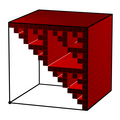


.svg)


.svg)

.png)


.svg)


.svg)

.png)


.svg)


.svg)

.png)
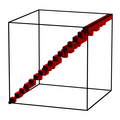


.svg)


.svg)

.png)


.svg)


.svg)

.png)


.svg)


.svg)

.png)


.svg)


.svg)

.png)
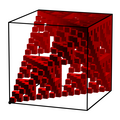


.svg)


.svg)

.png)


.svg)


.svg)

.png)


.svg)


.svg)

.png)


.svg)


.svg)

.png)
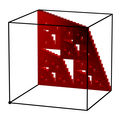


.svg)


.svg)

.png)


.svg)


.svg)

.png)


.svg)


.svg)

Propositional calculus examples: drivers and medics
[edit | edit source]A proposition is uniquely determined by the set of all cases, in which it is true.
This set could be called the proposition's validity set.
Two propositions are equal, when they have the same validity set.
The validity set of a negation is the complement of the initial proposition's validity set.
So to know the negation of a proposition, one has to know the set of all possible cases.
The set of all possible cases is the validity set of the tautology. It may be denoted 👁 {\displaystyle ~\Omega }
.
The empty set is the validity set of the contradiction.
Cases that can be the case and propositions that can be said are essentially different objects.
(Similar to outcomes and events in probability theory.)
When there are n possible cases, there are 2n possible propositions.
Among them are n elementary propositions (minterms). They have a 1-element validity set, and thus they are true in exactly one case.
(Cases and corresponding elementary propositions are easily mixed up - like outcomes and elementary events in probability theory.)
A single employee
[edit | edit source]One may be interested, if an employee is a driver or a medic.
There are exactly four possibilities (cases), how he can have these qualities or not:
- 👁 Image
He is neither D, nor M. - 👁 Image
He is D, but not M. - 👁 Image
He is not D, but M. - 👁 Image
He is D and M.


Exactly one of these statements will be true about a certain employee.
In respect to these qualities there are 24 = 16 statements (propositions), one can say about this employee:
- 👁 Image
"He is not." (i.e.: False) - 👁 Image
"He is neither D, nor M." - 👁 Image
"He is D, but not M." - 👁 Image
"He is not M."


- 👁 Image
"He is not D, but M." - 👁 Image
"He is not D." - 👁 Image
"He is either D or M." - 👁 Image
"He is not both D and M."


- 👁 Image
"He is D and M." - 👁 Image
"He is either both D and M, or neither." - 👁 Image
"He is D." - 👁 Image
"If he is M, then he is also D."


- 👁 Image
"He is M." - 👁 Image
"If he is D, then he is also M." - 👁 Image
"He is D or M." (E.g.: "He must be D or M, otherwise he would not be part of this project.") - 👁 Image
"He is." (i.e. True, the tautological case)


A group of employees
[edit | edit source]One may be interested, which of the following statements are true about a certain group of employees:
- 👁 Image
"Someone is neither D, nor M." - 👁 Image
"Someone is D, but not M." - 👁 Image
"Someone is not D, but M." - 👁 Image
"Someone is D and M."
These statements don't contradict each other. At least one will be true about a certain group of employees.
(Assumed, that the group consists of at least one employee.)
There are 15 possible cases:
- 👁 Image
All are neither D, nor M. - 👁 Image
All are D, but not M. - 👁 Image
There are D and not-D, which are all not M.
- 👁 Image
All are not D, but M. - 👁 Image
All are not D, among them are M and not-M. - 👁 Image
There are D and M, but no one is both. - 👁 Image
No one is both D and M.
- 👁 Image
All are D and M. - 👁 Image
All are both D and M, or neither. - 👁 Image
All are D. - 👁 Image
Those who are D are also M.
So there are 215 = 32768 propositions one can say about a particular group of employees:
Examples
[edit | edit source]- 👁 Image
the tautology


| with the validity set: | 👁 Image |
👁 Image |
👁 Image |
👁 Image |
👁 Image |
👁 Image |
👁 Image |
👁 Image |
👁 Image |
👁 Image |
👁 Image |
👁 Image |
👁 Image |
👁 Image |
👁 Image |
- 👁 Image
"All D are M."


| with the validity set: | 👁 Image |
👁 Image |
👁 Image |
👁 Image |
👁 Image |
👁 Image |
👁 Image |
- 👁 Image
"No one is D and M."


| with the validity set: | 👁 Image |
👁 Image |
👁 Image |
👁 Image |
👁 Image |
👁 Image |
👁 Image |
- 👁 Image
"No one is D."


| with the validity set: | 👁 Image |
👁 Image |
👁 Image |
- 👁 Image
"All are D or M."


| with the validity set: | 👁 Image |
👁 Image |
👁 Image |
👁 Image |
👁 Image |
👁 Image |
👁 Image |
- 👁 Image
"All are D and M."


| with the validity set: | 👁 Image |