
English
[edit]
Pronunciation
[edit]- (Received Pronunciation) IPA(key): /ləʊf/
Audio (Southern England): (file)
- (General American) IPA(key): /loʊf/
- Rhymes: -əʊf
Etymology 1
[edit]Etymology tree
- From Middle English laf, lof, loof, from Old English hlāf (“bread; loaf”), from Proto-West Germanic *hlaib, from Proto-Germanic *hlaibaz (“bread; loaf”), of uncertain origin. Perhaps related to Old English hlifian (“to stand out prominently, tower up”).
Cognates
Cognate with German Laib (“loaf”), Danish and Swedish lev (“loaf”), Faroese leivur (“an oblong bun”), Icelandic hleifur (“loaf”), Norwegian Nynorsk leiv (“loaf”), Gothic 𐌷𐌻𐌰𐌹𐌱𐍃 (hlaibs), 𐌷𐌻𐌰𐌹𐍆𐍃 (hlaifs, “bread”) (whence Proto-Slavic *xlěbъ (“bread”) (see there for further descendants)), Estonian leib (“black bread”), Finnish leipä (“bread; loaf”); also Latvian klaips (“loaf”), Lithuanian kliẽpas (“loaf”). Doublet of chleb and khleb.
- (brain or head): Rhyming slang, ellipsis of loaf of bread.
Noun
[edit]loaf (plural loaves)
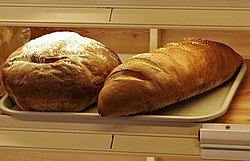
- (also loaf of bread) A block of bread after baking.
- 1913, Joseph C[rosby] Lincoln, chapter VIII, in Mr. Pratt’s Patients, New York, N.Y.; London: D[aniel] Appleton and Company, →OCLC:
- Philander went into the next room[…]and came back with a salt mackerel that dripped brine like a rainstorm. Then he put the coffee pot on the stove and rummaged out a loaf of dry bread and some hardtack.
- Any solid block of food, such as meat or sugar.
- 1627 (indicated as 1626), Francis [Bacon], “IV. Century.”, in Sylua Syluarum: Or A Naturall Historie. In Ten Centuries.[…], London: […] William Rawley[…]; [p]rinted by J[ohn] H[aviland] for William Lee[…], →OCLC:
- sugar-loaf
- (Cockney rhyming slang) Ellipsis of loaf of bread: the brain or the head.[1]
- Synonyms: (slang) bonce, noddle, nut; see also Thesaurus:head
- 1960, P[elham] G[renville] Wodehouse, “VIII AND XII”, in Jeeves in the Offing, London: Herbert Jenkins, →OCLC:
- It is frequently said of Bertram Wooster that he is a man who can think on his feet, and if the necessity arises he can also use his loaf when on all fours. [...] “Why didn't the idiot tell her not to open it?” “It was his first move. ‘I've found a letter from you here, precious,’ she said. ‘On no account open it, angel,’ he said. So of course she opened it.” She pursed the lips, nodded the loaf, and ate a moody piece of crumpet. “So that's why he's been going about looking like a dead fish.”
- A solid block of soap, from which standard bar soap is cut.
- (cellular automata) A particular still life configuration with seven living cells.
- (informal, slang) A catloaf.
Derived terms
[edit]- barracouta loaf
- catloaf
- catloafed
- confinement loaf
- cottage loaf
- disciplinary loaf
- Dutch loaf
- farmhouse loaf
- farthing loaf
- flesh loaf
- fleshloaf
- foodloaf
- French loaf
- frosted ribbon loaf
- granary loaf
- half a loaf is better than no bread
- half a loaf is better than no loaf
- half a loaf is better than none
- liverloaf
- loaf bread
- loaflet
- loaflike
- loaf of bread
- loaf pan
- loaf sugar
- malt loaf
- meatless loaf
- meatloaf, meat loaf
- nut loaf
- olive loaf
- pan-loaf
- pimento loaf
- pinch a loaf
- plain loaf
- Pullman loaf
- ribbon loaf
- sandwich loaf
- sugar loaf, sugar-loaf
- tank loaf
- tea loaf
- temse loaf
- Vienna loaf
- wave loaf
Descendants
[edit]Translations
[edit]block of bread
|
block of food
head (slang)
large block of soap
References
[edit]- ^ “loaf (of bread) n.”, in Green’s Dictionary of Slang, Jonathon Green, 2016–present.
- (soap) Miller, J.L. "Customers believe in downstate Soap Fairy", The News Journal, B10, January 10, 2006.
Verb
[edit]loaf (third-person singular simple present loafs, present participle loafing, simple past and past participle loafed)
Etymology 2
[edit]Probably a back-formation from loafer.
Verb
[edit]loaf (third-person singular simple present loafs, present participle loafing, simple past and past participle loafed)
- (intransitive) To do nothing, to be idle.
- loaf about, loaf around
- 2015, Elizabeth Royte, Vultures Are Revolting. Here’s Why We Need to Save Them., National Geographic (December 2015)[4]
- They don’t (often) kill other animals, they probably form monogamous pairs, and we know they share parental care of chicks, and loaf and bathe in large, congenial groups.
Synonyms
[edit]Derived terms
[edit]Descendants
[edit]Translations
[edit]do nothing
Anagrams
[edit]Retrieved from "https://en.wiktionary.org/w/index.php?title=loaf&oldid=89454424"
Categories:
- English 1-syllable words
- English terms with IPA pronunciation
- English terms with audio pronunciation
- Rhymes:English/əʊf
- Rhymes:English/əʊf/1 syllable
- English terms inherited from Proto-Germanic
- English terms inherited from Middle English
- English terms derived from Old English
- English terms inherited from Proto-West Germanic
- English terms derived from Proto-West Germanic
- English terms derived from Middle English
- English terms derived from Proto-Germanic
- English terms inherited from Old English
- English terms with unknown etymologies
- English doublets
- English ellipses
- English lemmas
- English nouns
- English countable nouns
- English nouns with irregular plurals
- English terms with quotations
- Cockney rhyming slang
- English terms with collocations
- en:Cellular automata
- English informal terms
- English slang
- English verbs
- English back-formations
- English intransitive verbs
- English terms with usage examples
- en:Cats
- en:Food and drink
Hidden categories:
- Pages with etymology trees
- English entries with etymology trees
- Pages with entries
- Pages with 1 entry
- Entries with translation boxes
- Terms with Arabic translations
- Terms with Bulgarian translations
- Terms with Catalan translations
- Terms with Mandarin translations
- Terms with Cornish translations
- Terms with Czech translations
- Terms with Old Czech translations
- Terms with Dutch translations
- Terms with Esperanto translations
- Requests for review of Esperanto translations
- Terms with Estonian translations
- Terms with Finnish translations
- Terms with French translations
- Terms with Galician translations
- Terms with Georgian translations
- Terms with German translations
- Terms with Greek translations
- Terms with Ancient Greek translations
- Terms with Hawaiian translations
- Terms with Hebrew translations
- Terms with Hungarian translations
- Terms with Icelandic translations
- Terms with Ingrian translations
- Terms with Irish translations
- Terms with Italian translations
- Terms with Japanese translations
- Terms with Kazakh translations
- Terms with Latin translations
- Terms with Latvian translations
- Terms with Macedonian translations
- Terms with Malay translations
- Terms with Māori translations
- Requests for review of Māori translations
- Terms with Old Church Slavonic translations
- Terms with Polish translations
- Terms with Portuguese translations
- Terms with Romanian translations
- Terms with Russian translations
- Terms with Scottish Gaelic translations
- Terms with Serbo-Croatian translations
- Terms with Slovene translations
- Terms with Spanish translations
- Terms with Swahili translations
- Terms with Swedish translations
- Requests for translations into Tagalog
- Terms with Taos translations
- Terms with Welsh translations
- Terms with Yiddish translations
- Requests for translations into Hawaiian
- Terms with Cherokee translations
- Terms with Ottoman Turkish translations