
English
[edit]Pronunciation
[edit]- (Received Pronunciation) IPA(key): /ˈpɪŋɡəʊ/
Audio (Southern England): (file)
- (General American) IPA(key): /ˈpɪŋɡoʊ/
- Rhymes: -ɪŋɡəʊ
- Hyphenation: pin‧go
Etymology 1
[edit]
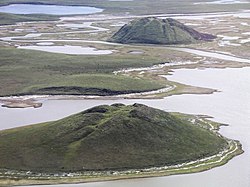
From Greenlandic pingu or Inuktitut pingu (“hummock, small hill”).
Noun
[edit]pingo (plural pingoes or pingos)
- (geomorphology) A conical mound of earth with an ice core caused by permafrost uplift, particularly if lasting more than a year. [from 1920s]
- Synonym: hydrolaccolith
- 1963, J[ohn] Ross Mackay, The Mackenzie Delta Area, N.W.T. (Memoir (Geographical Branch, Department of Mines and Technical Surveys, Canada); 8), Ottawa, Ont.: Department of Mines and Technical Surveys, →OCLC, page 74:
- The greatest variation in cover thickness, as determined from collapsed pingos, is in irregularly shaped pingos, or those with asymmetrically located ice-cores.
- 1973, Roger J. E. Brown, Troy L. Péwé, “Distribution of Permafrost in North America and Its Relationship to the Environment: A Review, 1963–1973: 13–28 July 1973, Yakutsk, U.S.S.R.”, in Permafrost: North American Contribution: Second International Conference, Washington, D.C.: National Academy of Sciences, →ISBN, page 80, column 2:
- Considerable progress has been made on the discovery and mapping of many open system pingos in central Alaska and Yukon Territory[…], as well as the discovery of pingo-like mounds in the shallow waters of the Beaufort Sea north of the mouth of the Mackenzie River. The greatest advance in pingo research in the last decade has been a consideration and understanding of theory and rate of pingo growth […]
- 1983, J[ohn] Ross Mackay, “Oxygen Isotope Variations in Permafrost, Tuktoyaktuk Peninsula Area, Northwest Territories”, in Current Research Part B = Recherches en Cours Partie B (Geological Survey Paper; 83-1B), Ottawa, Ont.: Geological Survey of Canada, →ISBN, page 68:
- With the exception of small pingos, most pingo ice cores have several ice types. The bulk of the core can be segregated ice, intrusive ice formed from the freezing of bulk water, or any combination of the two types. In addition, dilation-crack ice (tension-crack ice, Brown and Kupsch, 1974) is commonly the main ice type beneath the summit of pingos with craters.
- 1987, I. B. Campbell, G. G. C. Claridge, Antarctica: Soils, Weathering Processes and Environment (Developments in Soil Science; 16), Amsterdam; New York, N.Y.: Elsevier, →ISBN, page 106:
- Larger scale frost-heave features, such as pingoes, are rare because there is insufficient water available, generally, for the growth of large ice bodies.
Translations
[edit]
|
See also
[edit]Etymology 2
[edit]

Apparently from Sinhalese [Term?] (?),[1] but the word has not yet been identified.
Noun
[edit]pingo (plural pingoes or pingos)
- (Sri Lanka, dated) A flexible pole supported on one shoulder, with a load suspended from each end.
- Synonyms: carrying pole, milkmaid's yoke, shoulder pole
- 1861, J[ames] Emerson Tennent, “Appendix to Chapter III. Narratives of the Natives of Ceylon Relative to Encounters with Rogue Elephants.”, in Sketches of the Natural History of Ceylon with Narratives and Anecdotes Illustrative of the Habits and Instincts of the Mammalia, Birds, Reptiles, Fishes, Insects, &c. Including a Monograph of the Elephant and a Description of the Modes of Capturing and Training It. With Engravings from Original Drawings, London: Longman, Green, Longman, and Roberts, →OCLC, page 138:
- This done, he [an elephant] took up the pingo and moved away from the spot; but at the distance of about a fathom or two, laid it down again, and ripping open one of the bundles, took out of it all the contents, somans [footnote: Woman's robe], cambāyas [footnote: The figured cloth worn by men], handkerchiefs, and several pieces of white cambrick cloth, all which he tore to small pieces, and flung them wildly here and there. He did the same with all the other pingoes.
- 1887, S. M. Burrows, “A Year’s Work at Polonnáruwa”, in Journal of the Ceylon Branch of the Royal Asiatic Society, volume X, number 34, Colombo, Ceylon: G. J. A. Skeen, government printer, Ceylon, published 1888, →ISSN, →OCLC, page 49:
- The Gańga-vaṇṣa minissu are the washers of the Oliya caste, who are not only a low caste, but come below the Paduvó and Berawáyó, and are the only caste who will carry the pingoes of the smiths.
- 1859, James Emerson Tennent, “Vegetation.—Trees and Plants.”, in Ceylon: An Account on the Island Physical, Historical, and Topographical with Notices of Its Natural History, Antiquities and Productions, volume I, London: Longman, Green, Longman, and Roberts, →OCLC, part I (Physical Geography), footnote 2, page 109:
- The following are only a few of the countless uses of this invaluable tree [the coconut]. […] The stem of the leaf, for fences, for pingoes (or yokes) for carrying burthens on the shoulders, for fishing-rods, and innumerable domestic utensils.
- 1908, Ananda Kentish Coomaraswamy, Mediaeval Sinhalese Art: Being a Monograph on Mediaeval Sinhalese Arts and Crafts, Mainly as Surviving in the Eighteenth Century, with an Account of the Structure of Society and the Status of the Craftsmen, Broad Campden, Gloucestershire: Essex House Press, →OCLC, page 206:
- Ceremonial pingoes may also be silver tipped, as in the case of a beautiful example at the Embekke Devale[…].
- 1926, Ali Foad Toulba, “The Beautiful Mountain Railway to Kandy”, in Ceylon: The Land of Eternal Charm, London: Hutchinson & Co. (Publishers) Ltd., Paternoster Row, E.C., →OCLC; reprinted New Delhi; Madras: J. Jetley, Asian Educational Services, 2000, →ISBN, page 145:
- Pingo bearers walk to and fro with their burdens of fruit and vegetables, representing many varieties quite strange to us. The pingo is a long and flat piece of wood from the kittul palm, very tough and pliable. The coolie, having suspended his load to the two ends in baskets or nets, places the stave upon his shoulder at the middle, and is thus enabled by the elastic spring and easy balance of the pingo to carry great weights for a considerable distance. Some pingoes are made from the leaf-stalk of the coconut palm, which is even more pliable than the kittul.
- (Sri Lanka, dated) A measure of weight equivalent to that which can be carried using a pingo, perhaps about 55 pounds (25 kilograms) (see the 2013 quotation).
- Synonym: picul
- 1833, “The Chaliah Caste in Ceylon”, in The Asiatic Journal and Monthly Register for British and Foreign India, page 275:
- Upon reaching this quantity, the tribute decreased one pingo annually until the number was reduced to five.
- 1866, Dandris De Silva Goonaratne, “On Demonology and Witchcraft in Ceylon”, in Journal of the Ceylon Branch of the Royal Asiatic Society, Colombo, Ceylon: F. Fonseka, printer, Fort, Colombo, →ISSN, →OCLC, footnote, page 36:
- About an hour or so before a bridegroom accompanied by his friends arrives at the house of the bride, a person, named for the occasion Gamana or messenger, is sent forward with a number of betel leaves equal to the number of people, who accompany the bridegroom. The Gamana is to give these betel leaves to the bride's friends, together with the large pingo of plantains called Gira-mul-tada, which in the Maritime districts is always a sine qua non of the presents, which a Singhalese bridegroom carries to his bride's house.
- 2007, Karunasena Dias Paranavitana, “The Portuguese Tombos as a Source of Sixteenth- and Seventeenth-century Sri Lankan History”, in Jorge Flores, editor, Re-exploring the Links: History and Constructed Histories between Portugal and Sri Lanka (Maritime Asia; 18), Wiesbaden: Harrassowitz Verlag, →ISBN, →ISSN, page 74:
- He […] paid the lord of the village three pingos worth one larim and four fanões.
- 2013, Lodewijk Wagenaar, “The Apparition of the Cinnamon Peelers: Dutch Colonial Presence in Eighteenth-century Ceylon and Its Reflection in Non-literary Prose”, in Jeroen Dewulf, Ole Praamstra, Michiel van Kempen, editors, Shifting the Compass: Pluricontinental Connections in Dutch Colonial and Postcolonial Literature, Newcastle upon Tyne: Cambridge Scholars Publishing, →ISBN, page 125:
- A certain Wieremunie Joan testified about facts which already had occurred in 1772 when he had delivered four and a half pingo [footnote: A "pingo" is circa fifty-five pound of cinnamon.[…]] of cinnamon above the fixed duty of five and that the Durea still owed him four and a half rixdollar.
Translations
[edit]References
[edit]- ^ Edward Balfour, editor (1873), “PINGO”, in Cyclopædia of India and of Eastern and Southern Asia, Commercial, Industrial and Scientific: Products of the Mineral, Vegetable and Animal Kingdoms, Useful Arts and Manufactures, 2nd edition, volume IV, Madras: Printed at the Scottish, and Lawrence Presses, →OCLC, page 580, column 1: “PINGO, Singh[alese], […] an elastic stick loaded at both ends, poised on the shoulder, used in Ceylon for carrying burthens.”
Further reading
[edit]
Anagrams
[edit]Czech
[edit]Pronunciation
[edit]Noun
[edit]pingo n
Declension
[edit]Further reading
[edit]- “pingo”, in Příruční slovník jazyka českého (in Czech), 1935–1957
Esperanto
[edit]
| 👁 Request for quotations |
This entry needs quotations to illustrate usage. If you come across any interesting, durably archived quotes, then please add them! |

Etymology
[edit]Of Inuit origin; compare Inuktitut, Greenlandic pingu (“hillock”).
Pronunciation
[edit]Noun
[edit]pingo (accusative singular pingon, plural pingoj, accusative plural pingojn)
Galician
[edit]

Etymology 1
[edit]Back-formation from pingar (“to drop”), influenced by Latin pingue (“fat”).[1] For semantic development, compare English dripping.
Alternative forms
[edit]- pingue (western)
Pronunciation
[edit]Noun
[edit]pingo m (plural pingos)
- rendered lard, dripping
- 1519, X. Ferro Couselo, editor, A vida e a fala dos devanceiros. Escolma de documentos en galego dos séculos XIII ao XVI, volume 2, Vigo: Galaxia, page 218:
- Un asadiño de pingo de porco.
- A little pot with pork lard
- 1813, anonymous author, Conversa no Adro da Igrexa:
- —[…]despois poñíanvos na tortura do potro, atandovos antes os pés e as más; despois levabades oito garrotes; e si con todo esto non confesabades, fasíanvos tragar unha chea d'agua para que arremedásedes os afogados. Mais esto era pouco, que remataban a festa poñendovos os pés encoiro untados de pingo nun sepo, e despois traían unha chea de lume pra frixílos, ou pra poñerllo debaixo, e outras mil xudiadas, tanto que ás veses nin aínda lles permitían confesarse.
—¡Ave María! Eu confesaría o que me preguntasen, aún cando no'fixese.
—Eu o mesmo.- — [The Inquisition:] after this they would take you to the rack, tying your hands and your feet; after this they would hit you eight times with a club; and if, in spite of this, you didn't confess, then they obliged you to shallow a large quantity of water as if you should resemble a drowned man. But this was not enough, because they ended the celebration putting your bare feet, buttered with lard, in a clamp, and they would bring a large fire for frying them, or for putting them under it; and another thousand mean things. They even sometimes don't allowed them to confess.
—Ave María! I would admit anything they would ask, even if I had not done it.
—Me too.
- — [The Inquisition:] after this they would take you to the rack, tying your hands and your feet; after this they would hit you eight times with a club; and if, in spite of this, you didn't confess, then they obliged you to shallow a large quantity of water as if you should resemble a drowned man. But this was not enough, because they ended the celebration putting your bare feet, buttered with lard, in a clamp, and they would bring a large fire for frying them, or for putting them under it; and another thousand mean things. They even sometimes don't allowed them to confess.
- drop, droplet
- Synonym: gota
- (figuratively) small portion
Related terms
[edit]References
[edit]- Barreiro, Xavier Varela; Guinovart, Xavier Gómez (2006–2018), “pingo”, in Corpus Xelmírez: corpus lingüístico da Galicia medieval [Corpus Xelmírez: linguistic corpus of Medieval Galicia] (in Galician), Santiago de Compostela: Instituto da Lingua Galega
- Antón Luís Santamarina Fernández, editor (2006–2013), “pingo”, in Dicionario de Dicionarios da lingua galega [Dictionary of Dictionaries of the Galician language] (in Galician), Santiago de Compostela: Instituto da Lingua Galega
- Antón Luís Santamarina Fernández, Ernesto Xosé González Seoane, María Álvarez de la Granja, editors (2003–2018), “pingo”, in Tesouro informatizado da lingua galega (in Galician), Santiago de Compostela: Instituto da Lingua Galega
- Rosario Álvarez Blanco, editor (2014–2024), “pingo”, in Tesouro do léxico patrimonial galego e portugués (in Galician), Santiago de Compostela: Instituto da Lingua Galega, →ISSN
- ^ Coromines, Joan; Pascual, José Antonio (1983–1991), “pringar”, in Diccionario crítico etimológico castellano e hispánico [Critical Castilian and Hispanic etymological dictionary][1] (in Spanish), Madrid: Gredos
Etymology 2
[edit]Verb
[edit]pingo
Italian
[edit]Pronunciation
[edit]Verb
[edit]pingo
Latin
[edit]Alternative forms
[edit]Etymology
[edit]From Proto-Indo-European *peyḱ- (“to mark, paint; spot, color”), possibly via intermediate *pink- plus voicing assimilation, from the nasal-infixed form *pinéḱti ~ *pinḱénti;[1] cognate with Ancient Greek ποικίλος (poikílos, “spotted, embroidered”), Proto-Slavic *pьstrъ (“multicolored, variegated”) (e.g. Czech pestrý). Pokorny also links to the root: Ancient Greek πικρός (pikrós, “sharp, keen”), Proto-Slavic *pьsati (“paint, write”) (see Czech psát, Russian пятно́ (pjatnó), писать (pisatʹ) etc.), Proto-Germanic *faihaz (“spotted”) (whence Old English fāh, Scots faw). Compare also Sanskrit पिङ्क्ते (piṅkte, “to paint, tinge, dye”).
Pronunciation
[edit]- (Classical Latin) IPA(key): [ˈpɪŋ.ɡoː]
- (modern Italianate Ecclesiastical) IPA(key): [ˈpiŋ.ɡo]
Verb
[edit]pingō (present infinitive pingere, perfect active pīnxī, supine pī̆ctum); third conjugation
- to decorate, adorn, embellish
- (of artistic style) to embellish, agrandize; make ornate
- 46 BCE, Cicero, Brutus 37.141:[2]
- σχήματα (skhḗmata) enim quae vocant Graeci, ea maxime ornant oratorem eaque non tam in verbis pingendis habent pondus quam in illuminandis sententiis.
- 1939 translation by G. L. Hendrickson and H. M. Hubbell
- For what the Greeks call postures or figures are the greatest ornaments of oratory. They are not so important in heightening the colour of words, as in throwing ideas into a stronger light.
- 1939 translation by G. L. Hendrickson and H. M. Hubbell
- σχήματα (skhḗmata) enim quae vocant Graeci, ea maxime ornant oratorem eaque non tam in verbis pingendis habent pondus quam in illuminandis sententiis.
- to paint, tint or colour
- pingere capillum ― to dye one's hair
- 55 BCE, Cicero, De oratore 2.69:[3]
- ut in pictura, qui hominis speciem pingere perdidicerit, posse eum cuiusvis vel formae, vel aetatis, etiamsi non didicerit, pingere neque esse periculum, qui leonem aut taurum pingat egregie, ne idem in multis aliis quadrupedibus facere non possit
- 1942 translation by E. W. Sutton and H. Rackham
- as in painting, for instance, he who has thoroughly learned how to paint the semblance of a man, can without further lessons paint one of any figure or time of life, nor is there any danger that he, who would paint to admiration a lion or bull, will be unable to do the like with many other four-footed animals
- 1942 translation by E. W. Sutton and H. Rackham
- ut in pictura, qui hominis speciem pingere perdidicerit, posse eum cuiusvis vel formae, vel aetatis, etiamsi non didicerit, pingere neque esse periculum, qui leonem aut taurum pingat egregie, ne idem in multis aliis quadrupedibus facere non possit
- 77 CE – 79 CE, Plinius Maior, Naturalis Historia 35.33:[4]
- Nero princeps iusserat colosseum se pingi
- 1952 translation by H. Rackham
- The Emperor Nero had ordered his portrait to be painted on a colossal scale
- 1952 translation by H. Rackham
- Nero princeps iusserat colosseum se pingi
- to tattoo
- to portray
Conjugation
[edit]Derived terms
[edit]Descendants
[edit]- Insular Romance:
- Sardinian: pinghere
- Italo-Dalmatian:
- Rhaeto-Romance:
- Northern Gallo-Romance:
- Old French: peindre (see there for further descendants)
- Southern Gallo-Romance:
- Occitan: pénher
- Ibero-Romance:
- Old Galician-Portuguese: penher
- ⇒ Vulgar Latin: (see there for further descendants)
- Borrowings:
- → Interlingua: pinger
References
[edit]- ^ De Vaan, Michiel (2008), Etymological Dictionary of Latin and the other Italic Languages (Leiden Indo-European Etymological Dictionary Series; 7), Leiden, Boston: Brill, →ISBN, pages 465-6
- ^ Hendrickson, G. L.; Hubbell, H. M. (1939), Brutus. Orator[2], Harvard University Press, →ISBN, pages 124-125
- ^ Sutton, E. W.; Rackham, H. (1942), On the Orator: Books 1–2 (Loeb Classical Library)[3], Harvard University Press, →ISBN, pages 248-249
- ^ Rackham, H. (1952), Natural History, Volume IX (Loeb Classical Library)[4], Harvard University Press, →ISBN, page 298
Further reading
[edit]- “pingo”, in Charlton T. Lewis and Charles Short (1879), A Latin Dictionary, Oxford: Clarendon Press
- “pingo”, in Charlton T. Lewis (1891), An Elementary Latin Dictionary, New York: Harper & Brothers
- “pingo”, in Gaffiot, Félix (1934), Dictionnaire illustré latin-français, Hachette.
- pingo in Ramminger, Johann (16 July 2016 (last accessed)), Neulateinische Wortliste: Ein Wörterbuch des Lateinischen von Petrarca bis 1700[5], pre-publication website, 2005-2016
- Walther von Wartburg (1928–2002), “pĭngĕre”, in Französisches Etymologisches Wörterbuch (in German), volume 8: Patavia–Pix, page 522
Polish
[edit]

Etymology
[edit](This etymology is missing or incomplete. Please add to it, or discuss it at the Etymology scriptorium.)
Pronunciation
[edit]Noun
[edit]pingo n (indeclinable)
- pingo (conical mound of earth with an ice core caused by permafrost uplift, particularly if lasting more than a year)
- Synonym: bułgunniach
- Hypernym: pagór mrozowy
Further reading
[edit]Portuguese
[edit]Pronunciation
[edit]- Hyphenation: pin‧go
Etymology 1
[edit]Noun
[edit]pingo m (plural pingos)
- a drop
- a jot
- (Portugal, regional) espresso with milk, similar to a cortado
- (Brazil, typography) a small dot that is part of a letter; a tittle
- colocar os pingos nos is ― to dot the i's
Related terms
[edit]Etymology 2
[edit]Verb
[edit]pingo
Etymology 3
[edit]Noun
[edit]pingo m (plural pingos)
Further reading
[edit]- “pingo”, in Dicionário Aulete Digital (in Portuguese), Rio de Janeiro: Lexikon Editora Digital, 2008–2026
- “pingo”, in Dicionário Priberam da Língua Portuguesa (in Portuguese), Lisbon: Priberam, 2008–2026
Spanish
[edit]Verb
[edit]pingo
See also
[edit]Sranan Tongo
[edit]Etymology
[edit]Borrowed from a Cariban language, ultimately from Proto-Cariban *pôinôkô; possible direct sources include Kari'na pyinko, poinko and Yao (South America) pingo.
Noun
[edit]pingo
- white-lipped peccary (Tayassu pecari)
- 1783, C. L. Schumann, Neger-Englisches Worterbuch [Negro English Dictionary][6], archived from the original on 8 February 2023:
- wan lo pingo
- A herd of white-lipped peccaries.
Yao (South America)
[edit]Alternative forms
[edit]Etymology
[edit]From Proto-Cariban *pôinôkô; compare Apalaí poinoko, Kari'na pyinko, poinko, Trió ponjeke, pënjeke, Wayana pëinëkë, Waiwai poinko, Akawaio pöinkö, Macushi pinkî, Pemon poyinkö, as well as (from non-Cariban languages) Sranan Tongo pingo.
Noun
[edit]pingo
- a kind of peccary, larger than the pockiero; likely the white-lipped peccary
Further reading
[edit]- de Laet, Johannes (1633) Novus orbis seu descriptionis Indiæ occidentalis, Libri XVIII, page 643
- English 2-syllable words
- English terms with IPA pronunciation
- English terms with audio pronunciation
- Rhymes:English/ɪŋɡəʊ
- Rhymes:English/ɪŋɡəʊ/2 syllables
- English terms derived from Greenlandic
- English terms derived from Inuktitut
- English lemmas
- English nouns
- English countable nouns
- English nouns with irregular plurals
- en:Geomorphology
- English terms with quotations
- English terms derived from Sinhalese
- Sri Lankan English
- English dated terms
- en:Sri Lanka
- en:Units of measure
- Czech terms with IPA pronunciation
- Czech lemmas
- Czech nouns
- Czech neuter nouns
- Czech velar-stem neuter nouns
- cs:Geography
- Esperanto terms derived from Inuit languages
- Esperanto terms derived from Inuktitut
- Esperanto terms derived from Greenlandic
- Esperanto 2-syllable words
- Esperanto terms with IPA pronunciation
- Rhymes:Esperanto/inɡo
- Rhymes:Esperanto/inɡo/2 syllables
- Esperanto lemmas
- Esperanto nouns
- eo:Geography
- Galician back-formations
- Galician terms derived from Latin
- Galician terms with IPA pronunciation
- Galician lemmas
- Galician nouns
- Galician countable nouns
- Galician masculine nouns
- Galician terms with quotations
- Galician non-lemma forms
- Galician verb forms
- gl:Liquids
- Italian 2-syllable words
- Italian terms with IPA pronunciation
- Rhymes:Italian/inɡo
- Rhymes:Italian/inɡo/2 syllables
- Italian non-lemma forms
- Italian verb forms
- Latin terms derived from Proto-Indo-European
- Latin terms derived from the Proto-Indo-European root *peyḱ- (mark)
- Latin 2-syllable words
- Latin terms with IPA pronunciation
- Latin lemmas
- Latin verbs
- Latin terms with quotations
- Latin terms with collocations
- Latin third conjugation verbs
- Latin third conjugation verbs with perfect in -s- or -x-
- Latin terms infixed with -n-
- Latin unprefixed third conjugation verbs
- Polish 2-syllable words
- Polish terms with IPA pronunciation
- Rhymes:Polish/iŋɡɔ
- Rhymes:Polish/iŋɡɔ/2 syllables
- Polish lemmas
- Polish nouns
- Polish indeclinable nouns
- Polish neuter nouns
- pl:Landforms
- Portuguese 2-syllable words
- Portuguese terms with IPA pronunciation
- Portuguese deverbals
- Portuguese lemmas
- Portuguese nouns
- Portuguese countable nouns
- Portuguese masculine nouns
- European Portuguese
- Regional Portuguese
- Brazilian Portuguese
- pt:Typography
- Portuguese terms with usage examples
- Portuguese non-lemma forms
- Portuguese verb forms
- Portuguese terms borrowed from Spanish
- Portuguese terms derived from Spanish
- pt:Coffee
- Spanish non-lemma forms
- Spanish verb forms
- Sranan Tongo terms borrowed from Cariban languages
- Sranan Tongo terms derived from Cariban languages
- Sranan Tongo terms derived from Proto-Cariban
- Sranan Tongo lemmas
- Sranan Tongo nouns
- Sranan Tongo terms with quotations
- srn:Pigs
- Yao (South America) terms inherited from Proto-Cariban
- Yao (South America) terms derived from Proto-Cariban
- Yao (South America) lemmas
- Yao (South America) nouns
- Word of the day archive/2018/March
- Word of the day archive/2018
- Word of the day archive
- Pages with entries
- Pages with 11 entries
- Entries with translation boxes
- Terms with Armenian translations
- Terms with Chinese translations
- Terms with Czech translations
- Terms with Esperanto translations
- Terms with Estonian translations
- Terms with Finnish translations
- Terms with French translations
- Terms with German translations
- Terms with Hindi translations
- Terms with Hungarian translations
- Terms with Kazakh translations
- Terms with Korean translations
- Terms with Lithuanian translations
- Terms with Polish translations
- Terms with Russian translations
- Terms with Ukrainian translations
- Terms with Yakut translations
- Sinhalese term requests
- Requests for quotations in Esperanto
- Esperanto nouns with red links in their headword lines
- Quotation templates to be cleaned
- Latin verbs with red links in their inflection tables
- Requests for etymologies in Polish entries