 |
VOOZH | about |
|
VOOZH | about |
Despite the ongoing war in West Asia, outward remittances under the Liberalised Remittance Scheme (LRS) for travel-related expenses didn’t show sign of big moderation at $1.09 billion in March, a drop of 16% from $1.31 billion recorded in February, data released by the Reserve Bank of India said.
High air fares and disruption in travel services failed to dampen the travel spirit as over 60% of the travel-related expenses were for holiday expenses and international credit card bill settlements by Indians. In January, remittances under the travel category had touched $1.66 billion.
Total LRS in March was $2.59 billion, against $2.33 billion in February.
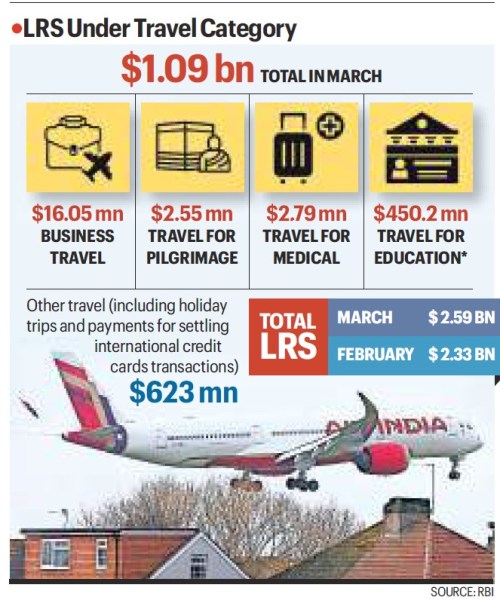
The “other travel” segment — covering holiday expenses and international credit card bill settlements — accounted for $623 million (over Rs 5,900 crore) in the month of March 2026, highlighting the discretionary overseas spending.
The numbers make it clear that affluent and aspirational Indians are increasingly prioritising foreign experiences, education and lifestyle-driven consumption at an unprecedented scale. The RBI has provided a break-up for remittances under the travel category after credit card transactions were brought under separate LRS category for the first time in March 2026.
The government has brought overseas spending through credit cards under the LRS to curb excessive foreign exchange outflows and close regulatory loopholes.
The move follows concerns that some individuals were using international credit cards to spend beyond the annual remittance ceiling of $250,000 permitted under the scheme. Until now, overseas transactions made through debit cards were already counted under the LRS framework, but credit card expenditures remained outside its ambit. Data gathered from leading money remittance agencies and financial institutions indicated that several international credit cards were being issued with spending limits significantly higher than the prescribed annual threshold, allowing users to bypass the cap indirectly.
By bringing credit card spending within the LRS net, the government aims to create uniformity across payment instruments, strengthen monitoring of foreign exchange outflows and prevent misuse of the existing regulations.
Travel for education also remained one of the biggest drivers of outbound money flows, touching $ 450.16 million in March alone.
The amount covered tuition fees, accommodation and a wide range of student expenses overseas, reinforcing the growing migration of Indian students — and Indian money — into global education markets.
Within the broader travel category, business travel remittances stood at $ 16.05 million, while pilgrimage-related travel accounted for $ 2.55 million.
Overseas medical treatment travel bill touched $ 2.79 million. Total travel remittances was $16.4 billion in FY2026 as against $ 16.9 billion in FY2025.
Overseas travel has declined since March this year as the US-Iran conflict disrupted air services and drove up air fares.
Under the LRS, all foreign remittances exceeding Rs 20 lakh — except those made for education or medical treatment — attract a 20% Tax Collected at Source (TCS). These remittances may include expenses related to overseas travel, gifts, and foreign investments. In contrast, remittances below Rs 10 lakh do not attract any TCS liability.
For international payments such as air ticket purchases made through a bank account, TCS will apply based on the transaction amount. No tax will be charged on payments up to Rs 10 lakh, while transactions exceeding this threshold will attract a 20% TCS.