


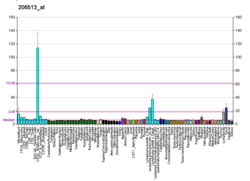
AIM2(absent in melanoma 2)は、ヒトではAIM2遺伝子によってコードされているタンパク質である[5][6]。
AIM2は造血系細胞などにみられるセンサー分子であり、細胞質に位置して微生物や宿主細胞由来の二本鎖DNAの存在を認識する[7]。現在のところAIM2をはじめとするALR(AIM2-like receptor)ファミリーは、ヒトゲノム中に4種類のメンバーが見つかっている[8]。活性化されたAIM2はASCをリクルートし、カスパーゼ-1の結合、そしてAIM2インフラマソームの形成を引き起こす。このシグナル伝達機構は細菌やウイルスのDNAを検知し、これらの病原体に対する防御機構に寄与している。AIM2インフラマソームは、PANoptosisを駆動するAIM2-PANoptosomeの中心的構成要素にもなっている[9][10]。
構造
[編集]ALRファミリーに属するタンパク質は通常、N末端のパイリンドメイン(PYD)、そして1つもしくは2つのHINドメイン(HIN-200ドメイン)から構成される。AIM2はN末端にPYD(アミノ酸1–87番)、C末端にHINドメイン(138–337番)を有し、2つのドメインは長いリンカーによって連結されている。PYDはhomotypicな(同種どうしの)タンパク質間相互作用を媒介し、HINドメインは2つのタンデムに並んだOBフォールドを介してDNAに結合する[11]。
機能
[編集]AIM2は自然免疫系の構成要素の1つであり、細胞質における二本鎖DNAセンサーとして抗ウイルス・抗細菌防御機能を果たしているほか、自己DNAに対する免疫応答が関わる自己免疫疾患にも関与している。AIM2はアダプタータンパク質ASCとともに、AIM2インフラマソームを呼ばれるカスパーゼ-1活性化複合体を形成する。このAIM2インフラマソームは、PANoptosisを駆動するAIM2-PANoptosomeと呼ばれる、さらに大きな細胞死誘導複合体の中心的構成要素にもなっている[9][10]。
AIM2インフラマソーム形成の第一段階は、AIM2へのDNAの結合である。AIM2のHINドメインはB型二本鎖DNA(ウイルス、細菌、そして宿主由来のものである場合もある)に結合する。結合は配列非依存的であるが、少なくとも80塩基対以上の長さが必要である[12]。この相互作用は主に静電的であり、正に帯電したアミノ酸残基がDNA骨格のリン酸や糖部分に配位する。二本鎖DNAはPYDに置き換わってHINドメインに結合し、フリーになったPYDはアダプタータンパク質ASCのPYDに対し、homotypicなPYD-PYD相互作用による結合を行う[13]。ASCはPYDとCARDを有するタンパク質であり、ASCのCARDがCARD-CARD相互作用によってプロカスパーゼ-1を複合体へリクルートすることでAIM2インフラマソームの基本的な構造的要素が形成される。プロカスパーゼ-1は自己切断によってカスパーゼ-1へと活性化され、IL-1β前駆体、IL-18前駆体、ガスダーミンDを切断するプロセシングが行われる。ガスダーミンDのN末端断片はパイロトーシスを誘導し、成熟型サイトカインとなったIL-1βやIL-18の細胞外放出が可能となる。
AIM2はPANoptosisも誘導する。PANoptosisは自然免疫系のセンサーによって開始される顕著な自然免疫性・炎症性・細胞溶解性の細胞死を特徴とし、PANoptosomeを介してカスパーゼやRIPKによって駆動される[14][15]。PANoptosomeは、細菌、ウイルス、真菌などの病原体のほか、病原体関連分子パターン、ダメージ関連分子パターン、サイトカイン、そして感染症や炎症性疾患、がんに伴う恒常性の変化への応答として、パターン認識受容体から組み立てられる多タンパク質複合体である[15][16][17][18][19][20][21][22][23][24][25][26][27][28][29]。PANoptosomeが形成されるためには、Francisella novicida、単純ヘルペスウイルス1型(HSV-1)など特定の病原体に対する応答として、AIM2インフラマソームがさらにカスパーゼ-8、FADD、RIPK3、RIPK1と相互作用することが必要である。
調節
[編集]インフラマソームの組み立ての調節は、細胞の恒常性の維持のために必要不可欠である。マウスでは、AIM2の活性化はp202によって阻害される。このp202タンパク質は2個のHINドメインを有するが、PYDを欠いている。そのため、p202はASCタンパク質をリクルートすることはできない。HIN1ドメインはDNAに結合し、HIN2ドメインはAIM2と相互作用する。HIN2ドメインの結合はAIM2のDNA結合面を遮断するわけではないため、AIM2のDNA結合親和性は影響を受けない。p202のDNAとAIM2への結合は、宿主防御とDNAによって誘発される病理的炎症とのバランスを保っていると考えられている。p202とAIM2が等量存在する場合には、二本鎖DNAへの結合をめぐって競合が生じる[30]。
ヒトのIFI16βと呼ばれるアイソフォームも、AIM2インフラマソームの組み立てを阻害することが示されている。そのドメイン構造はマウスp202タンパク質と類似しており、2個のHINドメインを有する。IFI16βはp202と同様にAIM2と相互作用し、二本鎖DNAへの結合に競合し、ASCのリクルートを妨げる[31]。p202やIFI16βの研究によると、2個のHINドメインを有するタンパク質は1個しか持たないタンパク質よりも頑強に二本鎖DNAへ結合するようである[32]。
AIM2の翻訳後修飾に関しては、情報は限られている。しかしながら、TRIM11はAIM2に結合し、分解をもたらすことが報告されている。そのため、AIM2インフラマソームの負の調節因子として機能している可能性がある[33]。
臨床的意義
[編集]AIM2は広範囲の微生物を検知し、インフラマソームやPANoptosomeを介した宿主の保護応答を引き起こす。近年の研究では、AIM2インフラマソームが感染症以外の疾患も関与していることが示されている。
感染症
[編集]細菌
[編集]細菌の宿主細胞への感染時に細胞質へ放出された細菌DNAは、AIM2やその他の細胞質DNAセンサーによって認識される。AIM2は野兎病菌Francisella tularensis、リステリア・モノサイトゲネスListeria monocytogenes、肺炎球菌Streptococcus pneumoniae、マイコバクテリウム属菌Mycobacterium spp.、ポルフィロモナス・ジンジバリスPorphyromonas gingivalis、黄色ブドウ球菌Staphylococcus aureus、Brucella abortus、クラミジア・ムリダルムChlamydia muridarumなど、多くの病原性細菌を認識することが示されている[7]。I型インターフェロンは、細菌感染時のAIM2インフラマソームの活性を高める[34][35]。さらに、Francisella novicidaに対する応答においてはAIM2-PANoptosome複合体をが組み立てられ、炎症性細胞死であるPANoptosisが誘導される[9]。
ウイルス
[編集]AIM2インフラマソームは細胞質に入ったDNAウイルス由来の遺伝物質も認識するため、ウイルス感染防御にも重要な役割を果たしている。しかしながら、AIM2は全てのDNAウイルスに応答するわけではない。今日までにAIM2インフラマソームが誘導されることが確認されているのは、マウスサイトメガロウイルス(MCMV)、ワクシニアウイルス、ヒトパピローマウイルスである[7]。AIM2は単純ヘルペスウイルス1型(HSV-1)にも応答し、AIM2-PANoptosomeを形成してPANoptosisを誘導する[9]。
その他の病原体
[編集]AIM2は病原性の真菌であるアスペルギルス・フミガーツスAspergillus fumigatusや[36]、原生動物であるPlasmodium berghei[37]に対する宿主防御を媒介することが示されている。
がん
[編集]AIM2遺伝子はもともと、ヒトのメラノーマ細胞の発がん性を抑制する遺伝子として単離された[5]。一方、AIM2は広範囲の腫瘍組織にさまざまな発現パターンを示すことが観察されており、さまざまながんの種類においてそれぞれ固有の役割を果たしている可能性が示唆されている。がんにおけるAIM2の機能に関する研究では、AIM2変異と関連したがんにおけるAKT経路を阻害する治療の可能性が注目されている[7]。
炎症、自己免疫、その他の疾患
[編集]細胞質基質へのDNAの蓄積は、AIM2インフラマソーム形成の引き金となる、内因性デンジャーシグナルとして機能する。自己DNAによるAIM2の異常な活性化は、炎症性疾患や自己免疫疾患の主要な駆動因子となっている。乾癬、アトピー性皮膚炎、接触皮膚炎など急性・慢性皮膚疾患の患者の皮膚細胞では、AIM2の発現レベルの上昇が観察される。AIM2の発現上昇は、炎症性腸疾患や肝炎の患者でも報告されている。さらに、AIM2は脳の炎症と細胞死にも関与している可能性がある[7]。全身性エリテマトーデスにおいては、食作用によって取り込まれたDNAがリソソームの機能不全のために分解されずに細胞質基質へ漏れ出し、AIM2の活性化、そしてI型インターフェロン産生の増大が引き起こされている[38]。
出典
[編集]- 1 2 3 GRCh38: Ensembl release 89: ENSG00000163568 - Ensembl, May 2017
- 1 2 3 GRCm38: Ensembl release 89: ENSMUSG00000037860 - Ensembl, May 2017
- ↑ Human PubMed Reference:
- ↑ Mouse PubMed Reference:
- 1 2 DeYoung KL, Ray ME, Su YA, Anzick SL, Johnstone RW, Trapani JA, Meltzer PS, Trent JM(July 1997).“Cloning a novel member of the human interferon-inducible gene family associated with control of tumorigenicity in a model of human melanoma”.Oncogene15(4): 453–7.doi:10.1038/sj.onc.1201206.PMID9242382.
- ↑ “Entrez Gene: AIM2 absent in melanoma 2”.2026年3月15日閲覧。
- 1 2 3 4 5 Man SM, Karki R, Kanneganti TD(February 2016).“AIM2 inflammasome in infection, cancer, and autoimmunity: Role in DNA sensing, inflammation, and innate immunity”.European Journal of Immunology46(2): 269–80.doi:10.1002/eji.201545839.PMC4758349.PMID26626159.https://pmc.ncbi.nlm.nih.gov/articles/PMC4758349/.
- ↑ Cridland JA, Curley EZ, Wykes MN, Schroder K, Sweet MJ, Roberts TL, Ragan MA, Kassahn KS, Stacey KJ(August 2012).“The mammalian PYHIN gene family: phylogeny, evolution and expression”.BMC Evolutionary Biology12(1): 140.Bibcode:2012BMCEE..12..140C.doi:10.1186/1471-2148-12-140.PMC3458909.PMID22871040.https://pmc.ncbi.nlm.nih.gov/articles/PMC3458909/.
- 1 2 3 4 Lee,SangJoon;Karki,Rajendra;Wang,Yaqiu;Nguyen,Lam Nhat;Kalathur,Ravi C.;Kanneganti,Thirumala-Devi(2021-09-01).“AIM2 forms a complex with Pyrin and ZBP1 to drive PANoptosis and host defense”.Nature597(7876): 415–419.Bibcode:2021Natur.597..415L.doi:10.1038/s41586-021-03875-8.PMC8603942.PMID34471287.https://pmc.ncbi.nlm.nih.gov/articles/PMC8603942/.
- 1 2 “The PANoptosome: a new frontier in innate immune responses”.www.stjude.org.2024年8月19日閲覧。
- ↑ Wang B, Yin Q(December 2017).“AIM2 inflammasome activation and regulation: A structural perspective”.Journal of Structural Biology200(3): 279–282.doi:10.1016/j.jsb.2017.08.001.PMC5733693.PMID28813641.https://pmc.ncbi.nlm.nih.gov/articles/PMC5733693/.
- ↑ Jin T, Perry A, Jiang J, Smith P, Curry JA, Unterholzner L, Jiang Z, Horvath G, Rathinam VA, Johnstone RW, Hornung V, Latz E, Bowie AG, Fitzgerald KA, Xiao TS(April 2012).“Structures of the HIN domain:DNA complexes reveal ligand binding and activation mechanisms of the AIM2 inflammasome and IFI16 receptor”.Immunity36(4): 561–71.doi:10.1016/j.immuni.2012.02.014.PMC3334467.PMID22483801.https://pmc.ncbi.nlm.nih.gov/articles/PMC3334467/.
- ↑ Morrone SR, Matyszewski M, Yu X, Delannoy M, Egelman EH, Sohn J(July 2015).“Assembly-driven activation of the AIM2 foreign-dsDNA sensor provides a polymerization template for downstream ASC”.Nature Communications6(1): 7827.Bibcode:2015NatCo...6.7827M.doi:10.1038/ncomms8827.PMC4525163.PMID26197926.https://pmc.ncbi.nlm.nih.gov/articles/PMC4525163/.
- ↑ “St. Jude finds NLRP12 as a new drug target for infection, inflammation and hemolytic diseases”.www.stjude.org.2024年8月19日閲覧。
- 1 2 Pandeya,Ankit;Kanneganti,Thirumala-Devi(2024-01-30).“Therapeutic potential of PANoptosis: innate sensors, inflammasomes, and RIPKs in PANoptosomes”.Trends Mol Med30(1): 74–88.doi:10.1016/j.molmed.2023.10.001.PMC10842719.PMID37977994.https://pmc.ncbi.nlm.nih.gov/articles/PMC10842719/.
- ↑ “Promising preclinical cancer therapy harnesses a newly discovered cell death pathway”.www.stjude.org.2024年8月19日閲覧。
- ↑ “ZBP1 links interferon treatment and dangerous inflammatory cell death during COVID-19”.www.stjude.org.2024年8月19日閲覧。
- ↑ “The PANoptosome: a new frontier in innate immune responses”.www.stjude.org.2024年8月19日閲覧。
- ↑ “In the lab, St. Jude scientists identify possible COVID-19 treatment”.www.stjude.org.2024年8月19日閲覧。
- ↑ “Discovering the secrets of the enigmatic caspase-6”.www.stjude.org.2024年8月19日閲覧。
- ↑ “Breaking the dogma: Key cell death regulator has more than one way to get the job done”.www.stjude.org.2024年8月19日閲覧。
- ↑ Kuriakose,Teneema;Man,Si Ming;Malireddi,R.K. Subbarao;Karki,Rajendra;Kesavardhana,Sannula;Place,David E.;Neale,Geoffrey;Vogel,Peteret al.(2016-08-05).“ZBP1/DAI is an innate sensor of influenza virus triggering the NLRP3 inflammasome and programmed cell death pathways”.Sci Immunol1(2).doi:10.1126/sciimmunol.aag2045.PMC5131924.PMID27917412.https://pmc.ncbi.nlm.nih.gov/articles/PMC5131924/.
- ↑ Karki,Rajendra;Sharma,Bhesh Raj;Lee,Ein;Banoth,Balaji;Malireddi,R.K. Subbarao;Samit,Parimal;Tuladhar,Shraddha;Mummareddy,Harisankeerthet al.(2020-06-18).“Interferon regulatory factor 1 regulates PANoptosis to prevent colorectal cancer”.JCI Insight5(12).doi:10.1172/jci.insight.136720.PMC7406299.PMID32554929.https://pmc.ncbi.nlm.nih.gov/articles/PMC7406299/.
- ↑ “Diet affects mix of intestinal bacteria and the risk of inflammatory bone disease”.www.stjude.org.2024年8月19日閲覧。
- ↑ Malireddi,R.K. Subbarao;Karki,Rajendra;Sundaram,Balamurugan;Kancharana,Balabhaskararao;Lee,SangJoon;Samir,Parimal;Kanneganti,Thirumala-Devi(2022-01-21).“Inflammatory cell death, PANoptosis, mediated by cytokines in diverse cancer lineages inhibits tumor growth”.ImmunoHorizons5(7): 568–580.doi:10.4049/immunohorizons.2100059.PMC8522052.PMID34290111.https://pmc.ncbi.nlm.nih.gov/articles/PMC8522052/.
- ↑ Karki,Rajendra;Sharma,Bhesh Raj;Tuladhar,Shraddha;Williams,Evan Peter;Zalduondo,Lillian;Samit,Parimal;Zheng,Min;Sundaram,Balamuruganet al.(2020-11-19).“Synergism of TNF-α and IFN-γ Triggers Inflammatory Cell Death, Tissue Damage, and Mortality in SARS-CoV-2 Infection and Cytokine Shock Syndromes”.Cell184(1): 149–168.doi:10.1016/j.cell.2020.11.025.PMC7605562.PMID33278357.https://pmc.ncbi.nlm.nih.gov/articles/PMC7605562/.
- ↑ Karki,Rajendra;Lee,SangJoon;Mall,Raghvendra;Pandian,Nagakannan;Wang,Yaqiu;Sharma,Bhesh Raj;Malireddi,RK Subbarao;Yang,Donget al.(2022-05-19).“ZBP1-dependent inflammatory cell death, PANoptosis, and cytokine storm disrupt IFN therapeutic efficacy during coronavirus infection”.Sci Immunol19.doi:10.1126/sciimmunol.abo6294.PMC9161373.PMID35587515.https://pmc.ncbi.nlm.nih.gov/articles/PMC9161373/.
- ↑ Wang,Yaqiu;Pandian,Nagakannan;Han,Joo-Hui;Sundaram,Balamurugan;Lee,SangJoon;Karki,Rajendra;Guy,Clifford S.;Kanneganti,Thirumala-Devi(2023-09-28).“Single cell analysis of PANoptosome cell death complexes through an expansion microscopy method”.Cell Mol Life Sci79(10): 531.doi:10.1007/s00018-022-04564-z.PMC9545391.PMID36169732.https://pmc.ncbi.nlm.nih.gov/articles/PMC9545391/.
- ↑ Sundaram,Balamurugan;Pandian,Nagakannan;Mall,Raghvendra;Wang,Yaqiu;Sarkar,Roman;Kim,Hee Jin;Malireddi,R.K. Subbarao;Karki,Rajendraet al.(2024-06-22).“NLRP12-PANoptosome activates PANoptosis and pathology in response to heme and PAMPs”.Cell186(13): 2783–2801.doi:10.1016/j.cell.2023.05.005.PMC10330523.PMID37267949.https://pmc.ncbi.nlm.nih.gov/articles/PMC10330523/.
- ↑ Ru H, Ni X, Zhao L, Crowley C, Ding W, Hung LW, Shaw N, Cheng G, Liu ZJ(June 2013).“Structural basis for termination of AIM2-mediated signaling by p202”.Cell Research23(6): 855–8.doi:10.1038/cr.2013.52.PMC3674390.PMID23567559.https://pmc.ncbi.nlm.nih.gov/articles/PMC3674390/.
- ↑ Wang PH, Ye ZW, Deng JJ, Siu KL, Gao WW, Chaudhary V, Cheng Y, Fung SY, Yuen KS, Ho TH, Chan CP, Zhang Y, Kok KH, Yang W, Chan CP, Jin DY(October 2018).“Inhibition of AIM2 inflammasome activation by a novel transcript isoform of IFI16”.EMBO Reports19(10).doi:10.15252/embr.201845737.PMC6172465.PMID30104205.https://pmc.ncbi.nlm.nih.gov/articles/PMC6172465/.
- ↑ Sharma M, de Alba E(January 2021).“Structure, Activation and Regulation of NLRP3 and AIM2 Inflammasomes”.International Journal of Molecular Sciences22(2): 872.doi:10.3390/ijms22020872.PMC7830601.PMID33467177.https://pmc.ncbi.nlm.nih.gov/articles/PMC7830601/.
- ↑ Yang J, Liu Z, Xiao TS(January 2017).“Post-translational regulation of inflammasomes”.Cellular & Molecular Immunology14(1): 65–79.doi:10.1038/cmi.2016.29.PMC5214939.PMID27345727.https://pmc.ncbi.nlm.nih.gov/articles/PMC5214939/.
- ↑ Henry T, Brotcke A, Weiss DS, Thompson LJ, Monack DM(May 2007).“Type I interferon signaling is required for activation of the inflammasome during Francisella infection”.The Journal of Experimental Medicine204(5): 987–94.doi:10.1084/jem.20062665.PMC2118578.PMID17452523.https://pmc.ncbi.nlm.nih.gov/articles/PMC2118578/.
- ↑ Fang R, Hara H, Sakai S, Hernandez-Cuellar E, Mitsuyama M, Kawamura I, Tsuchiya K(June 2014).Camilli, A..ed.“Type I interferon signaling regulates activation of the absent in melanoma 2 inflammasome during Streptococcus pneumoniae infection”.Infection and Immunity82(6): 2310–7.doi:10.1128/IAI.01572-14.PMC4019145.PMID24643540.https://pmc.ncbi.nlm.nih.gov/articles/PMC4019145/.
- ↑ Karki R, Man SM, Malireddi RK, Gurung P, Vogel P, Lamkanfi M, Kanneganti TD(March 2015).“Concerted activation of the AIM2 and NLRP3 inflammasomes orchestrates host protection against Aspergillus infection”.Cell Host & Microbe17(3): 357–368.doi:10.1016/j.chom.2015.01.006.PMC4359672.PMID25704009.https://pmc.ncbi.nlm.nih.gov/articles/PMC4359672/.
- ↑ Kalantari P, DeOliveira RB, Chan J, Corbett Y, Rathinam V, Stutz A, Latz E, Gazzinelli RT, Golenbock DT, Fitzgerald KA(January 2014).“Dual engagement of the NLRP3 and AIM2 inflammasomes by plasmodium-derived hemozoin and DNA during malaria”.Cell Reports6(1): 196–210.doi:10.1016/j.celrep.2013.12.014.PMC4105362.PMID24388751.https://pmc.ncbi.nlm.nih.gov/articles/PMC4105362/.
- ↑ Monteith AJ, Kang S, Scott E, Hillman K, Rajfur Z, Jacobson K, Costello MJ, Vilen BJ(April 2016).“Defects in lysosomal maturation facilitate the activation of innate sensors in systemic lupus erythematosus”.Proceedings of the National Academy of Sciences of the United States of America113(15): E2142-51.Bibcode:2016PNAS..113E2142M.doi:10.1073/pnas.1513943113.PMC4839468.PMID27035940.https://pmc.ncbi.nlm.nih.gov/articles/PMC4839468/.
関連文献
[編集]- Landolfo S, Gariglio M, Gribaudo G, Lembo D(1999).“The Ifi 200 genes: an emerging family of IFN-inducible genes”.Biochimie80(8–9): 721–8.doi:10.1016/S0300-9084(99)80025-X.PMID9865494.
- Woerner SM, Kloor M, Schwitalle Y, Youmans H, von Doeberitz M, Gebert J, Dihlmann S(December 2007).“The putative tumor suppressor AIM2 is frequently affected by different genetic alterations in microsatellite unstable colon cancers”.Genes, Chromosomes & Cancer46(12): 1080–9.doi:10.1002/gcc.20493.PMID17726700.
- Chen IF, Ou-Yang F, Hung JY, Liu JC, Wang H, Wang SC, Hou MF, Hortobagyi GN, Hung MC(January 2006).“AIM2 suppresses human breast cancer cell proliferation in vitro and mammary tumor growth in a mouse model”.Molecular Cancer Therapeutics5(1): 1–7.doi:10.1158/1535-7163.MCT-05-0310.PMID16432157.
- Cresswell KS, Clarke CJ, Jackson JT, Darcy PK, Trapani JA, Johnstone RW(January 2005).“Biochemical and growth regulatory activities of the HIN-200 family member and putative tumor suppressor protein, AIM2”.Biochemical and Biophysical Research Communications326(2): 417–24.doi:10.1016/j.bbrc.2004.11.048.PMID15582594.
- Liu G, Yu JS, Zeng G, Yin D, Xie D, Black KL, Ying H(2004).“AIM-2: a novel tumor antigen is expressed and presented by human glioma cells”.Journal of Immunotherapy27(3): 220–6.doi:10.1097/00002371-200405000-00006.PMID15076139.
- Choubey D, Walter S, Geng Y, Xin H(May 2000).“Cytoplasmic localization of the interferon-inducible protein that is encoded by the AIM2 (absent in melanoma) gene from the 200-gene family”.FEBS Letters474(1): 38–42.Bibcode:2000FEBSL.474...38C.doi:10.1016/S0014-5793(00)01571-4.PMID10828447.
外部リンク
[編集]- Human AIM2 genome location and AIM2 gene details page in the UCSC Genome Browser.