Popular
 |
VOOZH | about |
|
VOOZH | about |
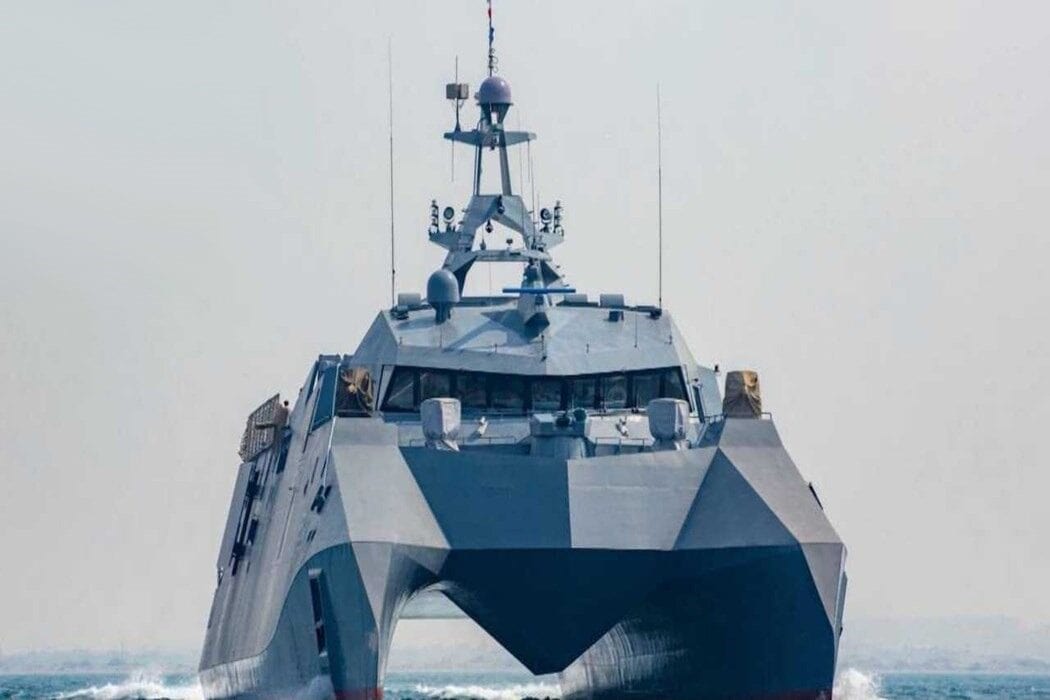
Today’s focus is another class of vessels in Iran’s naval forces: the Shahid Soleimani-class corvettes. At the outset, it is worth noting that Iran has (or had) two navies. One is the conventional navy within the armed forces (including, for example, the ‘destroyers’ of the Moudge-class and the Bayandor-class corvettes). The other operates under the Islamic Revolutionary Guard Corps (IRGC). The vessels discussed here belong to the latter.
The ships of the Shahid Soleimani-class are built on a catamaran hull design. Today, this configuration is widely used for high-speed ferries, but it remains uncommon among warships. Missile boats using this design can, for instance, be found in the navies of both China and Taiwan. Iran, however, has been developing catamarans consistently. In 2016, the IRGC Navy commissioned the high-speed transport catamaran Shahid Nazeri, which appears to have served as a prototype for the Shahid Soleimani, commissioned on February 19, 2022. This vessel, like others in the series, was built at the Shahid Mahallati shipyard in Bushehr. On February 19, 2024, the IRGC commissioned two more ships in the class — Shahid Bagheri and Shahid Sayyad Shirazi. Finally, Shahid Rais-Ali Delvari entered service on February 27, 2025. However, this date is questionable, as the vessel was already leading a four-ship detachment that visited the port of Sharjah (UAE) in early February. It was therefore likely commissioned no later than January 2025. The ships carry hull numbers FS313-1 through FS313-4.
The exact specifications of the Shahid Soleimani have not been officially disclosed. Its length is estimated at 65–67 meters, with a beam of around 14.5 meters. The vessel is powered by four domestically produced diesel engines. Its top speed is approximately 32 knots, with a range of up to 5,000 nautical miles.
The armament of the Shahid Soleimani-class shows a clear emphasis on missile systems, with a minimal artillery component and no anti-submarine capability. In this respect, the ships are closer in concept to Soviet small missile ships than to Western multi-role corvettes.
A closer look at available imagery reveals two types of vertical launch systems. Two triple-cell modules are likely designed for Sayyad-3G surface-to-air missiles (with a reported range of up to 150 km), while four larger cells appear intended for Abu Mahdi cruise missiles (named after the Iraqi militia leader Abu Mahdi al-Muhandis, killed by a U.S. strike in Baghdad on January 3, 2020, alongside Qasem Soleimani, commander of the Quds Force).
👁 Комірки вертикальних пускових установок на катамарані Shahid SoleimaniSix launchers for anti-ship missiles are mounted on either side of the superstructure: four Ghadir missiles (range up to 300 km) and two Nasr-1 missiles (a copy of the Chinese C-704, with a range of about 35 km).
The artillery armament is minimal: a single 30 mm gun and four 20 mm triple-barreled mounts (based on the American M197).
The vessel features a large helicopter landing pad but no hangar. Beneath the pad is storage space for three high-speed boats.
Shahid Soleimani-class corvettes have been actively involved in exercises. Notably, Shahid Sayyad Shirazi participated in the “Smart Control of the Strait of Hormuz” drills in February 2026, followed by joint exercises with the Russian Navy in the Gulf of Oman. However, U.S. strikes in March 2026 may have resulted in the destruction or disabling of these vessels.
👁 Уражений корвет-катамаран КВІР FS313-03 Sayyad Shirazi. Джерело: Центральне командування США.Dear readers, if you found this article of interest, you can support the author here: https://buymeacoffee.com/andrijkhar9
PrivatBank: 5168 7456 7352 6783
Підтримати нас можна через:
Приват: 5169 3351 0164 7408
PayPal - [email protected]
Стати нашим патроном за лінком ⬇
Subscribe to our newsletter
or on ours Telegram
Thank you!!
You are subscribed to our newsletter