Popular
 |
VOOZH | about |
|
VOOZH | about |
According to the Ukrainian Air Force Command, today’s missile attack was the first time that the Russians used an “intercontinental ballistic missile” and fired it at Dnipro.
This is in line with last week’s announcement about the test of the RS-26 Rubezh missile scheduled for today.
So what is this “tool”?
The RS-26 “Rubezh” is a missile whose declared characteristics (maximum range of 6000 km) are subject to the limitations set by the Intermediate-Range Nuclear Forces Treaty. Under this treaty, such a missile has no right to exist at all. But when have the Russians ever paid attention to international agreements?
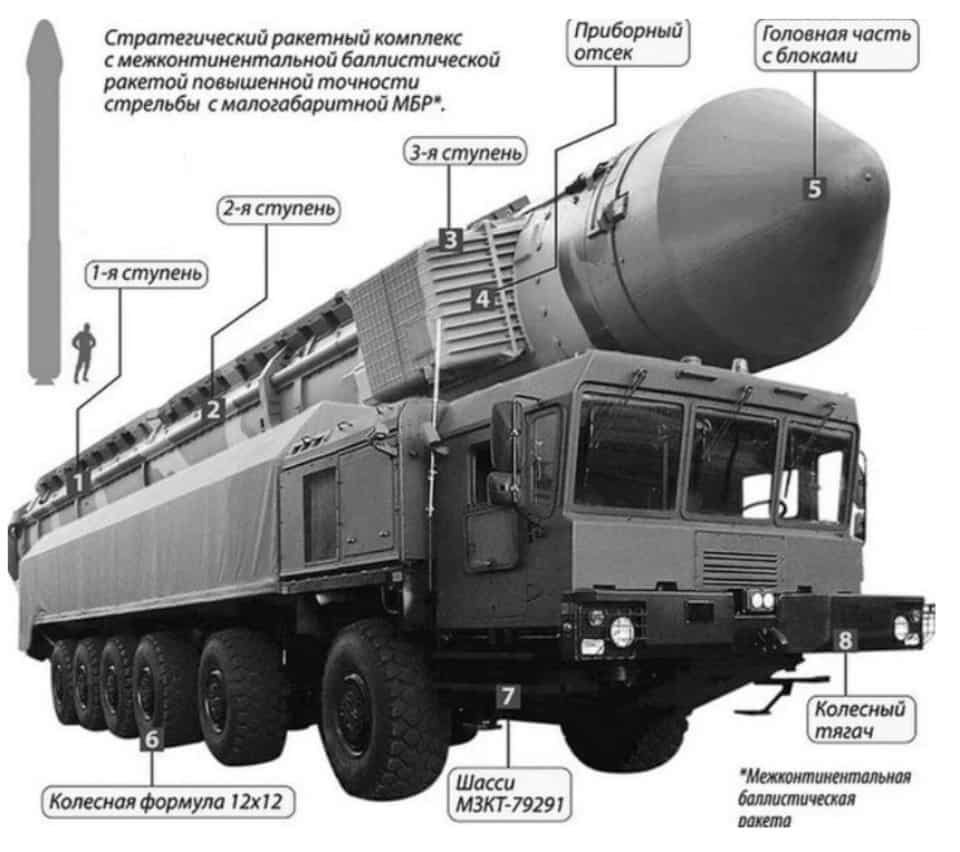
The RS-26’s design is believed to have been launched in 2006 and followed a proven path: two stages of the Topol three-stage ICBM were used to create this missile.
Half a century ago, the Soviets used this approach to create the RSD-10 Pioneer intermediate-range ballistic missile, which is based on two stages of the Temp-2S ICBM.
Notably, the developer (Moscow Institute of Thermal Technology) and manufacturer (Votkinsk Machine Building Plant) of the Rubezh remained the same as the Pioneer, so the continuity of design and technological solutions would seem quite logical.
Test launches of the RS-26 began in 2012 (according to other sources, in 2011). It was planned that the deployment of the RS-26 would start in 2017. However, in 2018, the Russians announced the exclusion of the Rubezh system from the state arms program until 2027.
According to published data, the RS-26 is 23 meters long and 2 meters in diameter. The missile weighs 40-50 tons (more precise data have not been published), and the entire launch system (a self-propelled launcher on a six-axle MZKT-79291 together with the missile) weighs 80 tons. For comparison, a self-propelled launcher with a Topol-M ICBM weighs 120 tons.
As far as we know, the Rubezh was designed exclusively for nuclear weapons. Its warhead weighing 1000-1200 kg should be equipped with several (three to six) individually guided warheads with a capacity of about hundreds of kilotons (most often, 3-4 warheads of 300 kt each are indicated).
The Russians write, “The missile is equipped with a fundamentally new control and guidance system operating on a unique algorithm that allows it to evade dangerous objects (anti-missiles) and enter a combat course with a high degree of probability of hitting the target. Individual systems create aperiodic fluctuations in speed and direction that prevent the warhead from being hit in flight.” In any case, such a target would require very expensive and specific anti-missile systems, such as the American THAAD.
What kind of warhead did the missile fired at the Dnipro River today have? I would hazard a guess that it had none – just a massive model.
The fact is that creating a conventional, non-nuclear warhead for such a missile is pointless from an economic point of view because an ICBM (well, let’s say the RS-26 is not too intercontinental) is extremely expensive. Spending a disposable carrier weighing 40-50 tons to deliver a ton of explosives to a target is too irrational; a couple of cruise missiles will do the job perfectly. Therefore, the current launch can serve as a kind of demonstration of the technical feasibility of a nuclear strike on Ukraine.
Підтримати нас можна через:
Приват: 5169 3351 0164 7408
PayPal - [email protected]
Стати нашим патроном за лінком ⬇
Subscribe to our newsletter
or on ours Telegram
Thank you!!
You are subscribed to our newsletter