* Your list is public by default.
Alternative TitlesSynonyms: Yuu Gi Ou Shadow Games, Yugioh Duelist, Yu-Gi-Oh! Millenium World, Game King, King of Games Japanese: 遊☆戯☆王 More titlesInformation
Volumes: 38
Chapters: 343
Status: Finished
Published: Sep 17, 1996 to Mar 8, 2004
StatisticsScore: 7.721 (scored by 2182521,825 users) Ranked: #1859 2 2 based on the top manga page. Please note that 'R18+' titles are excluded. Popularity: #443
Members: 45,019
Favorites: 2,326 Resources |
Ranked #1859Popularity #443Members 45,019
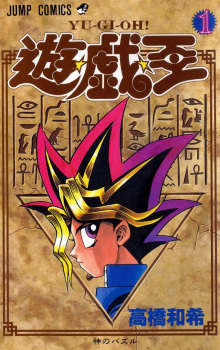
One night, Yuugi manages to solve the Millennium Puzzle, a seemingly impossible challenge that awakens his inner darkness and converts it into an alternate persona: Yami Yuugi. Transforming into the more bold and dangerous persona against his will in moments of great distress, Yuugi begins to moonlight as a vengeful vigilante, challenging bullies and evil-doers to risky games where failure results in fates worse than death.
Yuugi and his alter ego befriend some of the very students who once bullied him, forming unbreakable companionships with them. But the group must contend with villains far deadlier than the high school punks they originally rallied against, enemies who use games for nefarious purposes and threaten Yuugi and his friends' very lives.
[Written by MAL Rewrite]BackgroundYu☆Gi☆Oh! spawned Yu☆Gi☆Oh! Bandai Official Card Game in 1998 and the Konami Official Card Game in 1999. While the Bandai version was popular during its initial release in Japan, the Konami version became one of the most popular card games in the world and has sold over 25 billion cards since 1999.
The series was published in English by VIZ Media under the Shonen Jump imprint. The publishing is divided into three parts: seven volumes of Yu-Gi-Oh were published from May 7, 2003, to December 7, 2004; 24 volumes of Yu-Gi-Oh!: Duelist from February 1, 2005, to December 4, 2007; and seven volumes of Yu-Gi-Oh!: Millenium World from August 2, 2005, to February 5, 2008. A special hardcover collector's edition first volume and a 3-in-1 omnibus edition were later published, with the final omnibus containing volumes 37 and 38. The series was also released in Brazilian Portuguese by Editora JBC from July 2006 to February 2010. |
|
Side Story:
|
|
|
Spin-Off:
|
|
|
Alternative Version:
|
|
|
MALxJapan -More than just anime-
|
Reviews
Mar 30, 2025
Yu-Gi-Oh! is a franchise that, despite its overwhelming popularity, is often subject to unfair criticism. In general, there is an unwillingness to take the series seriously because “it’s just for kids,” and thus, for many, any positive sentiment about the series is reduced to nostalgia. While there is some truth to these claims, they do not justify writing off the series as a whole and undermining the feats it does accomplish. After all, a series can be an object of nostalgia while simultaneously achieving a certain level of quality (think Cowboy Bebop or Princess Mononoke); likewise, one could argue that the whole shonen demographic is
...
“just for kids,” yet this ‘criticism’ fails to come up amid discussions of One Piece or Hunter x Hunter – two manga that ran alongside Yu-Gi-Oh! in Weekly Shonen Jump. I suspect that this misconception is rooted in a common experience with the franchise: most people have only been exposed to the 4Kids’ dub of the Yu-Gi-Oh! anime, a highly censored version of an already questionable adaptation. What’s more, most people have only experienced the series as a child, a time in which one’s interpretive faculties are the least developed. It is only natural, then, that for those whose only experience with the franchise is of a censored dub of a questionable adaptation at a time when their interpretive faculties are the least developed that they struggle to entertain the idea that Yu-Gi-Oh! could actually be a well written battle shonen – but that is precisely what it is.
The first seven volumes take on a largely episodic structure: each week, a new villain appears doing something villainous, Yugi challenges them to some sort of game, beats them, then saves the day. Generally, this sort of formula grows tired quickly, but that is not the case here. Takahashi's original intention was to write a manga about "a weak and childish boy who becomes a hero when he plays games." In this way, the manga was Takahashi's means of exploring his love for games, using them as a vehicle through which an average Japanese schoolboy could mature and establish their own identity. To what extent he accomplishes this in the first part is questionable, but what is clear is how this love for games translates into each chapter, keeping readers engaged during the entirety of the first part. Each week, Takahashi creates a unique game for Yugi and company to participate in. The episodic structure works because each game is given an appropriate amount of screen time: no one game overstays its welcome, and if one game does not interest you, it will be gone in the following week. What's more is many of these early games have surprisingly high stakes. In chapter four, for example, an escaped prisoner holds Anzu at gun point. Yugi challenges said prisoner to a game, wherein each participant may only move one finger – a seemingly simple and benign 'game' (if you can call it that). The prisoner chooses his index finger, so that he may pull the trigger on his gun, while Yugi chooses his thumb. The reason for this is not clear until the next page: the prisoner has an unlit cigarette in his mouth. Yugi offers to light it for him, and as he reaches over the table, he places the lighter on the other hand of the prisoner, which is pouring a glass of alcohol. The situation is thus: the prisoner cannot fire the gun, as the recoil would knock the lighter into the alcohol, setting him aflame. This creates an opportunity for Yugi to escape with Anzu, leaving the prisoner to eventually drop the lighter, burning him to death.
The beauty of this scene is twofold. For one, Takahashi has proven that every move in the manga is calculated. Earlier scenes of the prisoner drinking and smoking were not only to establish certain character traits, but calculated steps that would later be integrated into the game / conclusion of the story. This sort of situational awareness is one of Takahashi's greatest virtues, as it allows him to unify various, seemingly arbitrary elements of a chapter into a cohesive ending. For another, this also demonstrates that Yu-Gi-Oh! is not merely some manga about a children's card game with no stakes: many of these games end in the death / near death of a character, which Takahashi is not afraid to depict (unlike the anime counterpart).
Despite my seemingly endless sea of praises for the first part of the manga, there are a couple of issues I would like to highlight, above all being the character writing. While some earlier dynamics are done with a great level of care (for example, Honda's transition from Yugi's bully to his friend, and his hesitancy to fully commit to the friend group because of his fear that Yugi holds a grudge against him), much of the characters are fairly stock. I am willing to forgive this, as Takahashi himself intended on creating a "normal Japanese schoolboy," which we will see developed in subsequent parts, but as they exist in isolation in part one, apart from the rest of the story, they can come off as generic, especially to a more modern reader who has been overexposed to many of these archetypes. The other major issue (and one that will plague the series as a whole) is that Yugi constantly feels undefeatable. Again, this is not a problem in-and-of-itself; rather, it is only when these victories do not feel justified, and at least in part one, Takahashi takes great care to come up with unique solutions to the games he creates, giving the reader the impression that Yugi genuinely had to think his way out of the game, and hence, that the victory is deserved. This is not always the case, but I would like to think that in part one, it is not as big of an issue as it will become.
Yu-Gi-Oh! Duelist takes up the majority of the series, constituting almost two thirds of the manga. It should come as no surprise, then, that it contains both the highest highs and lowest lows of the series. This section begins with the famous Duelist Kingdom, spanning chapters 60 to 133. This is, for all intents and purposes, the pinnacle of Yu-Gi-Oh! as a battle shonen. To understand why, a brief summary is in order. Duel monsters (the game) starts as a collaboration between Industrial Illusions (an American company headed by Pegasus) and Kaiba Corporation (a Japanese tech company headed by Kaiba). When Kaiba enters into a coma (in part one), Pegasus plots to take over the company by going to the five biggest shareholders and convincing them to let him assume the role of CEO. The issue, however, is that the value of the company is contingent on Kaiba being the king of games, but since his defeat to Yugi in part one, their value has plummeted. As such, Pegasus suggests holding a tournament with the intentions of defeating Yugi, making him (Pegasus) the new king of games. These "big five" would then accept him as their CEO, as it would allow them to restore their value as a company. While this context is laid out in the anime, the manga emphasizes it in a way that better structures the arc, giving all the actions within it more purpose. By contrast, the anime can often come across as a mere series of duels with individual characters having their own motives but no significant overarching meaning.
The real virtue of Duelist Kingdom, however, is its approach to duel monsters. The game officially debuted in chapter 9 of part one, where it took on a fairly privative form: using a variety of monster and spell cards, reduce your opponents life points to zero. When the game returns in Yu-Gi-Oh! Duelist, it is largely under this same privative guise, but now with even more cards and longer duels. What makes Duelist Kingdom great, however, is that unlike the real life card game, with its standardized rules, the manga featured a much more flexible ruleset. The advantage of this is that Takahashi could focus on creating more unique card interactions that make duels both interesting and unpredictable. For instance, in Yugi's duel against Ryota Kajiki, the ocean field spell gave Ryota's water-based monsters a huge advantage; however, Yugi – in a move that can only be described as pure genius – decides to attack not any one of Ryota's monsters but the moon. As a result, the tide of the ocean drops, revealing and weakening Ryota's monsters, allowing Yugi to win. It's this kind of situational awareness that Takahashi excels at: taking otherwise mundane details from a chapter, like the location of a duel or the time of day it occurs, and incorporating that into a strategy for the duelists to use. These unique card interactions introduce more nuance into the battles; unlike the actual card game, where the outcome of a battle is determined by the monster with the higher attack, the manga utilizes these unique interactions, which introduce the possibility of a weaker monster winning – with a bit of strategy. While such examples might seem like an 'ass pull' from the perspective of a modern reader whose familiarity is limited to the real life card game, this flexibility is precisely what makes the earlier duels much more exciting.
On the whole, I have very little to complain about with regards to Duelist Kingdom. Here, we start to see some of the characters breakaway from the shackles of their earlier, generic selves, and we are given a whole host of interesting duels, all packaged within this corporate-political drama. It begins to foreshadow a lot of future developments, especially with respect to the ancient lore behind the game and how Yami Yugi is connected to it all, and overall, it is a pleasure to read. However, it is not perfect. As previously mentioned, Yugi still feels unbeatable. While there are many instances in which his victories are well earned, here we start to see Takahashi employ the 'power of friendship' troupe at a much higher frequency than before. While this is not inherently bad, it becomes quite repetitive and can leave readers with a bad taste in their mouth (especially seeing Jonouchi win his millionth duel through the power of friendship).
Duelist Kingdom is then followed by a brief (albeit fun) arc, Dungeon Dice Monsters, which covers chapters 134 to 145. While this arc has no real significance outside of introducing a new member of the cast, Ryuji Otogi, it is a nice detour for both Takahashi – who likely desired a break from drawing just duel monsters and wanted to further explore his passion for all-things-games – and the reader – who, likewise, could use a palate cleanser from all the card games.
The second major saga in Duelist is Battle City, which covers chapters 146 to 201 (or 278 if you include the Tournament Finals). For many, this arc is paradigmatic of what Yu-Gi-Oh! is all about, and understandably so: it maintains a healthy balance of all the dueling fun from Duelist Kingdom, with the stakes of part one, and the Egyptian lore of Millennium World. Here, we also start to see some major developments in the rules of the card game: monsters above level four require tributes, fusion monsters cannot attack on the turn they were summoned, and so on. This brings the manga's card game more in line with the real life card game (admittedly, not by much). More importantly, however, it also helps mitigate a pressing issue for all battle shonen, namely, power creep. In Duelist Kingdom, players could summon their most powerful monsters for free: Dark Magician, Blue-Eyes White Dragon, and Red-Eyes Black Dragon, despite their enormous strength, required zero sacrifice. This was not a huge issue then, as the difference between the weakest and strongest monsters was not so great, and further, because of Takahashi's approach to the game, there was always the opportunity for a weaker monster to defeat a stronger one through some clever strategy. However, this is not the case in Battle City, where the difference between a God card and even the previous strongest monsters is monumental. Hence, tribute summoning presents such monsters with a much needed check.
On the topic of duels in Battle City, something else must be said: unlike Duelist Kingdom, where duels were largely settled by unique card interactions, Battle City attempts to situate most of its duels within the bounds of the established ruleset. As a result, there is much more spell and trap card play than in Duelist Kingdom, but much less outside strategy. The difference between the two is perhaps best explained through a hypothetical example: in Duelist Kingdom, Yugi attacked the literal moon, but in Battle City, he would have activated a spell card that destroys the moon card. While the outcome is similar, the Duelist Kingdom style presents itself as a sort of outside-the-box thinking: Yugi had to figure out that the moon was affecting the tide, giving Ryota an advantage, and that destroying the moon would reverse this effect, allowing him to win; conversely, the Battle City style already tells Yugi that the moon is giving Ryota an advantage, and he has to hope that he can draw a card capable of destroying it. While he still has to come up with the idea himself, it often feels like he is simply lucky enough to draw the exact cards necessary to complete the combo. The reason I mention this difference in style is because of how it amplifies a previously established problem: Yugi's undefeatable-ness. Although Yugi is not literally undefeated, he has this presence of "I am the protagonist, so I will ultimately win at the end of the day." As previously mentioned, it is not inherently problematic if it feels like he earns the win, which in Duelist Kingdom, he often did through his on-the-fly thinking, but now in Battle City, where luck plays a much larger role, some of his wins can feel less justified.
While the quality of dueling starts to tapper in Battle City, a greater emphasis is placed on developing individual characters to new heights. Of particular significance is the dynamic between Yugi and Yami Yugi. While the two have co-existed in unity over the course of the story, Yami Yugi is slowly confronted with the reality of his past life, forcing Yugi to wrestle with the reality of his difference from Yami. Here we find the seeds of Takahashi's original intention start to blossom: Yugi, as an average Japanese schoolboy, begins to wrestle with his identity as distinct from Yami's for the first time in a serious way. We will not see the resolution of this internal tension until the end of the series, but it is clear that the longer Yu-Gi-Oh! goes on, the more of a character-based drama it becomes.
Yu-Gi-Oh! Millennium World is the part for which I have the least to say. As I have mentioned, the trajectory of the manga, especially post-Duelist Kingdom, is to focus less on the duels and more on developing individual characters, and in particular, Yugi and his relationship to Yami. That is not to say that the duels are somehow less important in Millennium World – after all, the arc is perhaps best understood as a history of duel monsters – but rather, it is clear that Takahashi's emphasis is now on finishing the character arc he started all the way back in part one. Millennium World picks up with Yugi's identity crisis in Battle City, and amplifies it tenfold by literally splitting Yugi and Yami apart, forcing the two to grapple with who they are as an individual. Their journey to uncover the truth of Yami's past and where that journey takes them is handled with the same level of sophistication one would expect from Takahashi at this point. However, because this is the climax of the series, and a climax which differs in meaningful ways from the anime adaptation, I have opted to keep my remarks here practically non-existent; instead, I hope that what I have said up until this point has convinced you to read the series, so that once you get here, you, too, will be able to understand what makes Yu-Gi-Oh! special.
Reviewer’s Rating: 10
What did you think of this review?
Apr 6, 2023
By far, the most interesting aspects the Yu-Gi-Oh manga are the first 7 volumes, which are an interesting cross section between a gambling and horror story. This series really hit the ground running. The story then goes on to arcs that would be familiar to those who watched the anime, but probably has a better ending than the anime that really gets into the backstory and lore in ways the anime never really touched or explored. I definitely recommend the first 7 volumes for everybody. The duelist portions are best for those who want to experience the anime with a slightly darker take on the
...
story. The millennium world is good for people who watched the anime attentively and want more details.
Reviewer’s Rating: 7
What did you think of this review?
Mar 21, 2025
Not Recommended
Preliminary
(119/343 eps)
First things first: Before this, I had absolutely zero exposure to this work or the franchise. I've neither watched the anime (yes, not even as a child), nor collected the trading cards, nor had anything else to do with it. So there's no nostalgia factor here; I'm approaching this series completely neutrally, experiencing it for the first time, knowing it only from hearsay.
Well, how should I put it… The manga hasn't really convinced me. In other words, it hasn't met my expectations at all up to this point. However, I'm not saying the manga or the series is outright "bad" - no, in fact, I
...
think it has some genuinely cool and positive aspects (for example, the art style, paneling, smooth reading flow, and some genuinely awesome monster designs) - but Yu-Gi-Oh! just has several problems that left me cold, to the point that I haven't continued reading the manga in weeks.
The most obvious issue, in my opinion, is the very first arc, the first roughly 60 chapters. This arc is episodic, lacking a clear structure, with no visible common thread. Funnily enough, the card game isn't even the main focus here; there are only two duels in this entire arc - the rest consists of other, rather trivial games.
And that's precisely the problem: This arc feels incredibly unnecessary for the manga's subsequent development, almost like an extended filler. My impression was that the mangaka didn't initially know where he wanted his story to go, resorting instead to an episodic and, unfortunately, somewhat boring structure. In my view, this was a mistake (and no, I usually have no problem enjoying episodic anime or manga). Interestingly enough, I wasn't the only one feeling this way, since the animation studio responsible for the anime adaptation skipped the first arc entirely. While many manga fans dislike this decision, I actually support it. Perhaps they also omitted it because Yami Yugi was admittedly quite brutal and physically harmful toward people in the early chapters - but that doesn't change the validity of my earlier points.
The second major issue for me is the character cast as of chapter 119. I find it incredibly weak and poorly executed:
Yugi and Yami Yugi each seem to have only one or two characteristic traits, which they continuously exhibit. There's absolutely no depth - even by Shonen standards, it's excessively shallow - and I doubt it'll improve much. After over 100 chapters, there's barely any character development, and beyond their cool designs, these two characters offer me nothing... really, absolutely nothing.
Female characters are practically nonexistent, and it feels like Anzu only exists to slightly increase the female representation in this series. Yet even she remains flat, boring, monotonous, and exhibits only a single character trait. Again, by Shonen standards, this is utterly insufficient.
The only characters showing any hint of "character development" up to chapter 119 are Katsuya and Hiroto - but their development, which took its place at chapter 1 (!), makes absolutely no sense. I just can't understand how these two bullies, who previously tormented Yugi, suddenly became friendly people merely because Yugi rescued them once. Either I'm being too harsh, or this rushed and senseless development really is that bad. And again: apart from this, they remain incredibly flat, dull, and uninspiring.
Seto Kaiba is seemingly the only character I find somewhat interesting and cool. However, having just one decent character in a broader cast after over 100 chapters is terribly weak and insufficient for me.
The second arc, where I'm currently at, is decent - but nothing more. Initially, I thought it could easily rival Naruto's Chunin Exams, given the similar concept—but no, Yu-Gi-Oh! unfortunately can't even come close to that level.
The duels themselves are cool and occasionally really exciting, but this excitement quickly vanishes once you realize that Yugi has somehow won every single duel so far. The outcome becomes predictable after a while, making future duels involving Yami Yugi entirely boring. I mean, we're talking about a card game here… is it really that difficult to let the protagonist lose just once!? These aren't real, physical fights, after all.
The card game itself is okay so far, but nowhere near as spectacular as the community describes and praises it to be. This aspect hasn't really convinced me either. The only plus, as mentioned earlier, is the cool monster designs.
I'm putting the manga on pause for now and will only continue reading when I genuinely feel like it. However, whether that time will ever actually come - I seriously doubt it.
Reviewer’s Rating: 5
What did you think of this review?
Poll: Yu-Gi-Oh! Chapter 1 Discussion
thecatchphrase - Jan 20, 2012 |
16 replies | by Regular_Viewer »»
Mar 2, 12:43 AM |
Poll: Yu-Gi-Oh! Chapter 21 Discussion
DeleteThisShit - Jul 27, 2014 |
4 replies | by Lucifrost »»
Jan 16, 6:46 PM |
Poll: Yu-Gi-Oh! Chapter 42 Discussion
DeleteThisShit - Jan 4, 2015 |
4 replies | by BluaPapilio »»
May 24, 2025 9:48 PM |
Poll: Yu-Gi-Oh! Chapter 41 Discussion
DeleteThisShit - Jan 3, 2015 |
4 replies | by BluaPapilio »»
May 24, 2025 9:47 PM |
Poll: Yu☆Gi☆Oh! Chapter 49 Discussion
removed-user - Jul 21, 2019 |
2 replies | by BluaPapilio »»
May 24, 2025 9:37 PM |
|
|




.jpg?ver=835bcf6a9114326fa7a699bd76ae21aa9671d484)