* Your list is public by default.
Alternative TitlesJapanese: 無職転生 ~異世界行ったら本気だす~ English: Mushoku Tensei: Jobless Reincarnation Information
Volumes: 26
Chapters: 330
Status: Finished
Published: Jan 23, 2014 to Nov 25, 2022
Serialization:
None
StatisticsScore: 8.821 (scored by 4422644,226 users) Ranked: #43 2 2 based on the top manga page. Please note that 'R18+' titles are excluded. Popularity: #162
Members: 101,407
Favorites: 9,219 Available AtResources |
Ranked #43Popularity #162Members 101,407
Now gifted with a tremendous amount of magical power as well as the mind of a grown adult, Rudeus is seen as a genius in the making by his new parents. Soon, he finds himself studying under powerful warriors, such as his swordsman father and a mage named Roxy Migurdia—all in order to hone his apparent talents. But despite his innocent exterior, Rudeus is still a perverted otaku, who uses his wealth of knowledge to make moves on women whom he could never make in his previous life.
[Written by MAL Rewrite]BackgroundMushoku Tensei: Isekai Ittara Honki Dasu is a web novel that was serialized on Shousetsuka ni Narou website from November 22, 2012, to April 3, 2015. It made repeated appearances on the site's rankings as the most popular work during its serialization. Media Factory published the first volume on January 23, 2014.
The series was published in English as Mushoku Tensei: Jobless Reincarnation by Seven Seas Entertainment under the Airship imprint from May 21, 2019, to March 12, 2024, and as deluxe hardcover 3-in-1 omnibus volumes since November 25, 2025. It has also been released in Italian by Dokusho Edizioni since July 26, 2024. | |
|
MALxJapan -More than just anime-
|
Reviews
Oct 22, 2023
Mushoku Tensei: A Fulfilling Journey about a Broken Person’s Second Chance at Living.
Seeing that the light novels are officially done in Japan, I wanted to ramble a bit here and give my thoughts on a series that was initially one I dropped, to end up being one of the best series I have read of all time and one that played a big part in impacting my life forever.
STORY
This series is not a straight-up ‘redemption’ journey, it is about Rudeus living a life with no regrets and trying to live in a satisfactory way by the end without wasting his chances. It is not about
...
him being whitewashed to being a perfect human being with zero flaws but growing amidst them and learning from his mistakes to do better and find a real purpose in his life, and stick to it as much as possible.
Knowing that, Mushoku Tensei is an exceptional story that serves as not just a character journey for Rudeus Greyrat’s life in his second chance in this new world, but as a prequel to something even potentially greater down the line. It is a series that explores Rudeus’ character in tons of depth, and progresses well over time with him constantly aging and growing – which prevents the series from ever feeling stagnant for me, as there was always a sense of direction with what the story wanted to accomplish. But it is also a series that fleshed out its worldbuilding and lore so immensely that the world felt alive when reading through the books and I was immersed in the little details of each continent and the cultural differences between all of them, and a series that also features plot elements and twists that are phenomenally executed and written in a way that Rudeus is only a part of the world and what is happening, not being the main guy the world is revolving around.
This is a series that excels too in being many different things. It can be a great adventure story like how the Dead End crew were traveling from the Demon Continent all the way back home, or a great slice-of-life story exploring Rudeus living his daily life and getting to actually spend time with people outside and bonding with them naturally, or even his chapters as a parent. It can be a dramatic, action-heavy story, or a purely emotionally complex one like with the whole Paul-Rudeus reunion in Volume 5. The series tackles many themes, and many different tones at different times and pulls them all off really well. Nothing feels forced, there’s genuine nuance and thought-provoking elements to them that made the story feel even more hearty and polished than what I was expecting early on.
The magic techniques, the hearty character interactions and moments, the excellent fights that were well-paced too alongside the detail, the great sense of progression and development for characters and the storytelling, and great payoffs too for character and narrative arcs too throughout this series as a whole. Mushoku Tensei always offered something different with each volume and excelled for the most part in whatever it was trying to accomplish narratively and emotionally.
Rifujin na Magonote’s writing shined immensely here overall, and by the end, I was left satisfied with his work and the journey of this series completely. There are just too many elements to this story besides just Rudeus’ development that shines here, so I can only praise how good the writing and storytelling were from start to finish. Everything felt so well thought out that a part of me felt like he crafted the world and many plot points before he even began writing about the main character and his story to come. It’s not something I can compliment often for any series, let alone an isekai-based series (which I normally hate in general). Even the 26-volume length it had felt just about right, the series never felt rushed, nor did it feel stagnant, just exceptionally paced and, consistently fun and engaging throughout.
CHARACTERS
Mushoku Tensei is superbly written from the narrative elements and underlying storytelling and buildup to the future series to come, to the well-thought-out, detailed and immersive world-building that makes the series and world feel real and alive. But what shines for me more than anything are the characters in Mushoku Tensei, especially one very controversial and complex protagonist in Rudeus Greyrat.
Rudeus Greyrat in his previous life was a broken human being. An overweight, demotivated, and depressed person who was locked in his room for decades after facing intensive bullying and trauma, to the point of being a reject in society in his eyes, and relying mainly on games, eroges, and anime to help him just live through. A guy that was living but felt dead on the inside and lost his ability to communicate and bond with anyone properly, and a guy who was terrified of the outside world too. He was a person with a ton of regrets about how he wasted decades of his life from being spineless to turning to help and finding the strength to give his life a second chance right there.
It's easy to understand why a lot of people hate Rudeus, especially for his perverse tendencies (early on in particular). Since he was drowned in many eroges, hentai, and anime for decades, his social skills and treatment of women were really poor early on and he thought of his second chance as a way to do whatever he wants with no genuine consequences, like a video game.
But it is when he makes mistakes that hurt others when he experiences pain in this world and realizes and reminds himself constantly how much a second chance is meaningful to him, that kept him pushing forward and enabled him to grow and mature as a character. His development does not turn him into a saint and a guy with no flaws whatsoever, but he does develop into a pretty outstanding and morally complex character as a whole. A guy who knew he was scum in the past but is living a second life to just feel satisfied and gain closure in a way that he never got to do in the past. To stop blaming everything on others and realize how much accountability he needs to take with his own actions, to go from taking advantage of his parents and thinking of them as evil, to being a father himself and understanding what they went through and how he needs to be in the future to avoid situations like that. To use mistakes as stepping stones to becoming a better person in this world and living a life that he can feel satisfied with by the end, regardless of how flawed or bumpy it can be at times. He does not care to be the strongest person ever just for fun, he grows in a way where he wants to protect and cherish his family in this world, the people that help give him happiness, and more reasons to live. Considering how he failed to communicate at all with anyone in his past for a long time, pushed his frustrations to others, and struggled with his treatment of women early on, he really did grow leaps and bounds by the end in a believable manner without just whitewashing every single trait of his in the past.
He was definitely an unlikeable person to me early on, but even before this series, I always believed that unlikeable characters can still be phenomenal characters, and Rudeus is one I could call a phenomenal character by the end. He might not have grown in ways some people might expect with a ‘redemption’ story, but the whole point of this story is to learn from his mistakes and grow from them to live a proud, satisfying life in this new world. Even if some of the morality and relationship elements clash with our world and their standards nowadays.
Beyond him, the other characters feel incredibly fleshed out and are enjoyable to read through, especially given how many of them are as morally complex to read like Rudeus. Eris was a spoiled brat who mistreated everyone when nothing went her way and was abusive, Ruijerd was a person that went to overly extreme lengths to fulfill his promises in a stubborn, clouded fashion, without trying to understand the kids and their strengths himself. Paul was incredibly talented but was lazy to fulfill his potential in the past, and a sleazebag who still was trying to be a good dad despite not being mature enough early on to understand how to tackle that situation (especially with him having a son like Rudeus who was mentally older than he was). So many characters have complex issues or flaws, but despite them, still manage to grow, develop and live in ways that feel satisfying for me to read through. Besides Eris, Roxy and Sylphie are also fantastic heroines, and the other side characters were great too. None of the development elements felt forced too in this story, all were subtly done without having any character feel static whatsoever.
One real aspect I loved, was how fleshed out each character felt and how I can easily imagine the journeys everyone were undergoing even when the series hadn’t focused on them for a long time. The series focuses mainly on Rudeus, but the writing is so strong, that I can imagine many of these characters be protagonists of their own series in this world. There are Eris and Roxy manga spinoffs for example, but those can be applied to Paul and his past journey as an adventurer with his party, Ruijerd and his journey of redeeming the reputation of the Sperds, Norn and her journey to find her worth amidst her two more talented siblings, Orsted and his journey, etc. That is a good indication of how well these characters were written and treated, all having depth, realism, and great development elements to read through. For such a complex and dysfunctional cast on the surface, this series has one of the best groups of characters I have read in light novels for sure.
ART
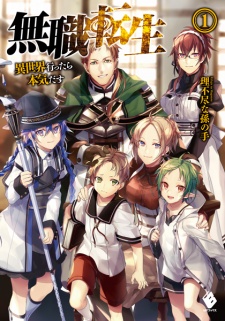
Like the story and characters, one huge way that the series evolved over time was with Shirotaka's art. The illustrations and volume covers early on were solid for the most part. But the illustrations from Volume 7 I would say onwards, went from solid to amazing and complimented the growth and progress of Rudeus' journey extremely well. Seeing illustrations of Rudeus and his family in the first volume, to how much they grew alongside the quality of their art was outstanding and even made me emotional when reflecting on the illustrations after finishing the series. In general, the art is fantastic, evokes tons of emotions well and captures the storytelling well. The art really benefitted from this series having their characters grow up, that's for sure. There is even a map, which is nice to have for a series that does a great job with its world-building in general. Just comparing the earlier covers with the ones by the end can tell how well the art evolved with time.
FINAL THOUGHTS
"You only realize the real value of something you discarded when you get the chance to pick it up again." - Rudeus Greyrat
That quote summarizes my experience with Mushoku Tensei. I was one of those people that picked up the series without warnings, read the start of it, and felt grossed out to the point of dropping it early. But I gave it a second chance and moved forward through the difficult times and what I got by the end was a personal, gripping, and emotional rollercoaster of a story, filled with tons of adventure, action happiness, heartbreak, complicated moments, and more importantly, tons of heart.
As a guy who was a shut-in for a couple of years and felt like there was no hope for me to recover the rest of my life and even had no willpower to brush my embarrassment aside and communicate with my loved ones about the depression and anxiety-riddled years I went through, this series opened my eyes and gave me that strength I needed to let go of my pride and open up to everyone. And to find the motivation to not give up while I still have the chance to live and push forward. To wake up and take a step. Even if the road down the line continues to be extremely bumpy and motivations might lose a bit of strength from time to time because of that, it is still important to never give up and still find a way to enjoy life. Don't aim for a perfect life with no mistakes, but a life where I can feel satisfied by the very end. Because of this series, I finally gained the confidence to abandon being a perfectionist, speak to my family after ignoring them for years, and not wallow in my self-pity anymore and grow up.
To that, I'm grateful that I got to read this series and glad to have experienced the complex, bizarre yet touching, endearing, empowering, and genuinely life-changing journey that is Mushoku Tensei. It makes me happy that I gave it a second chance, to see what value this series offered underneath all the layers of controversial elements that people criticize deeply on the surface (sometimes even superficially or untruthfully, without adequately exploring what the series was trying to portray and using stuff out of context to make the series’ image look even worse in the process). It’s definitely not for everyone, and I would not recommend it casually for anyone to read, but it is still one I would proudly call my favorite series.
A massive thanks to Rifujin na Magonote-sensei and Shirotaka-sensei for their wonderful series here, can’t wait to see the Redundancy portion be adapted and see where the franchise as a whole goes from here.
Reviewer’s Rating: 10
What did you think of this review?
Apr 22, 2025
Before diving into this review, I want to make it clear that I’m not here to praise or condemn Mushoku Tensei based on personal discomfort. The discourse surrounding this series often falls into two extremes: either labeling it along the lines of “MUSHOKU TENSEI IS DISGUSTING AND ANYONE WHO ENJOYS IT IS WORSE THAN SCUM,” or the contrary that claims “MUSHOKU TENSEI IS A DEEP AND MEANINGFUL JOURNEY AND ALL OF YOU HATE IT BECAUSE Y'ALL ARE SENSITIVE SNOWFLAKES.” It is either irredeemably vile or praised as a misunderstood masterpiece. I intend to take a more balanced approach while addressing the controversy that surrounds it.
...
My goal is to inform readers who are considering giving Mushoku Tensei a try and maybe offer each side a wider perspective.
The reason Mushoku Tensei inspires such polarized responses is because it attempts to be more than just another escapist fantasy. It positions itself as a story about redemption–a character-driven narrative set in a world that gives its protagonist a second chance at life. However, before exploring whether it succeeds in that goal, it’s important to acknowledge its foundations.
Mushoku Tensei is undeniably trite. It borrows heavily from familiar tropes and themes common in the isekai genre, often prioritizing appeal over originality. Yet, author Rifujin na Magonote succeeds in crafting a protagonist with a coherent and believable backstory, whose motivations align with his character. The world–though formulaic–shows effort in its historical, cultural, and political layers, providing a solid narrative foundation. In terms of isekai, Mushoku Tensei is arguably one of the best. But given the generally low bar in the genre, that claim comes with an asterisk.
Isekai as a genre has a reputation for being derivative and formulaic in nature. The premise limited to ideas around a reincarnated protagonist with a purpose–be it slaying a demon lord or simply indulging in fantasy wish-fulfillment without having a conceivable plot. Mushoku Tensei could’ve easily fit into this description, but it did something different. It used the idea of reincarnation to create something meaningful: redemption. However, it ultimately fails to do so through reckless writing decisions.
Mushoku Tensei is, first and foremost, a redemption story. It doesn’t try to hide that–even marketing itself as such. A protagonist portrayed as an unforgivable bastard in his previous life and shows his regret in life living as a deadbeat. At his lowest, he decided to do one last act of humanity before Truck-kun claimed him as another victim, and lo and behold, he reincarnated in a new world where he can start anew. Unfortunately, that ambition is also where the narrative stumbles. Though Mushoku Tensei is built around the idea of personal growth and atonement, it often undermines its own premise through inconsistent and at times questionable writing decisions. This disconnect between intention and execution forms the core of the controversy surrounding the series.
Rudeus as a Character: Addressing the Controversy
As mentioned, Mushoku Tensei is a controversial title. Before diving into the story, I want to address the controversy. Feel free to skip ahead if you'd prefer. The backlash mainly stems from two things: the main character being a pedophile and the author’s objectification of women—especially children. While these themes are common within Japanese light novel media, Mushoku Tensei is centered on redemption, making these writing decisions especially questionable.
Pedophilia is evil. I think everyone can agree on that. I won't be deconstructing pedophilia as something to be taken personally nor provide thought-provoking commentaries about its evil. It is a sensitive subject, and whether or not it deserves credence in Mushoku Tensei's narrative is still debated. Yes, disturbingly creepy scenes are all over the novel series, but that doesn't decide its overall worth. If personal incapability to cope with unsettling scenes decide a poorly-written story, then works like Nabokov's Lolita would be dismissed, regardless of its critical acclaim. The key lies behind the author’s intent and how they handle a subject matter. For instance, in Lolita, Nabokov uses pedophilia to reveal the true moral decay of a character, all while weaving a deeper narrative without normalizing their behavior. Similarly, The Monogatari Series exaggerates its portrayal of such themes as a form of satire. In Mushoku Tensei, Rudeus’ damning flaws were intended to be a character foundation to create a redemption story. However, the intent and execution behind that decision falls flat. Rifujin na Magonote never addresses this flaw with the depth or intention it could have, reducing it to mere fan service rather than an integral part of Rudeus' growth.
Rudeus ultimately has a solid foundation. Although his competency as a mage was his most identifying development, his identity didn’t revolve around that alone. He is still a very much flawed and vulnerable character with room for growth–an element needed for redemption. He was introduced in his previous life heavily flawed as a person, socially and especially morally; a shut-in, free-loader, drop-out, even refusing to attend his parent’s funeral so he could beat his meat to child porn. Chekov’s gun was loaded, reborn to redeem himself. Unfortunately, the story undermines its own redemption arc the moment Rudeus shows no guilt or remorse for his past life post-reincarnation.
Some flaws are resolved, others dragged out, but the most damning is left completely unaddressed. It’s emphasized through repeated scenes and monologues, suggesting narrative importance, yet never serves as a turning point for growth. Chekhov’s gun is left unfired. Rudeus continues indulging in pedophilic fantasies, rendering that trait narratively pointless—a shallow display of lechery with no thematic weight. The redemption arc collapses further when every woman is objectified–be they adult or child–before Rudeus even considers his second chance at life. Nearly every female character is sexualized—not by Rudeus, but by the author—except the grannies, although I’m sure it has nothing to do with the author’s preference for women, right?
It’s difficult to redeem pedophilia, a sexual preference seemingly inherent in one’s mind. However, despite the lack of guarantee of scientifically grounded treatment, this flaw could have been used as a powerful element to explore the depths of his evil and personal transformation. Rufujin had the opportunity to depict Rudeus slowly confronting the depravity of his desire–maybe using his new relationship with his female friends and family to realize how vulnerable women and children are, thereby challenging his warped worldview. But the author either lacked skills and experience to execute this journey, or just plainly didn’t see anything wrong with that aspect of the protagonist’s character.
That's why I didn't understand the decision to make Rudeus a pedophile in the first place. The story didn’t need that–rather–the story would have thrived in its absence. His terrible qualities as a family member in his previous life would have been the perfect conflict he needed to resolve, but it was overshadowed by the emphasis the author placed on Rudeus’ interest in children. It's a thoughtless decision made by an amateur author who didn't understand the intricacies of what he was writing nor realize how hard it would be to create a string of developments that would allow Rudeus to deviate from the aforementioned problem. Either that or he made that decision to gratify those desperate for fanservice.
I won’t deny that Rudeus experiences growth in other areas. Although many of the changes were just him acting his physical age to avoid suspicion, his maturity in other areas are commendable. He overcomes his social trauma by stepping foot outside for the first time, discovers a sense of purpose in life through his competency in magic, and–after a pivotal moment in the story–acknowledges his shortcomings as a member of a family in his past life. However, there remains a lecherous omission of his character arc: he never grew past his deviant sexual desires. While Rudeus practiced proper manners, kindness, and sympathy, it is important to remember that propriety alone does not equate to morality. Regardless of personal growth, when the most damning flaw is left unaddressed, it undercuts the entire premise of a redemption narrative.
Worldbuilding: A Strong Foundation Poorly Built Upon
As previously mentioned, Mushoku Tensei relies on a formulaic plot and a generic framework to construct its world. It's important not to conflate the light novel with the anime in this regard. Studio Bind’s meticulous planning and research enriched the adaptation’s setting—going so far as to develop distinct languages with their own writing systems, adding authenticity and depth to the world. In contrast, the light novel shows little effort in these same areas. Aside from its well-structured magic system, most aspects of the worldbuilding feel underdeveloped or glossed over, missing the opportunity to elevate the story beyond its conventional fantasy trappings.
The world is rich in culture, diverse in races, and nuanced in political conflict. The only other gripe I have is a one-dimensional history. Everything built upon one line of history, a legend foreshadowed to be repeated. While not a critical flaw in the writing, it becomes tiring to hear how such events and cultures were built upon Laplace’s intervention, diminishing the complexity a world of this scale deserves.
Side Characters: A Weak Support
Past Rudeus as a central figure to the story, there aren’t many characters whose depth and narrative relevance can stand on par with our protagonist’s. Look no further than Paul, Gisu, Orsted, and Hitogami. Unlike our main character, Paul, in spite of his failures as a father and husband at times, acknowledged his shortcomings and didn’t run away from his past. He faced them head-on, redeeming his character, and was met with a complete and satisfying character arc. Gisu, meanwhile, hid his complexity behind a simple guise and utilitarian worldview–believing his actions served the greater good–yet still expressed remorse, highlighting internal conflict born from uncertainty rather than inherent villainy. Finally, Orsted and Hitogami, whose characters and conflict upscaled the plot so much, they took the main character role away from Rudeus.
Syphy, Roxy, and Eris: Rudeus’ Trophy Collection
The three love interests–Sylphy, Roxy, and Eris–could have been great characters. Their introductions and small personal journeys void of Rudy’s intervention allowed them to shine. However, once they become involved with our main character again, they are reduced to damsels in distress whose goals were ultimately turned to bearing our big-dicked protagonist’s children. I mean screw the “who will win the harem” theme, let my boy wife up all three love interests, I guess.
I was disappointed, especially with Eris’ development. Unlike the other two, she had her own journey–consciously making the choice to separate herself from Rudeus so she could grow independently–and for a time, she did. Upon reuniting with Rudeus, she held her own well enough. But apparently, Redeus’ big dick energy was a force so strong, it can collapse any semblance of female agency. Eris’ journey as a swordswomen and as a person ultimately feels futile–forgotten in favor of her being a trophy in Rudeus’ collection.
Forgotten Protagonist: The Cost for a Grander Plot
Orsted and Hitogami, to their credit, are arguably two of the most intriguing characters in Mushoku Tensei’s world. Their deep-rooted enmity, backed by ancient history, cosmological manipulation, and clashing motives, is ripe with potential–not only for the ultimate fate of their world, but as an avenue for Rudeus’ growth.
Orsted, the Dragon God–cold and fearsome, bound and cursed by duty and existence–acts with a sense of responsibility that shows a more complex figure beyond his stoic demeanor. Hitogami, the Human God, operates through charm and manipulation–his benevolent façade masking his selfish and malicious core. These opposing forces could have served as a rich backdrop: enhancing Rudeus’ arc, challenging his values, and pushing him toward maturity.
Instead, the narrative pivots in a direction that ultimately places Rudeus on the sidelines. As the tension between the two gods takes center stage, Rudeus ceases to be a protagonist and is reduced to nothing more than a tool–Orsted’s errand boy, caught in a war he barely understands. The focus shifts toward a more celestial conflict, abandoning the character-driven and introspective story that was promised–the redemption of a deeply flawed man.
The issue isn’t that Rudeus gets pulled into a grander plot. It’s that the story gives up on his character arc completely. Instead of using the conflict between Hitogami and Orsted as an avenue for moral growth, it uses him as a mouthpiece akin to that of a personal secretary. The Rudeus whose journey was once built on psychological conflict and a troubled past falls flat. His development stagnates, redemption is forgotten, and what remains is a character no longer driving the story but being driven by it.
Final Thoughts
If you can look past the ill-intended use of pedophilia, excessive perversion, and misogyny, Mushoku Tensei might still be worth your time. For all its faults, it remains one of the more polished and ambitious titles the isekai genre has to offer–though, given the genre’s baseline of mediocrity, that may not be saying much. But if you can’t stomach lecherous portrayal of pedophilia and underlying misogyny–consider this your way out. I read Mushoku Tensei so you don’t have to. Instead, I’d recommend The Beginning After the End–an isekai light novel that tackles reincarnation and redemption with far more nuance, restraint, and respect.
Reviewer’s Rating: 4
What did you think of this review?
Feb 2, 2016
Not Recommended
Preliminary
(126/330 eps)
Should you read this? That's sorta the big question here and for those of you who only want to know that it should be covered in the first part very rapidly. If you want more in depth this will be getting rather long as I explain each point a little more. For a story such as this I don’t think a number scale really shows a good representation of whether or not to read the series, this story is incredibly long and a wish fulfillment to the extreme, as such I would say it is more important to be the target audience than an objective
...
critic. So, here we go.
Should I read this? This is a list of the most important to least important aspects to who you are as a reader.
Most Important – Least Important
1. Are you between the ages of 12-17?
2. Can you stop reading stories halfway through?
3. Do you read very little or have little familiarity with Japanese story tropes?
At this point if you have answered “yes” to 2/3 of these first questions I would highly suggest you go read this, don’t even bother reading the more in depth reasoning’s given later until you’ve finished the first few volumes of the story.
4. I love the “trapped in a video game” genre. (Or I have no idea what this point means)
5. Do you enjoy turning your brain off to read?
6. I rarely analyse stories.
7. I don’t mind characters acting strange for the sake of the plot.
I could go on with this list but you get the point, I will speak about each of these points more in depth below but if you haven’t started reading yet then I would suggest starting right after this paragraph and ignoring everything else I say. The only point that needs some light explanation before you go is number 2. I read up to volume 13 and I can say that the story goes from amazing to steadily worse, so don’t hold on if you feel yourself getting bored, at that point come back here to complain / praise the story and see if it matches up with the rest of this review.
1. Are you between the ages of 12-17?
Now there are a few generic reasons I think this is important, first off you are closer to the protagonist for the parts of the story that are the most entertaining. Being closer to the main characters age is always nice in a wish fulfillment since you relate so much better to them, also, as far as I can tell that age is the target demographic as the Main Character (I’ll be calling him Rudi) seems to have the disposition of a teenage boy the entire story. Another rather generic one is that you have less life experience to compare to an actual story, for instance the younger you are the more you’ll enjoy your first stories, and the older you get it seems you become more critical comparing the story to other stories as well as your own life. Since this story relies quite a bit on suspension of disbelief (more so than a normal wish fulfillment) the less you think the better it seems to be. Now generic stuff out of the way the story just seems less weird if you’re younger. When I was reading I was generally able to look over lots of the perverted stuff, since I’m more or less used to the fan servicy stuff (nudity) and a rather quick reader I just skimmed over it. However the sheer amount of incredibly detailed perversion in this story is rather absurd, so much so I would say it’s impossible to avoid. A lot of it is generic panties, boobs, and buts sort of stuff and some of it is done in an ok manner, so while not being a strong point of the story it doesn’t really drag it down. The problem comes up when you get back to the perspective of the story. Two characters banging for no real reason without any romantic buildup? Well I guess that’s ok. Oh it happens fairly often you say? Well still ok. Oh, they’re younger than 14? Well sorta weird but not a deal breaker. And one of those “kids” is actually a 40 year old in a kid’s body? Well, fuck, that’s really messed up then isn’t it? So you sorta see what I’m getting at, it’s weird, and more than that it’s unavoidably in your face about it as well, it’s not something that is addressed as being weird either, it’s more just “perverted people gonna do perverted things” and everyone’s sorta ok with it. But back to how this relates to being a teenager who’s reading this. If you’re 14 say, you get to avoid all the weird stuff about the random sex scenes being between kids, cuz hey, that’s your age! Lucky you! All you have to get over is the fact that one of them is actually 40 but hey, that’s way less of a barrier than someone over 18 will have. In all seriousness this is a large factor in me dropping the books, the ridiculous perversion is just too over the top, I don’t know if it’s a culture thing with the younger characters banging or what but it got to a point that I became aware of it too much, and then it bothered me forever.
2. Can you stop reading stories halfway through? (Or, where’d all that cool shit I was promised go!)
This story dives harder than a base jumper. If I were to have stopped reading after volume 2 I’d give the series an 8/10. Actually up till volume 4 it would be an arguable 8/10 still, but it can’t keep it up. This story abandons its good points, and it doesn't really explain why. The 2 big ones are the change in themes / tones, and ideas never really being expanded on despite being really interesting. The main theme in this story is rebirth and new chances, and that’s an awesome theme to have with this type of story. However Rudi doesn’t keep changing, he sorta just ends up as complicated as he’s gonna get around volume 4 and then almost loses development slipping backwards to who he was in his previous life. It’s almost as if Rudi just becomes the same as his past self except with determination, like that’s really it. When I stopped reading Rudi’s past self was basically a generic NEET, and by basically I mean exactly. The problem here is that NEET’s are pretty much people without determination, so just add determination and you’ll get a relatively standard human being. Rudi’s first life had the traits of, shut in, pervert, and selfish. Seeing Rudi overcome his shut in self was great, and to a degree the selfishness is gone as well, but the perversion is almost grandiose, it goes against the message of the story. Rudi is essentially the same person as his past life just with more confidence and power. But this isn’t a bad thing. If you wanted to delve into this it would be amazing to see the contrast of how people treat you based off appearance and success despite still being a normal bordering on lousy human being. This doesn’t happen. Rather everyone just sorta treats Rudi like a god, and well, he pretty much is in terms of power, but he’s not a good guy. He still struggles with his relationships with people as he did in his past life and still has his perversion to a hyperbolic degree, but you’re supposed to believe he’s truly changed. The disconnect between the Rudi the reader sees and how other characters treat Rudi is absurd, and that’s an issue. There’s really no conflict surrounding Rudi’s personality, he’s never forced to change so he never does, and that’s fine, but it’s not fine in a story where the main theme is changing oneself with new opportunities. Another thing that gets thrown away is the whole melding of worlds which would allow Rudi to use magic and science combined to beat up everyone. Sounds awesome. Is awesome. But no, scrap that idea, we need more school life and panty stealing. The ideas just sorta pitter out and it’s rather annoying. Since the story is so long I gave it a ton of leeway in its buildup, I kept reading thinking things would improve, things were looking good as well, and characters were seeing development and it was more a slice of life genre getting to know more about the world. A tad boring but it seemed like a great set up, but no. The shift in tones is almost unavoidable in a series of this length, and since I’d thoroughly enjoyed the start so much I kept on reading. Personally what ended up driving me away was this really weird love / harem / relationship? Stuff that was going on. I really don’t mind the harem genre, it’s sort of always just below average quality but usually entertaining, however this story seemed to do things differently. We had important family values presented early on, we also had a whole subplot about what it means to be faithful. Alright, this is good. I expected standard harem from the cover but this is nice, and for a long time it is. Then we get a random sex scene, well ok, little weird but sure makes enough sense I guess. Wait now we have a misunderstanding between the 2? Well ok, little generic but ok. Now we don’t see that other character at all? WTF, (Like legit when I stopped this character was still off on their own doing random adventure things.) But still it’s largely ok. Wait another random sex scene? Well I guess not that random... But far from logical. And that’s the problem, the relationships surrounding Rudi are pretty good, even the female characters are pretty good on their own, but at some point Rudi just bangs em then they become super generic and boring. It makes no sense. For instance Rudi gets married, really weird tonal shift I thought, we’ve got this pervert getting married? Why? Seems like a bad mix for someone who wants to bang everyone. But it sorta worked, like in a creepy “my wife is a sex doll” sorta way, but it worked, 6/10. Rudi seems hella serious about it and is seeming to be a good guy about the whole thing. O no! A succubus! But wait, that wasn’t the reason for Rudi to break his marriage vows, really impressive honestly that it was written that way, points for not taking the easy way out Mr. Writer. But later Rudi breaks his vows anyways, in a super illogical dumb way, so I had to stop reading because it was getting too dumb and all the female characters I liked became sex objects. The drop in character quality is annoying, the lack of continuation of ideas is annoying, the pacing is annoying, the tonal shifts are annoying, all of these combined resulted in my dropping the series. If you are someone who has to finish a series once started be wary of this one.
3. Do you read very little or have little familiarity with Japanese story tropes?
This story has been done before, and it’s generic to boot. The main appeals that stood out to me was some solid characters and humour. If you’ve never been exposed to these types of characters before you’ll immensely enjoy the story. If you’ve read a lot of these types of stories and enjoyed them then still give it a go, but if you’ve seen it all before maybe let this one slide.
4. I love the “trapped in a video game” genre. (Or I have no idea what this point means)
Like I said earlier, if this is your niche type of story you’ll find everything you’re looking for here.
5. Do you enjoy turning your brain off to read?
This is not an in depth deep thought “I am so edgy kind of story”, it’s largely an upbeat adventure where you go around beating the crap out of everything. It has some good mental parts but if you think about the story too much it becomes worse, this is a pure good time kill the baddies bang the ladies video game type plot.
6. I rarely analyse stories.
So I do this very little, and I try to do it even less, but even I got caught up in the flaws that come up throughout the story. Basically the plot is really bad as the story goes on. If you want to test this ask yourself “Why are the characters acting the way they do,” now that’s the next part of the review, but it also applies here. Rudi is pretty powerful, but he’s no god. Well fuck. Now how will he know everything and anything and decide what to do to save the day? “Why don’t we just have a vague character who calls himself god tell him exactly what to do?” Brilliant! This is a weak point in the plot, it’s the equivalent of “go here” “Do this,” well a little better. At the start it was interesting to know if the advice was malicious or not, and I see this being a major plot point in the story past where I stopped reading, but it’s so slow and not explained. So the result is just super strong Rudi being told to do things by an even stronger character who is apparently on his side for some reason. A second issue is the pure randomness that happens and lack of knowledge the reader gets. Like are we being real when the strongest fighter in the ENTIRE world just sort of shows up, beats the shit out of everyone, and then goes and fucks off having almost no impact on the story? Like that was crazy? Why did that happen? We’ve got OP Rudi being guided by even more OP random character and the hardest fight they have is just randomly wrong place wrong time? Like c’mon. And there’s no answers! It makes no sense, why are we having this random panty bullshit when I still don’t know what’s happening? Like we get Rudi’s perspective, but we also get that Rudi’s a small part in a big world, but we know shit about shit about this world’s politics. Strong enemies show up all but unexplained and Rudi just sort of beats them..? What? Rudi is strong, we get it, but how he gets stronger is really random, like having a power level for the opponents could help a lot. Like Oh, this guy is 5000, Rudi is 5250, that was a close fight. Like I had no idea who was strong or not when I finished, it just seems that Rudi beats everyone except like 4 people, only one of which he’s ever actually fought. Rudi just sorta gets stronger, and it's ok I guess but really poorly represented. Also what the fuck happened to caring about the giant explosion teleportation thing? We just accept it as a natural disaster and that’s it? It was one of the most random plot points I’ve ever seen and it still didn’t make any sense as to who made it happen. This book focuses on the wrong things, ideas that should be flushed out aren’t, why Rudi only uses a rock bullet every fucking fight but still wins is also a mystery, too many inconsistencies and point A to point B plot lines. Its fine for a journey but having what basically amounts to a narrator telling Rudi what to do all the time is ridiculous without any context. Also some of these may seem bordering on spoilers, but fear not, you get about a paragraph of buildup or knowledge that these events could happen, yeah, it’s that sudden.
7. I don’t mind characters acting strange for the sake of the plot.
These characters do the dumbest things for the sake of entertainment. Overall it’s pretty straightforward characters act how they are represented throughout the story, but you need a little better than “most of the time act reasonably” to convince me these are real people. While a lot of this can be attributed to forcing the plot along and characters we don’t know just sorta doing their own things that we may or may not find out about later on, some of the things just get ridiculous. There’s 2 main parts to this that I really noticed, first off is that everyone’s relationships are bullshit. Like bring sex into the equation and it’s used almost as a magical tool to fix things. Characters never build into liking each other, well maybe they sorta do if you wanna argue it, but relationships go from friends to sex in a paragraph. And some of the characters make a lot of sense when this happens, it suits them to go have random sex and fall in love, but that’s not how relationships work as a rule, that’s more the exception. For instance characters it makes no sense for them to seek out sex, like it’s been built up that they’re innocent and the like, then they just go for it no holds barred style. And the issue with this is Rudi. Female characters act so dumb around him it’s unbelievable at times. But that’s spoiler talk so let’s stop that. An easy spoiler free example is Rudi’s reaction, have sex = marriage. What? Well I guess a plot twist on his personality..? Have sex = ignore the person and leave them alone. But last time you didn’t do that… Have sex = yeah that was great, (O that’s normal, you can fit that in anywhere), but my wife is gonna be pissed. GOD DAMMIT. The inconsistency is so bad it hurts. Another part of Rudi is that he’s portrayed as super rational and not emotional, then like 10 pages later he’s all depressed. Well ok I guess that makes sense, big events, character development, a weird tonal shift but we’ll bounce back. O, what? We’re not bouncing back? Well shit, this is not really in line with the rest of your character, let’s see this new and developed Rudi. O you had sex and now you feel better and are back to the exact way you were before? O right, this is the second time this has happened now that I think about it. You have to suspend a lot of belief to grow attached to some of these characters, almost all of the complicated characters seem to fall apart somewhere in the story whether it be for the sake of the plot or the sake of sexy times.
My Enjoyment
Story: 4
Characters: 4
Enjoyment: 5
Overall 4
I had so much fun with this at the start, but the drag on and on just killed it for me. I would highly recommend the first 2 volumes and say if you liked them continue reading until your interest fades out. I’m not sure why this work is as popular as it is but to hazard a guess since the intro was so good people stayed with it as it came out and kept it in high regard, overall a slightly below average story for me. But it is rather niche so even as I say it’s a 4/10 it can easily be your 9/10.
Random Thoughts
Why is any of this happening? Why are characters acting this way? Why is rock bullet the most overpowered spell in the universe? Is this the plot of an MMO? How is “pervert” a character trait?
Reviewer’s Rating: 4
What did you think of this review?
50 Entries · 199 Restacks
50 Entries · 106 Restacks
|
|