

abdellahramadan/seo-bundle
All in One Symfony Seo Bundle
Maintainers
Package info
github.com/abdellahrk/SeoBundle
Type:symfony-bundle
pkg:composer/abdellahramadan/seo-bundle
Requires
- php: ^8.2
- ext-dom: *
- doctrine/persistence: ^3.4 || ^4.0
- symfony/cache: ^6.0 || ^7.0 || ^8.0
- symfony/config: ^6.0 || ^7.0 || ^8.0
- symfony/console: ^6.0 || ^7.0 || ^8.0
- symfony/dependency-injection: ^6.0 || ^7.0 || ^8.0
- symfony/event-dispatcher: ^6.0 || ^7.0 || ^8.0
- symfony/http-kernel: ^6.0 | ^7.0 || ^8.0
- symfony/messenger: ^6.0 || ^7.0 || ^8.0
- symfony/routing: ^6.0 || ^7.0 || ^8.0
- twig/twig: ^2.0 || ^3.0
Requires (Dev)
- phpstan/phpstan: ^2.1
- phpunit/phpunit: ^11 || ^12.1
- symfony/framework-bundle: ^6.0 || ^7.0 || ^8.0
- symfony/profiler-pack: ^1.0
- symfony/serializer: ^6.0 || ^7.0 || ^8.0
- symfony/test-pack: ^1.0
- symfony/yaml: ^6.0 || ^7.0 || ^8.0
Suggests
None
Provides
None
Conflicts
None
Replaces
None
MIT e98a941763b777ae5be3009ad20a6f16df33b158
- Abdellah Ramadan <ramadanabdel24.woop@gmail.com>
README
- Meta Tags
- OpenGraph (Twitter Cards, Facebook, LinkedIn, Instagram, Discord and more)
- Structured Data (Schema)
- Sitemap Generation
- Google Tag
- Meta Pixel
- SEO Profiling [Dev mode]
- Breadcrumb Generation
Installation
Make sure Composer is installed globally, as explained in the installation chapter of the Composer documentation.
Open a command console, enter your project directory and execute:
composer require rami/seo-bundle
This will enable the bundle by adding it to the list of registered bundles
in the config/bundles.php file of your project:
// config/bundles.php

return [
 // ...
 Abdellahramadan\SeoBundle\SeoBundle::class => ['all' => true],
];

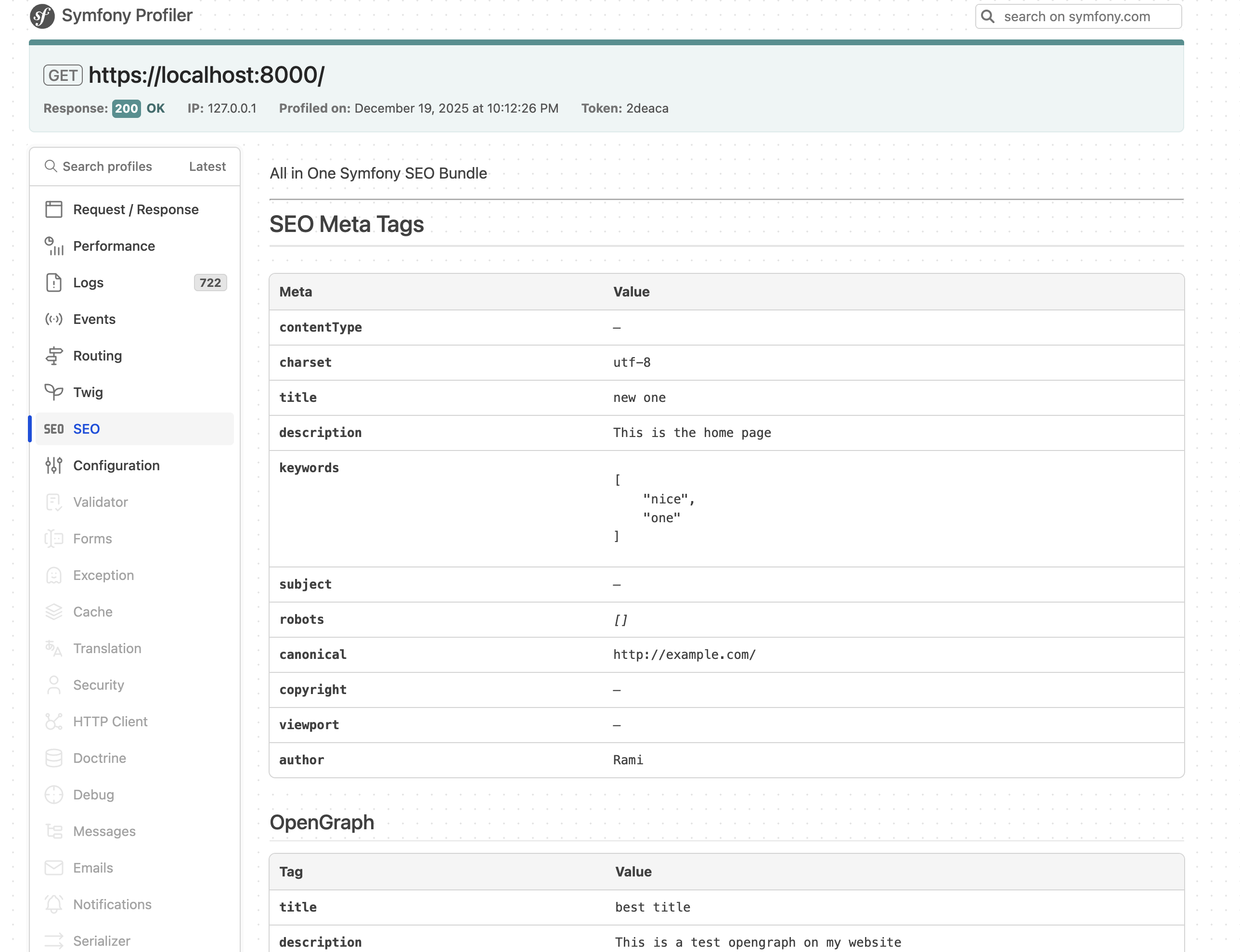
For full documentation, click on the desired topic above to be taken to its documentation page
Meta Tags
Example
Define Meta Tags in Two ways:
- Type hint the
MetaTagsInterfaceinto a controller
use Abdellahramadan\SeoBundle\Metas\MetaTagsManagerInterface;


public function myController(MetaTagsManagerInterface $metaTags): Response
{
 $metaTags->setTitle('My Title')
 ->setDescription('This is the description of the page')
 ->setKeywords(['keywords', 'seo', 'meta'])
 ->setCanonical('https://canonical.com')
 ;
}
- Directly in twig
{{ meta_tags(title: 'My Title', description: 'This is the description of the page' ...)}
Make sure you add this {{ meta_tags }} to the head your Twig file (preferably the base template)
<head>
 {{ meta_tags() }}
</head>
This will render in the head the following
<head>
 <title>My Title</title>
 <meta name="description" content="This is the description of the page'">
 <meta name="keywords" content="keywords, seo, meta">
 <link rel="canonical" href="https://canonical.com">
</head>
Open Graph
Example
Add to template file
Add {{ open_graph() }} to the base template or any page where the meta information will be injected
Add meta inforation
In your controller, type-hint OpenGraphInterface
Example
use Abdellahramadan\OpenGraphBundle\OpenGraph\OpenGraphManagerInterface;

class HomeController extends AbstractController
{
 public function index(OpenGraphManagerInterface $openGraph): Response
 {
 $openGraph
 ->setTitle('My website')
 ->setDescription('Some descriptions ...')
 ->setSiteName('My Blog')
 ;
 ...
 return $this-render('index.html.twig');
 }
}
This will render
<meta property="og:title" content="My website">
<meta property="og:description" content="Some descriptions ...">
<meta property="og:site_name" content="My Blog">
You can also leave out setting the properties in the controller and set directly in Twi
{{ meta_tags(title: 'My website', siteName: 'My Blog') }}
full document at Open Graph Docs
Schema Org [Rich Result]
Usage
use Rami\SeoBundle\Schema\SchemaInterface;
use Symfony\Component\HttpFoundation\Response;

...
 #[Route('/', name: 'app_home')]
 public function index(SchemaInterface $schema): Response
 {
 $person = $schema
 ->person()
 ->name('Abdel Ramadan')
 ->email('abdellah@hey.cm')
 ->children([
 $schema->person()->name('Rami')->email('ramadanabdel24@gmail.com')->givenName('Ramadan'),
 $schema->person()->name('Rami 3')->email('test@gmail.com')
 ]);
 $schema->render($person);
 }
enable the schema in the config:
seo:
 schema:
 enabled: true
This is an example using the Person object which will render
<script type="application/ld+json">
{
 "@context": "https://schema.org",
 "@type": "Person",
 "name": "Abdel Ramadan",
 "email": "abdellah@hey.cm",
 "children": [
 {
 "@type": "Person",
 "name": "Rami",
 "email": "ramadanabdel24@gmail.com",
 "givenName": "Ramadan"
 },
 {
 "@type": "Person",
 "name": "Rami 3",
 "email": "test@gmail.com"
 }
 ]
}
</script>
Full Schema docs at Schema Org Docs
Sitemap Generation
This package automates the generation of sitemaps.
Usage
 #[Sitemap()]
 #[Route('/', name: 'app_home')]
 public function index() {
 ...
 }

 #[Sitemap()]
 #[Route('/blog', name: 'blog')]
 public function blogIndex() {
 ...
 }
This will add the the url entries into sitemaps/default.xml
<?xml version="1.0" encoding="UTF-8"?>
<urlset xmlns="http://www.sitemaps.org/schemas/sitemap/0.9">
 <url>
 <loc>https://mysite.com/blog</loc>
 </url>
 <url>
 <loc>https://mysite.com/</loc>
 </url>
</urlset>
Full Sitemap docs Sitemap Docs
Full documentation at Documentation