

rawr/phpunit-data-provider
Lightweight builder for PhpUnit data providers
Maintainers
Fund package maintenance!
Requires
- php: >=7.1.0
Requires (Dev)
- phpunit/phpunit: ^9.5.4 || ^8.0 || ^7.5
Suggests
None
Provides
None
Conflicts
None
Replaces
None
MIT a8bbc37340cee2976265ec06fe1694f499233f67
This package is auto-updated.
Last update: 2026-06-15 14:13:26 UTC
README

Helper for PhpUnit @dataProvider
Handy require-dev testing tool for PhpUnit. It allows to manage data providers
with zip(), join(), cross(), pairs(), slice(), map() and more.
👁 Build Status
👁 Coverage Status
👁 Dependencies
👁 License
👁 Composer lock

👁 PHP Version
👁 PHP Version
👁 PHP Version
👁 PHP Version
👁 PHP Version
👁 PHP Version
👁 PHP Version
👁 PHP Version
👁 PHP Version
Installation
Installation for PHP 7.1 and later:
composer require --dev rawr/phpunit-data-provider
Overview
DataProvider can be used to build, compose and edit data providers to be used with PhpUnit
by @sebastianbergmann.
DataProvider::list()
DataProvider::list() provides a list of elements. Test is invoked each time with a single argument.
/**
 * @test
 * @dataProvider colors
 */
public function test(string $color): void {
 // your test here
}

public function colors(): DataProvider {
 return DataProvider::list('blue', 'yellow', 'red');
}


Additionally, DataProvider::list() names rows based on values.
DataProvider::join()
Vertically join data providers together.
💡 Useful when two data providers are used in other tests, and a new test should use both of them.
/**
 * @test
 * @dataProvider colors
 */
public function test(string $color, string $thing): void {
 // your test here
}

public function colors(): DataProvider {
 return DataProvider::join($this->blueColors(), $this->yellowColors(), $this->redColors());
}

public function blueColors(): DataProvider {
 return DataProvider::tuples(
 ['blue', 'sky'],
 ['deep blue', 'ocean']
 );
}

public function yellowColors(): iterable {
 yield 'sun' => ['yellow', 'sun'];
}

public function redColors(): array {
 return [
 'apple' => ['red', 'apple']
 ];
}

Note:
- Only data provider with equal amounts of arguments in rows can be joined.
DataProvider.drop()can be used to trim overflowing columns, orDataProvider::zip()to widen data provider with less rows.
DataProvider::zip()
Horizontally join data providers together.
💡 Useful for keeping data providers clean and simple.
/**
 * @test
 * @dataProvider colors
 */
public function test($blueColor, $blueThing, $adjective, Factory $factory): void {
 // your test here
}

public function colors(): DataProvider {
 return DataProvider::zip($this->blueThings(), $this->adjectives(), $this->factories());
}

public function blueThings(): DataProvider {
 return DataProvider::tuples(
 ['blue', 'ink'],
 ['light blue', 'shirt'],
 ['deep blue', 'ocean']
 );
}

public function adjectives(): iterable {
 return DataProvider::list('liquid', 'comfortable', 'majestic');
}

public function factories(): iterable {
 yield [new InkFactory()];
 yield [new ShirtFactory()];
 yield [new OceanFactory()];
}


Note:
- Only data provider with equal amounts of rows can be zipped.
DataProvider.slice()can be used to trim overflowing rows, orDataProvider::join()to prolong a shorter data provider.
DataProvider::cross()
Creates a square matrix of given data providers.
💡 Useful for testing all combinations of arguments.
/**
 * @test
 * @dataProvider colorsAndThings
 */
public function test(string $color, string $shade): void {
 // your test here
}

public function colorsAndThings(): DataProvider {
 return DataProvider::cross($this->colors(), $this->things());
}

public function colors(): array {
 return [
 ['blue'], ['yellow'], ['red']
 ];
}

public function things(): iterable {
 return DataProvider::list('sky', 'sun', 'apple');
}


DataProvider::pairs()
Calls test with two arguments. Each argument is paired with all of the other arguments. All rows are named according to the arguments.
Example shows a test paring image formats:
/**
 * @test
 * @dataProvider formats
 */
public function shouldConvertFile(string $from, string $to): void {
 // your test here
}

public function formats(): array {
 return DataProviders::distinctPairs('png', 'jpg', 'bmp');
}


DataProvider::of()
Instantiates a DataProvider from a raw-array accepted by PhpUnit.
public function example(): DataProvider {
 return DataProvider::of($this->rawArray());
}

public function rawArrayDataProvider(): array {
 return [
 'key' => ['argument 1', 'argument 2']
 ];
}


Notes:
- Also accepts
iterable,\Generatorand other types accepted by PhpUnit.
DataProvider::tuples()
Provide multiple arguments for each a test. DataProvider::tuples() names each row based on the values.
/**
 * @test
 * @dataProvider colors
 */
public function test(string $color, string $thing): void {
 // your test here
}

public function colors(): DataProvider {
 return DataProvider::tuples(
 ['blue', 'sky'],
 ['yellow', 'sun'],
 ['red', 'apple']
 );
}


DataProvider::dictionary()
Specify a single argument for test. DataProvider::dictionary() names each row based on the
provided array key.
/**
 * @test
 * @dataProvider colors
 */
public function test(string $color): void {
 // your test here
}

public function colors(): DataProvider {
 return DataProvider::dictionary([
 'custom name 1' => 'blue',
 'custom name 2' => 'yellow',
 'custom name 3' => 'red'
 ]);
}

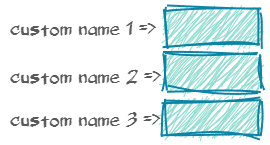
In most cases, DataProvider::list() or DataProvider::tuples() should be used to name
rows based on arguments. Method DataProvider::dictionary() is useful when the arguments are not self-explanatory:
public function ports(): DataProvider {
 return DataProvider::dictionary([
 'http' => 80,
 'https' => 443,
 'ftp' => 21
 ]);
}
DataProvider.map()
Transform each row's values in DataProvider to any other set of values.
💡 Useful for separating providers content and their form.
/**
* @test
* @dataProvider folderIterators
*/
public function test(\Iterator $iterator, string $name): void {
 // your test here
}

public function folderIterators(): DataProvider {
 return $this->folders()->map(function (string $name, string $path): array {
 return [
 new \DirectoryIterator($path),
 $name
 ];
 });
}

public function folders(): DataProvider {
 return DataProvider::tuples(
 ['temporary', '/tmp'],
 ['user directory', '/home'],
 ['system resources', '/usr/bin']);
}


Notes:
- Names in
DataProviderwill be preserved.
DataProvider.slice()
Remove leading or trailing rows from DataProvider.
💡 Useful for adapting DataProvider to be zipped or limit provided values.
/**
 * @test
 * @dataProvider limitedColors
 */
public function test(string $color, string $thing): void {
 // your test here
}

public function limitedColors(): DataProvider {
 return $this->colors()->slice(0, 2);
}

public function colors(): DataProvider {
 return DataProvider::tuples(
 ['blue', 'sky'],
 ['yellow', 'sun'],
 ['red', 'apple']
 );
}
DataProvider.entries()
Provide two arguments for each a test, from key-value pairs.
DataProvider::entries() names each row based on the key-value pair.
/**
 * @test
 * @dataProvider colors
 */
public function test(string $color, string $thing): void {
 // your test here
}

public function colors(): DataProvider {
 return DataProvider::entries(
 'blue' => 'sky',
 'yellow' => 'sun',
 'red' => 'apple',
 );
}


Documentation
Functionalities
-
Creating new data providers:
-
Composing existing providers:
-
Editing existing providers:
DataProvider.map(),DataProvider.slice(),DataProvider.drop(). These methods don't modifyDataProviderinstance, but return a new instance.
Features
- Clear naming
- Each
DataProviderbuilder sets proper names for rows, based on values.
- Each
- Duplicate keys:
- Duplicate keys are properly handled and formatted in an informative manner. No rows are ever being "lost" when editing.
- Lazy evaluation:
- Iterators are being evaluated only when called. Argument iterators are only called once, even if
DataProvideris called multiple times.
- Iterators are being evaluated only when called. Argument iterators are only called once, even if
DataProvideraccepts many provider types.
Names
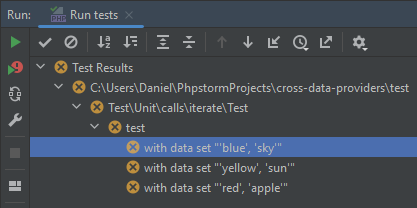
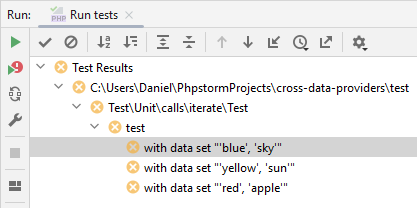
DataProvider sets proper names for each row based on values.
/**
 * @test
 * @dataProvider colors
 */
public function test(string $color, string $thing): void {
 // your test here
}

public function colors(): DataProvider {
 return DataProvider::tuples(
 ['blue', 'sky'],
 ['yellow', 'sun'],
 ['red', 'apple']
 );
}


Example usage
DataProvider::cross() returns an instance of DataProvider which is a square matrix of input data providers.
/**
 * @test
 * @dataProvider services
 */
public function shouldLogin(string $service, string $method, int $port): void {
 // your test here
}

public function services(): DataProvider {
 return DataProvider::cross(
 [
 ['github.com'], ['bitbucket.com'], ['gitlab.com'], ['sourceforge.net']
 ],
 [
 ['http', 80],
 ['https', 443],
 ['ssh', 22]
 ]);
}
This is equivalent of having a regular data provider that is composed of 12 entries, similar to:
public function services(): array {
 return [
 ['github.com', 'http', 80],
 ['github.com', 'https', 443],
 ['github.com', 'ssh', 22],
 ['bitbucket.com', 'http', 80],
 ['bitbucket.com', 'https', 443],
 ['bitbucket.com', 'ssh', 22],
 ['gitlab.com', 'http', 80],
 ['gitlab.com', 'https', 443],
 ['gitlab.com', 'ssh', 22],
 ['sourceforge.net', 'http', 80],
 ['sourceforge.net', 'https', 443],
 ['sourceforge.net', 'ssh', 22],
 ];
}
DataProvider::cross() accepts data providers of different
types: array, \Iterator, \IteratorAggregate, \Traversable, \Generator,
iterable and DataProvider.
That means DataProvider can be composed together.
public function services(): DataProvider {
 return DataProvider::cross(
 DataProvider::list('github.com', 'bitbucket.com', 'gitlab.com', 'sourceforge.net'),
 DataProvider::tuples(['http', 80], ['https', 443], ['ssh', 22]));
}
Advanced usage
DataProvider can be combined with other DataProviders as well as regular PhpUnit data providers.
/**
 * @test
 * @dataProvider urls
 */
public function test0(string $url): void {
 // your test here
}

/**
 * @test
 * @dataProvider services
 */
public function test1(string $url, string $name, string $method, int $port): void {
 // your test here
}

/**
 * @test
 * @dataProvider allServices
 */
public function test2(string $url, string $name, string $method, int $port): void {
 // your test here
}

public function urls(): DataProvider {
 return DataProvider::list('github.com', 'bitbucket.com', 'gitlab.com', 'sourceforge.net');
}

public function rawArrayProvider(): array {
 return [
 ['GitHub'],
 ['BitBucket'],
 ['GitLab'],
 ['SourceForge']
 ];
}

public function services(): DataProvider {
 return DataProvider::cross(
 DataProvider::zip($this->urls(), $this->rawArrayProvider()),
 DataProvider::tuples(
 ['http', 80],
 ['https', 443],
 ['ssh', 22]));
}

public function allServices(): DataProvider {
 return DataProvider::join(
 $this->services(),
 $this->localServices()
 );
}

public function localServices(): array {
 return [
 'my local service' => ['localhost', 'local', 'http', '80']
 ];
}
Accepted types
DataProvider accepts any type of data provider:
- all types allowed
by PhpUnit:
array,iterable,\Traversable,\Iterator,\IteratorAggregate,\Generator DataProvideritself, allowing data providers to be composed together
Notes
Notes on DataProvider::join():
DataProvider::join()preserves names of each data provider, and also joins the names vertically. Duplicates in titles are preserved and presented appropriately.DataProvider::join()accepts any type of data-provider.DataProvider::join()is conceptually similar to calling\array_merge()on raw-array providers, but\array_merge()would override duplicate keys, whileDataProvider::join()preserves duplicate keys, and titles them appropriately.DataProvider::join()variadic arguments...iterableand can be used to join many data providersDataProvider::join()can only join data providers with the same amount of arguments in each row, otherwiseIrregularDataProviderExceptionis thrown.DataProvider::join()acceptsDataProvideror otheriterableaccepted by PhpUnit. If improper data-provider is passed,MalformedDataProviderExceptionis thrown.
Notes on DataProvider::zip():
DataProvider::zip()preserves names of each data provider, and also joins them horizontally.DataProvider::zip()accepts any type of data-provider.DataProvider::zip()variadic arguments...iterableand can zip many data providersDataProvider::zip()can only zip data providers with the same amount of rows, otherwiseIrregularDataProviderExceptionis thrown. Additionally, each particular data provider must have the same amount of arguments in each row.DataProvider::zip()acceptsDataProvideror otheriterableaccepted by PhpUnit. If improper data-provider is passed,MalformedDataProviderExceptionis thrown.
Note on DataProvider::pairs():
DataProvider::pairs()produces duplicate pairs (for example'png', 'png'), whileDataProvider::distinctPairs()only makes pairs of different arguments.
Note on DataProvider::tuples():
DataProvider::tuples()is similar toDataProvider::of(), but::of()accepts an explicit name, whileDataProvider::tuples()titles the rows according to the values in the row.
Migration from previous version
To use version 3.0.0, migrating from 2.4.0 or earlier:
- Library namespace changed from
\TRegx\DataProvider\to\TRegx\PhpUnit\DataProviders\. - Change
\TRegx\DataProvider\DataProviders::cross()to\TRegx\PhpUnit\DataProviders\DataProvider::cross(). - Change
\TRegx\DataProvider\CrossDataProviders::cross()to\TRegx\PhpUnit\DataProviders\DataProvider::cross(). - Change your data providers return type from
arraytoiterableor\TRegx\PhpUnit\DataProviders\DataProvider. - Removed
\TRegx\DataProvider\CrossDataProviders::builder(), use\TRegx\PhpUnit\DataProviders\DataProvider::cross()instead.