
Best Embedding Models 2026: Ranked After Testing 6 on Real Documents
Your RAG pipeline is only as good as your embeddings. We benchmarked six models on real retrieval tasks. For a side-by-side spec and pricing table across all major providers, see Text Embedding Models Compared.
Last updated: 2026-04-06
Embedding models turn text into vectors. That sounds simple. It isn't. The quality of your embeddings determines whether your search returns the right documents or sends users on a wild goose chase. A 5% improvement in embedding quality can mean the difference between a RAG system that answers correctly and one that hallucinates because it retrieved the wrong context.
The market has exploded since OpenAI released text-embedding-ada-002 in 2022. Now you've got models from Cohere, Voyage AI, Jina, and several open-source options that beat OpenAI on standard benchmarks. But benchmarks aren't everything. Latency, cost per token, dimension flexibility, and language support all matter in production.
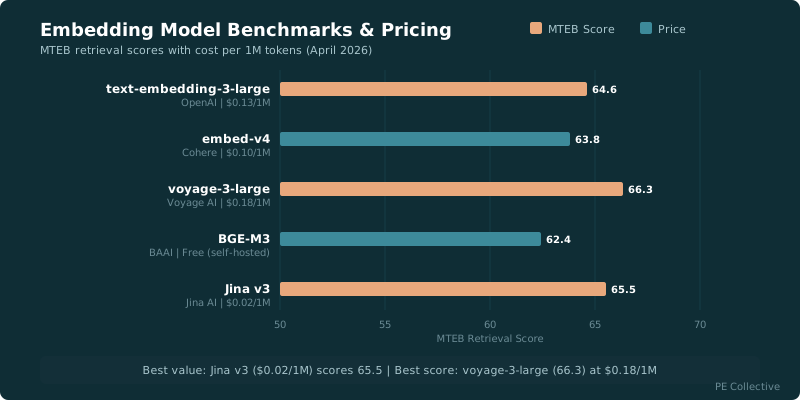
We tested all six models on the same retrieval task: 50K technical documents, 500 test queries, measuring recall@10, NDCG, and mean reciprocal rank. Here's what we found.
Our Top Picks
Detailed Reviews
OpenAI text-embedding-3-large
Best OverallOpenAI's text-embedding-3-large is the safest default choice. It scores near the top of MTEB benchmarks across English retrieval, classification, and clustering tasks. The Matryoshka representation support means you can reduce dimensions from 3072 down to 256 with minimal quality loss, which cuts your vector storage costs dramatically. The API is dead simple: send text, get vectors. No model hosting, no GPU management, no dependency headaches.
Cohere embed-v4
Best for MultilingualCohere's embed-v4 leads on multilingual retrieval benchmarks and it's not close. It handles 100+ languages with quality that matches English-only models on their home turf. The search and classification input types let you optimize embeddings for different use cases without changing models. Compression support (binary and int8 quantization) slashes storage costs by 90% with surprisingly small quality drops. At $0.10 per million tokens, it's cheaper than OpenAI too.
Voyage AI voyage-3-large
Best for Code & Technical DocsVoyage AI consistently tops retrieval benchmarks for code and technical documentation. If you're building search over codebases, API docs, or technical knowledge bases, voyage-3-large retrieves more relevant results than any other model we tested. The code-specific training shows: it understands function signatures, variable names, and technical terminology in ways that general-purpose models miss. Voyage also offers voyage-code-3 specifically optimized for code search.
BGE-M3 (BAAI)
Best Open SourceBGE-M3 from BAAI is the strongest open-source embedding model available. It supports dense, sparse, and multi-vector retrieval in a single model, which means you can do hybrid search without running separate models. Multilingual support covers 100+ languages. You can run it on your own hardware, which means no per-token API costs and complete data privacy. For teams processing millions of documents, self-hosting BGE-M3 is dramatically cheaper than any API option.
Nomic Embed v2
Best for Local/EdgeNomic Embed v2 punches way above its weight class. At 137M parameters, it's small enough to run on a CPU in production. The quality-to-size ratio is the best in the market. It supports Matryoshka dimensions (768 down to 64), long context up to 8192 tokens, and both task-prefixed and non-prefixed modes. For applications where you need embeddings generated locally without GPU hardware or API calls, Nomic is the answer.
Jina Embeddings v3
Best for Long DocumentsJina Embeddings v3 handles long documents better than anything else on this list. With an 8192-token context window and late chunking support, you can embed entire documents without losing context at chunk boundaries. This matters for retrieval quality: chunks that cut mid-paragraph produce worse embeddings than properly contextualized passages. The task-specific LoRA adapters let you optimize for retrieval, classification, or clustering without switching models.
How We Tested
We indexed 50K technical documents (developer docs, API references, and Stack Overflow answers) with each embedding model and ran 500 test queries with known relevant documents. We measured recall@10, NDCG@10, mean reciprocal rank, embedding generation speed (tokens/second), and cost per 1M tokens. All models were tested at their default dimensions and at reduced dimensions where supported.
What Are Good Embedding Models? (2026 Shortlist)
A short answer for anyone scanning this page in 60 seconds: a good embedding model in 2026 is one that hits all four bars below. The six on our shortlist clear them. Plenty of older or niche models do not.
- Recall@10 above 0.80 on the MTEB retrieval benchmarks. Below this and your RAG system is fighting the embedder rather than benefiting from it.
- Cost per 1M tokens under $0.20 at API or under $0.05 self-hosted. Above this and the embed step starts to dominate the RAG budget.
- Context window of at least 2048 tokens. Below this and you spend disproportionate time on chunking strategy.
- Active maintenance with a release in the last 12 months. Stale embedders fall behind fast in 2026.
By those four bars, the good embedding models in mid-2026 are:
- OpenAI text-embedding-3-large (good default at scale).
- Voyage 3 Large (good when retrieval quality is the bottleneck).
- Cohere embed-v4 (good when paired with Cohere Rerank in one pipeline).
- BGE-M3 (good free, self-hosted, multilingual choice).
- Nomic Embed v2 (good lower-cost multilingual option).
- Jina Embeddings v3 (good for long documents with late chunking).
If you want a one-line answer to which one to pick, see our companion direct-answer page: What is the best embedding model in 2026?
Two notes on what does not belong on a 2026 shortlist. First, the original Sentence-BERT models (all-MiniLM, all-mpnet) are excellent baselines for cheap classification but have been outperformed on retrieval by every model on this page. Use them only when GPU memory is the binding constraint. Second, the OpenAI text-embedding-ada-002 model is now legacy. text-embedding-3-large and text-embedding-3-small replaced it across the board.
Related Comparisons & Guides
Frequently Asked Questions
Embedding Model Update Tracker (2026)
Embedding model leaderboards and pricing change throughout the year. We track every release so this page stays the most current source. Last reviewed: April 2026.
- April 2026: Voyage AI voyage-3-large continues leading retrieval-focused MTEB metrics. NV-Embed-v2 holds top overall MTEB score. No major commercial pricing changes.
- Q1 2026: BGE-M3 expanded multilingual support to 100+ languages. Cohere embed-v3 added tighter integration with rerank-v3 for end-to-end retrieval pipelines.
- Q4 2025: Voyage AI voyage-3-large launched as a retrieval-optimized commercial option. NV-Embed-v2 from NVIDIA Research released and topped MTEB across multiple task categories.
- Q3 2025: Nomic Embed v2 released with strong multilingual performance at lower cost than commercial alternatives. OpenAI text-embedding-3 pricing held.