
| Australopithecina | |
|---|---|
| 👁 Image | |
| Australopithecus sediba | |
| Classificação científica 👁 e | |
| Reino: | Animalia |
| Filo: | Chordata |
| Classe: | Mammalia |
| Ordem: | Primates |
| Subordem: | Haplorhini |
| Família: | Hominidae |
| Tribo: | Hominini |
| Subtribo: | Australopithecina Gregory & Hellman, 1939 |
| Espécie-tipo | |
| †Australopithecus africanus Dart, 1925 | |
| Gêneros | |
| |
| Sinónimos | |

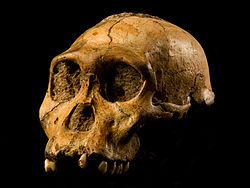

O termo australopitecíneo refere-se geralmente a qualquer espécie relacionada aos gênero Australopithecus e Paranthropus. Pode também incluir Kenyanthropus,[4] Ardipithecus,[4] Praeanthropus,[5] Orrorin, Sahelanthropus, e Graecopithecus. O termo deriva de uma classificação antiga que considerava esses gêneros em uma subfamília separada, Australopithecinae.[6] Agora, o termo se refere a uma subtribo, Australopithecina, incluída na tribo Hominini.[7][8] Membros do gênero Australopithecus são às vezes referidos como "australopitecíneos gráceis", enquanto que do gênero Paranthropus são chamados de "australopitecíneos robustos".[9][10]
Os australopitecíneos ocorreram entre o Plioceno e Pleistoceno, e eram bípedes e a dentição similar ao dos humanos, mas não possuím o cérebro muito maior que dos modernos chimpanzés, com encefalização menor do que observado no gênero Homo.[11] Humanos provavelmente descendeem de australopitecíneos, enquanto que o gênero Ardipithecus é provável ancestral dos australopitecíneos.[10]
Filogenia
[editar | editar código]Filogenia de acordo com [8].
Referências
- ↑ Stanford 2012.
- ↑ Gray, J. E. (1825). «An outline of an attempt at the disposition of Mammalia into Tribes and Families, with a list of genera apparently appertaining to each Tribe.». Annals of Philosophy. New Series. 10: 337–340
- ↑ Andrews, Peter; Harrison, Terry (1 de janeiro de 2005). «The Last Common Ancestor of Apes and Humans»👁 Subscrição paga é requerida
. Interpreting the Past (em inglês): 103–121. ISBN9789047416616. doi:10.1163/9789047416616_013 - 1 2 Wood 2010.
- ↑ Cela-Conde & Ayala 2003.
- ↑ Kottak 2004.
- ↑ Wood & Richmond 2000.
- 1 2 Briggs & Crowther 2008, p.124.
- ↑ Mai, Owl & Kersting 2005.
- 1 2 Szpak, P. (2007). «Evolution of the Australopithecines». Tree of Life
- ↑ Mai, Owl & Kersting 2005, p.45.

- Briggs, D.; Crowther, P. R., eds. (2008). Palaeobiology II. [S.l.]: John Wiley & Sons. p.600. ISBN9780470999288
- Cela-Conde, C. J.; Ayala, F. J. (2003). Genera of the human lineage. Proceedings of the National Academy of Sciences 100 (13): 7684–7689. PMID12794185. doi:10.1073/pnas.0832372100
- Kottak, C. P. (2004). «Glossary». Cultural Anthropology: The Exploration of Human Diversity 10th ed. [S.l.]: McGraw-Hill. ISBN978-0072832259
- Mai, L. L.; Owl, M. Y.; Kersting, M. P. (2005). The Cambridge Dictionary of Human Biology and Evolution. Cambridge & New York: Cambridge University Press. p.45. ISBN978-0-521-66486-8
- Stanford, C. B. (2012). Chimpanzees and the behavior of Ardipithecus ramidus. Annual Review of Anthropology 41: 139–149. doi:10.1146/annurev-anthro-092611-145724
- Wood, B.; Richmond, B. G. (2000). «Human evolution: Taxonomy and paleobiology». Journal of Anatomy 197 (Pt 1): 19–60. doi:10.1073/pnas.1001649107
- Wood, B.; Richmond, B. G. (2000). «Human evolution: Taxonomy and paleobiology». Journal of Anatomy 197 (Pt 1): 19–60. doi:10.1046/j.1469-7580.2000.19710019.x


