VOOZH about

URL: https://pubmed.ncbi.nlm.nih.gov/14765337/

⇱ Viral replication in the nasopharynx is associated with diarrhea in patients with severe acute respiratory syndrome - PubMed


Clipboard, Search History, and several other advanced features are temporarily unavailable.
Skip to main page content
👁 Dot gov

The .gov means it’s official.
Federal government websites often end in .gov or .mil. Before sharing sensitive information, make sure you’re on a federal government site.

👁 Https

The site is secure.
The https:// ensures that you are connecting to the official website and that any information you provide is encrypted and transmitted securely.

Access keys NCBI Homepage MyNCBI Homepage Main Content Main Navigation

Add to Collections

Add to My Bibliography

Your saved search

Create a file for external citation management software

Your RSS Feed

Abstract

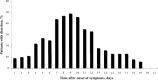
The role of severe acute respiratory syndrome (SARS) coronavirus as an enteric pathogen was investigated in a cohort of 142 patients with SARS who were treated with a standard treatment protocol. Data from daily hematological, biochemical, radiological, and microbiological investigations were prospectively collected, and the correlation of these findings with diarrhea was retrospectively analyzed. Sixty-nine patients (48.6%) developed diarrhea at a mean (+/- standard deviation [SD]) of 7.6+/-2.6 days after the onset of symptoms. The diarrhea was most severe at a mean (+/-SD) of 8.8+/-2.4 days after onset, with a maximum frequency of 24 episodes per day (median, 5 episodes; range, 3-24 episodes). A higher mean virus load in nasopharyngeal specimens obtained on day 10 after the onset of symptoms was significantly associated with the occurrence of diarrhea (3.1 log10 vs. 1.8 log10 copies/mL; P=.01) and mortality (6.2 vs. 1.7 log10 copies/mL; P<.01). However, diarrhea was not associated with mortality. The lung and the gastrointestinal tract may react differently to SARS coronavirus infection. Additional investigation of the role of SARS coronavirus in the pathogenesis of diarrhea in patients with SARS should be conducted.


Figures

👁 Table 1
Table 1
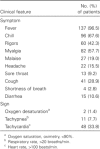
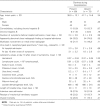
Clinical symptoms and signs for 142 patients with severe accurate respiratory syndrome at presentation.
👁 Table 2
Table 2
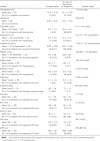
Hematological and biochemical findings for 142 patients with severe acute respiratory syndrome at presentation and on day 10 after the onset of symptoms.
👁 Table 3
Table 3
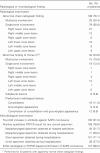
Extent of radiological involvement and microbiological findings for 142 patients with severe acute respiratory syndrome (SARS).
👁 Figure 1
Figure 1
Percentage of patients with severe acute respiratory syndrome who had diarrhea during hospitalization
👁 Table 4
Table 4
Demographic characteristics of 142 patients who had severe acute respiratory syndrome with or without diarrhea during hospitalization.
👁 Figure 2
Figure 2
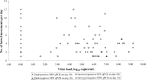
Frequency of bowel movements in relation to virus load in nasopharyngeal specimens on day 10 after the onset of symptoms. NPS, nasopharyngeal specimen; qPCR, quantitative RT-PCR.

References

    1. World Health Organization . Summary table of SARS cases by country, 1 November 2002–7 August 2003. 23 September. 2003. Available at: http://www.who.int/csr/sars/country/en/country2003_08_15.pdf.
    1. Ksiazek TG, Erdman D, Goldsmith CS, et al. A novel coronavirus associated with severe acute respiratory syndrome. N Engl J Med. 2003;348:1953–66. - PubMed
    1. Drosten C, Gunther S, Preiser W, et al. Identification of a novel coronavirus in patients with severe acute respiratory syndrome. N Engl J Med. 2003;348:1967–76. - PubMed
    1. Peiris JS, Lai ST, Poon LL, et al. Coronavirus as a possible cause of severe acute respiratory syndrome. Lancet. 2003;361:1319–25. - PMC - PubMed
    1. Fouchier RA, Kuiken T, Schutten M, et al. Aetiology: Koch's postulates fulfilled for SARS virus. Nature. 2003;423:240. - PMC - PubMed
Cite

NCBI Literature Resources

MeSH PMC Bookshelf Disclaimer

The PubMed wordmark and PubMed logo are registered trademarks of the U.S. Department of Health and Human Services (HHS). Unauthorized use of these marks is strictly prohibited.