VOOZH about

URL: https://pubmed.ncbi.nlm.nih.gov/15498155/

⇱ Viral loads in clinical specimens and SARS manifestations - PubMed


Clipboard, Search History, and several other advanced features are temporarily unavailable.
Skip to main page content
👁 Dot gov

The .gov means it’s official.
Federal government websites often end in .gov or .mil. Before sharing sensitive information, make sure you’re on a federal government site.

👁 Https

The site is secure.
The https:// ensures that you are connecting to the official website and that any information you provide is encrypted and transmitted securely.

Access keys NCBI Homepage MyNCBI Homepage Main Content Main Navigation

Add to Collections

Add to My Bibliography

Your saved search

Create a file for external citation management software

Your RSS Feed

Abstract

A retrospective viral load study was performed on clinical specimens from 154 patients with laboratory-confirmed severe acute respiratory syndrome (SARS); the specimens were prospectively collected during patients' illness. Viral load in nasopharyngeal aspirates (n = 142) from day 10 to day 15 after onset of symptoms was associated with oxygen desaturation, mechanical ventilation, diarrhea, hepatic dysfunction, and death. Serum viral load (n = 53) was associated with oxygen desaturation, mechanical ventilation, and death. Stool viral load (n = 94) was associated with diarrhea, and urine viral load (n = 111) was associated with abnormal urinalysis results. Viral replications at different sites are important in the pathogenesis of clinical and laboratory abnormalities of SARS.


Figures

👁 Figure
Figure
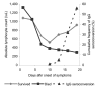
Serial change of the mean absolute lymphocyte count and immunoglobulin (Ig) G seroconversion of severe acute respiratory syndrome (SARS)–associated coronavirus in 154 SARS patients.

References

    1. World Health Organization. Summary of probable SARS cases with onset of illness from 1 November 2002 to 26 September 2003. [monograph on the Internet]. 2003 Sep 26 [cited 2003 Sep 26]. Available from: http://www.who.int/csr/sars/country/table2003_09_23/en
    1. Peiris JS, Lai ST, Poon LL, Guan Y, Yam LY, Lim W, et al. Coronavirus as a possible cause of severe acute respiratory syndrome. Lancet. 2003;361:1319–25. 10.1016/S0140-6736(03)13077-2 - DOI - PMC - PubMed
    1. Drosten C, Gunther S, Preiser W, van der Werf S, Brodt HR, Becker S, et al. Identification of a novel coronavirus in patients with severe acute respiratory syndrome. N Engl J Med. 2003;348:1967–76. 10.1056/NEJMoa030747 - DOI - PubMed
    1. Ksiazek TG, Erdman D, Goldsmith CS, Zaki SR, Peret T, Emery S, et al. A novel coronavirus associated with severe acute respiratory syndrome. N Engl J Med. 2003;348:1953–66. 10.1056/NEJMoa030781 - DOI - PubMed
    1. Fouchier RA, Kuiken T, Schutten M, van Amerongen G, van Doornum GJ, van den Hoogen BG, et al. Aetilogy: Koch's postulates fulfilled for SARS virus. Nature. 2003;423:240. 10.1038/423240a - DOI - PMC - PubMed

LinkOut - more resources

Cite

NCBI Literature Resources

MeSH PMC Bookshelf Disclaimer

The PubMed wordmark and PubMed logo are registered trademarks of the U.S. Department of Health and Human Services (HHS). Unauthorized use of these marks is strictly prohibited.