VOOZH about

URL: https://pubmed.ncbi.nlm.nih.gov/20524140/

⇱ Summarizing the evidence on the international trade in illegal wildlife - PubMed


Clipboard, Search History, and several other advanced features are temporarily unavailable.
Skip to main page content
👁 Dot gov

The .gov means it’s official.
Federal government websites often end in .gov or .mil. Before sharing sensitive information, make sure you’re on a federal government site.

👁 Https

The site is secure.
The https:// ensures that you are connecting to the official website and that any information you provide is encrypted and transmitted securely.

Access keys NCBI Homepage MyNCBI Homepage Main Content Main Navigation

Add to Collections

Add to My Bibliography

Your saved search

Create a file for external citation management software

Your RSS Feed

Abstract

The global trade in illegal wildlife is a multi-billion dollar industry that threatens biodiversity and acts as a potential avenue for invasive species and disease spread. Despite the broad-sweeping implications of illegal wildlife sales, scientists have yet to describe the scope and scale of the trade. Here, we provide the most thorough and current description of the illegal wildlife trade using 12 years of seizure records compiled by TRAFFIC, the wildlife trade monitoring network. These records comprise 967 seizures including massive quantities of ivory, tiger skins, live reptiles, and other endangered wildlife and wildlife products. Most seizures originate in Southeast Asia, a recently identified hotspot for future emerging infectious diseases. To date, regulation and enforcement have been insufficient to effectively control the global trade in illegal wildlife at national and international scales. Effective control will require a multi-pronged approach including community-scale education and empowering local people to value wildlife, coordinated international regulation, and a greater allocation of national resources to on-the-ground enforcement.


Figures

👁 Figure 1
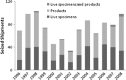
Figure 1
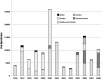
Number of seized shipments of animals and animal products recorded per year between 1996 and 2008, divided by live specimens, products, and mixed shipments. Source: TRAFFIC Bulletin.
👁 Figure 2
Figure 2
Animal and animal product seizures, 1996–2008, by country of origin. One dot corresponds to one seizure. Dots are randomly placed within countries. Source: TRAFFIC Bulletin.
👁 Figure 3
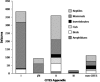
Figure 3
Seized animal shipments, 1996–2008, divided by taxonomic group and Convention on International Trade in Endangered Species (CITES) appendix. I/II refers to specimens whose species or subspecies could not be positively identified so as to class them as Appendix I or Appendix II. Source: TRAFFIC Bulletin.
👁 Figure 4
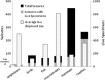
Figure 4
Number of seized shipments of animals and animal products recorded per year between 1996 and 2008, and average size of live shipments, divided by taxonomic group. Source: TRAFFIC Bulletin.
👁 Figure 5
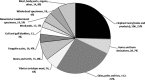
Figure 5
Total numbers and percentages of seized shipments of mammal products, 1996–2008. Source: TRAFFIC Bulletin.
👁 Figure 6
Figure 6
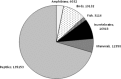
Total live animals seized, by major taxonomic group, from 1996 to 2008. These numbers do not depict the total number of live animals seized, as a number of shipments did not have quantity data and some were recorded by weight rather than number. Source: TRAFFIC Bulletin.
👁 Figure 7
Figure 7
Seized live reptile specimens, 1996–2008, divided by taxonomic group. Source: TRAFFIC Bulletin.

References

    1. Amin R, Thomas K, Emslie RH, Foose TJ, Van Strien N. An overview of the conservation status of and threats to rhinoceros species in the wild. International Zoo Yearbook. 2006;40:96–117. doi: 10.1111/j.1748-1090.2006.00096.x. - DOI
    1. ASEAN-WEN (2009) www.asean-wen.org. Accessed 23 June 2009
    1. Balmford A, Bruner A, Cooper P, Costanza R, Farber S, Green RE, et al. Ecology—economic reasons for conserving wild nature. Science. 2002;297:950–953. doi: 10.1126/science.1073947. - DOI - PubMed
    1. Bailey TA, Silvanose CD, Naldo J, Combreau O, Launay F, Wernery U, Kinne J, Gough R, Manvell R (1999) Health considerations of the rehabilitation of illegally traded houbara bustards Chlamydotis undulata macqueenii in the Middle East. European Association of Avian Veterinarians Conference, Italy, 1999
    1. Cheung SN, Dudgeon D. Quantifying the Asian turtle crisis: market surveys in southern China, 2000–2003. Aquatic Conservation: Marine and Freshwater Ecosystems. 2006;16:751–770. doi: 10.1002/aqc.803. - DOI

LinkOut - more resources

Cite

NCBI Literature Resources

MeSH PMC Bookshelf Disclaimer

The PubMed wordmark and PubMed logo are registered trademarks of the U.S. Department of Health and Human Services (HHS). Unauthorized use of these marks is strictly prohibited.