


Display options
Format
Abstract
The steroid 5alpha-reductase (SRD5A) family of enzymes produces steroid hormones that regulate male sexual development. Now, Cantagrel et al. (2010) identify a member of this family, SRD5A3, as a polyprenol reductase with a crucial role in N-linked protein glycosylation and pinpoint SRD5A3 mutations as the cause of a rare Mendelian disease.
Copyright 2010 Elsevier Inc. All rights reserved.
Figures

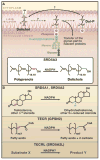
(A) The addition of a 14 sugar oligosaccharide to nascent proteins (N-linked glycosylation) occurs in the membrane of the endoplasmic reticulum (ER), where dolichol-phosphate (Dol-P) serves as a lipid carrier for the glycan unit. The steroid 5α-reductase SRD5A3 catalyzes the reduction of the terminal double bond of polyprenols to generate dolichols, the precursor of Dol-P (Cantagrel et al., 2010). Mutations in SRD5A3 cause a congenital disorder of glycosylation leading to severe developmental anomalies in humans. (B) The other four human steroid 5α-reductase enzymes also reduce the double bond of various lipid substrates using the NADPH cofactor. SRD5A1 and SRD5A2 are required for the proper sexual development of males by catalyzing the synthesis of dihydrotestosterone from testosterone. Although the trans-2,3-enoyl-CoA reductase (TECR) is known to operate on fatty acids, the substrate(s) for the trans-2,3-enoyl-CoA reductase-like (TECRL) enzyme is unknown.
Comment on
-
SRD5A3 is required for converting polyprenol to dolichol and is mutated in a congenital glycosylation disorder.Cantagrel V, Lefeber DJ, Ng BG, Guan Z, Silhavy JL, Bielas SL, Lehle L, Hombauer H, Adamowicz M, Swiezewska E, De Brouwer AP, Blümel P, Sykut-Cegielska J, Houliston S, Swistun D, Ali BR, Dobyns WB, Babovic-Vuksanovic D, van Bokhoven H, Wevers RA, Raetz CR, Freeze HH, Morava E, Al-Gazali L, Gleeson JG. Cantagrel V, et al. Cell. 2010 Jul 23;142(2):203-17. doi: 10.1016/j.cell.2010.06.001. Epub 2010 Jul 15. Cell. 2010. PMID: 20637498 Free PMC article.
References
Publication types
Grants and funding
LinkOut - more resources
Full Text Sources
Medical
