


Expression of concern in
-
Editorial expression of concern: Experimental evidence of massive-scale emotional contagion through social networks.Verma IM. Verma IM. Proc Natl Acad Sci U S A. 2014 Jul 22;111(29):10779. doi: 10.1073/pnas.1412583111. Epub 2014 Jul 3. Proc Natl Acad Sci U S A. 2014. PMID: 24994898 Free PMC article. No abstract available.
Abstract
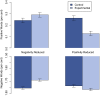
Emotional states can be transferred to others via emotional contagion, leading people to experience the same emotions without their awareness. Emotional contagion is well established in laboratory experiments, with people transferring positive and negative emotions to others. Data from a large real-world social network, collected over a 20-y period suggests that longer-lasting moods (e.g., depression, happiness) can be transferred through networks [Fowler JH, Christakis NA (2008) BMJ 337:a2338], although the results are controversial. In an experiment with people who use Facebook, we test whether emotional contagion occurs outside of in-person interaction between individuals by reducing the amount of emotional content in the News Feed. When positive expressions were reduced, people produced fewer positive posts and more negative posts; when negative expressions were reduced, the opposite pattern occurred. These results indicate that emotions expressed by others on Facebook influence our own emotions, constituting experimental evidence for massive-scale contagion via social networks. This work also suggests that, in contrast to prevailing assumptions, in-person interaction and nonverbal cues are not strictly necessary for emotional contagion, and that the observation of others' positive experiences constitutes a positive experience for people.
Keywords: big data; computer-mediated communication; social media.
Conflict of interest statement
The authors declare no conflict of interest.
Figures

Comment in
-
Unethical work must be filtered out or flagged.Ruxton GD, Mulder T. Ruxton GD, et al. Nature. 2019 Aug;572(7768):171-172. doi: 10.1038/d41586-019-02378-x. Nature. 2019. PMID: 31384054 No abstract available.
References
-
- Hatfield E, Cacioppo JT, Rapson RL. Emotional contagion. Curr Dir Psychol Sci. 1993;2(3):96–100.
-
- Cohen-Cole E, Fletcher JM. Is obesity contagious? Social networks vs. environmental factors in the obesity epidemic. J Health Econ. 2008;27(5):1382–1387. - PubMed
MeSH terms
Grants and funding
LinkOut - more resources
Full Text Sources
Other Literature Sources
