VOOZH about

URL: https://pubmed.ncbi.nlm.nih.gov/28149583/

⇱ The role of bronchoscopy in the diagnosis of airway disease - PubMed


Clipboard, Search History, and several other advanced features are temporarily unavailable.
Skip to main page content
👁 Dot gov

The .gov means it’s official.
Federal government websites often end in .gov or .mil. Before sharing sensitive information, make sure you’re on a federal government site.

👁 Https

The site is secure.
The https:// ensures that you are connecting to the official website and that any information you provide is encrypted and transmitted securely.

Access keys NCBI Homepage MyNCBI Homepage Main Content Main Navigation

Add to Collections

Add to My Bibliography

Your saved search

Create a file for external citation management software

Your RSS Feed

Abstract

Endoscopy of the airway is a valuable tool for the evaluation and management of airway disease. It can be used to evaluate many different bronchopulmonary diseases including airway foreign bodies, tumors, infectious and inflammatory conditions, airway stenosis, and bronchopulmonary hemorrhage. Traditionally, options for evaluation were limited to flexible and rigid bronchoscopy. Recently, more sophisticated technology has led to the development of endobronchial ultrasound (EBUS) and electromagnetic navigational bronchoscopy (ENB). These technological advances, combined with increasing provider experience have resulted in a higher diagnostic yield with endoscopic biopsies. This review will focus on the role of bronchoscopy, including EBUS, ENB, and rigid bronchoscopy in the diagnosis of bronchopulmonary diseases. In addition, it will cover the anesthetic considerations, equipment, diagnostic yield, and potential complications.

Keywords: Bronchoscopy; diagnosis; electromagnetic fields; endosonography; lung disease.


Conflict of interest statement

The authors have no conflicts of interest to declare.

Figures

👁 Figure 1
Figure 1
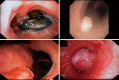
Examples of airway pathology identified by flexible bronchoscopy. Upper left: airway foreign body upper right: granular cell tumor of the trachea. Lower left: tracheobronchial airway injury with avulsion of the right mainstem bronchus lower right: obstructing bronchopulmonary carcinoid tumor in the left mainstem bronchus.
👁 Figure 2
Figure 2
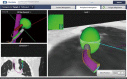
ENB peripheral navigation screenshot. The CT guided planned pathway is used to navigate to the left upper lobe nodule to allow for tissue sampling. ENB, electromagnetic navigational bronchoscopy.

References

    1. Panchabhai TS, Mehta AC. Historical perspectives of bronchoscopy. Connecting the dots. Ann Am Thorac Soc 2015;12:631-41. 10.1513/AnnalsATS.201502-089PS - DOI - PubMed
    1. Kollofrath O. Entfernung eines Knochenstücks aus dem rechten Bronchus auf natürlichem Wege und unter Anwendung der directen Laryngoscopie. MMW 1897;38:1038-9.
    1. Jackson C. Tracheo-bronchoscopy, esophagoscopy and gastroscopy. St. Louis, MO: The Laryngoscope Company, 1907. Available online: https://archive.org/stream/tracheobronchosc00jackuoft/tracheobronchosc00...
    1. Walters DM, Wood DE. Operative endoscopy of the airway. J Thorac Dis 2016;8:S130-9. - PMC - PubMed
    1. McRae K. Anesthesia for airway surgery. Anesthesiol Clin North America 2001;19:497-541, vi. 10.1016/S0889-8537(05)70245-5 - DOI - PubMed

LinkOut - more resources

Cite

NCBI Literature Resources

MeSH PMC Bookshelf Disclaimer

The PubMed wordmark and PubMed logo are registered trademarks of the U.S. Department of Health and Human Services (HHS). Unauthorized use of these marks is strictly prohibited.