VOOZH about

URL: https://pubmed.ncbi.nlm.nih.gov/28466096/

โ‡ฑ Pathogenic human coronavirus infections: causes and consequences of cytokine storm and immunopathology - PubMed


Clipboard, Search History, and several other advanced features are temporarily unavailable.
Skip to main page content
๐Ÿ‘ Dot gov

The .gov means itโ€™s official.
Federal government websites often end in .gov or .mil. Before sharing sensitive information, make sure youโ€™re on a federal government site.

๐Ÿ‘ Https

The site is secure.
The https:// ensures that you are connecting to the official website and that any information you provide is encrypted and transmitted securely.

Access keys NCBI Homepage MyNCBI Homepage Main Content Main Navigation

Add to Collections

Add to My Bibliography

Your saved search

Create a file for external citation management software

Your RSS Feed

Abstract

Human coronaviruses (hCoVs) can be divided into low pathogenic and highly pathogenic coronaviruses. The low pathogenic CoVs infect the upper respiratory tract and cause mild, cold-like respiratory illness. In contrast, highly pathogenic hCoVs such as severe acute respiratory syndrome CoV (SARS-CoV) and Middle East respiratory syndrome CoV (MERS-CoV) predominantly infect lower airways and cause fatal pneumonia. Severe pneumonia caused by pathogenic hCoVs is often associated with rapid virus replication, massive inflammatory cell infiltration and elevated pro-inflammatory cytokine/chemokine responses resulting in acute lung injury (ALI), and acute respiratory distress syndrome (ARDS). Recent studies in experimentally infected animal strongly suggest a crucial role for virus-induced immunopathological events in causing fatal pneumonia after hCoV infections. Here we review the current understanding of how a dysregulated immune response may cause lung immunopathology leading to deleterious clinical manifestations after pathogenic hCoV infections.

Keywords: Cytokine storm; Immunopathology; Interferon; MERS-CoV; Monocyte-macrophage; SARS-CoV.


Figures

๐Ÿ‘ Fig. 1
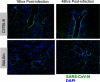
Fig. 1
Staining for SARS-CoV-N antigen in lungs of C57BL/6 and BALB/c mice at 16 and 48 h post-infection
๐Ÿ‘ Fig. 2
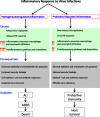
Fig. 2
Schematic representation of protective versus pathogenic inflammatory responses to pathogenic hCoV infections

References

    1. Masters PS, Perlman, S (2013) Coronaviridae. In: Knipe DM, Howley P (eds) Fields Virology. Lippincott Williams and Wilkins, Philadelphia, PA, pp 825โ€“858
    1. Siddell SZJ, Snijder EJ. Coronaviruses, toroviruses, and arteriviruses, vol. 1. London: Hodder Arnold; 2005.
    1. Peck KM, et al. Coronavirus host range expansion and Middle East respiratory syndrome coronavirus emergence: biochemical mechanisms and evolutionary perspectives. Annu Rev Virol. 2015;2(1):95โ€“117. doi: 10.1146/annurev-virology-100114-055029. - DOI - PubMed
    1. Su S, et al. Epidemiology, genetic recombination, and pathogenesis of coronaviruses. Trends Microbiol. 2016;24(6):490โ€“502. doi: 10.1016/j.tim.2016.03.003. - DOI - PMC - PubMed
    1. Weiss SR, Navas-Martin S. Coronavirus pathogenesis and the emerging pathogen severe acute respiratory syndrome coronavirus. Microbiol Mol Biol Rev. 2005;69(4):635โ€“664. doi: 10.1128/MMBR.69.4.635-664.2005. - DOI - PMC - PubMed

MeSH terms

Cite

NCBI Literature Resources

MeSH PMC Bookshelf Disclaimer

The PubMed wordmark and PubMed logo are registered trademarks of the U.S. Department of Health and Human Services (HHS). Unauthorized use of these marks is strictly prohibited.