Abstract
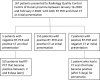
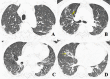
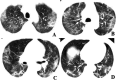
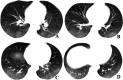
Some patients with positive chest CT findings may present with negative results of real-time reverse-transcription polymerase chain reaction (RT-PCR) tests for coronavirus disease 2019 (COVID-19). In this study, the authors present chest CT findings from five patients with COVID-19 infection who had initial negative RT-PCR results. All five patients had typical imaging findings, including ground-glass opacity (five patients) and/or mixed ground-glass opacity and mixed consolidation (two patients). After isolation for presumed COVID-19 pneumonia, all patients were eventually confirmed to have COVID-19 infection by means of repeated swab tests. A combination of repeated swab tests and CT scanning may be helpful for individuals with a high clinical suspicion of COVID-19 infection but negative findings at RT-PCR screening.
© RSNA, 2020.
Figures




Comment in
-
High-resolution CT features in patients with COVID-19 pneumonia and negative nasopharyngeal and oropharyngeal swabs.Quaia E, Baratella E, Crimi F, Cancian L, Crivelli P, Vianello A. Quaia E, et al. Pulmonology. 2021 Jul-Aug;27(4):351-353. doi: 10.1016/j.pulmoe.2020.10.001. Epub 2020 Oct 21. Pulmonology. 2021. PMID: 33158785 Free PMC article. No abstract available.
References
-
- WHO. Novel coronavirus–China. Jan 12, 2020[EB/OL]. http://www.who.int/csr/don/12-january-2020-novel-coronavirus-china/en/ (accessed Jan 19, 2020).
-
- China National Health Commission . Diagnosis and treatment of pneumonitis caused by new coronavirus (trial version 5). Beijing: China National Health Commission, 2020. http://www.nhc.gov.cn/yzygj/s7653p/202001/4294563ed35b43209b31739bd0785e... (accessed Feb 5, 2020).
-
- AJLAN A M, AHYAD R A, JAMJOOM L G, et al. Middle East respiratory syndrome coronavirus (MERS-CoV) infection: chest CT findings[J]. AJR Am J Roentgenol, 2014,203(4):782-787. - PubMed
-
- OOI G C, KHONG P L, MULLER N L, et al. Severe acute respiratory syndrome: temporal lung changes at thin-section CT in 30 patients[J]. Radiology, 2004,230(3):836-844. - PubMed
Publication types
MeSH terms
Substances
LinkOut - more resources
Full Text Sources
Other Literature Sources
Medical