


Abstract
Background: A relatively high mortality of severe coronavirus disease 2019 (COVID-19) is worrying, and the application of heparin in COVID-19 has been recommended by some expert consensus because of the risk of disseminated intravascular coagulation and venous thromboembolism. However, its efficacy remains to be validated.
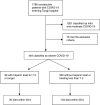
Methods: Coagulation results, medications, and outcomes of consecutive patients being classified as having severe COVID-19 in Tongji hospital were retrospectively analyzed. The 28-day mortality between heparin users and nonusers were compared, as was a different risk of coagulopathy, which was stratified by the sepsis-induced coagulopathy (SIC) score or D-dimer result.
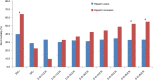
Results: There were 449 patients with severe COVID-19 enrolled into the study, 99 of them received heparin (mainly with low molecular weight heparin) for 7 days or longer. D-dimer, prothrombin time, and age were positively, and platelet count was negatively, correlated with 28-day mortality in multivariate analysis. No difference in 28-day mortality was found between heparin users and nonusers (30.3% vs 29.7%, P = .910). But the 28-day mortality of heparin users was lower than nonusers in patients with SIC score ≥4 (40.0% vs 64.2%, P = .029), or D-dimer >6-fold of upper limit of normal (32.8% vs 52.4%, P = .017).
Conclusions: Anticoagulant therapy mainly with low molecular weight heparin appears to be associated with better prognosis in severe COVID-19 patients meeting SIC criteria or with markedly elevated D-dimer.
Keywords: D-dimer; coagulopathy; coronavirus disease 2019; low molecular weight heparin; sepsis.
© 2020 International Society on Thrombosis and Haemostasis.
Figures


Comment in
-
The versatile heparin in COVID-19.Thachil J. Thachil J. J Thromb Haemost. 2020 May;18(5):1020-1022. doi: 10.1111/jth.14821. Epub 2020 Apr 27. J Thromb Haemost. 2020. PMID: 32239799 Free PMC article. No abstract available.
-
Venous thromboembolism in COVID-19 patients.Porfidia A, Pola R. Porfidia A, et al. J Thromb Haemost. 2020 Jun;18(6):1516-1517. doi: 10.1111/jth.14842. J Thromb Haemost. 2020. PMID: 32294289 Free PMC article. No abstract available.
-
Pathological evidence of pulmonary thrombotic phenomena in severe COVID-19.Dolhnikoff M, Duarte-Neto AN, de Almeida Monteiro RA, da Silva LFF, de Oliveira EP, Saldiva PHN, Mauad T, Negri EM. Dolhnikoff M, et al. J Thromb Haemost. 2020 Jun;18(6):1517-1519. doi: 10.1111/jth.14844. J Thromb Haemost. 2020. PMID: 32294295 Free PMC article. No abstract available.
-
Reply to "Anticoagulant treatment is associated with decreased mortality in severe coronavirus disease 2019 patients with coagulopathy".Coto-Hernández R, Fábregas Ruano MT. Coto-Hernández R, et al. J Thromb Haemost. 2020 Jun;18(6):1519-1520. doi: 10.1111/jth.14852. Epub 2020 May 6. J Thromb Haemost. 2020. PMID: 32302445 Free PMC article. No abstract available.
-
Response to 'Reply to Anticoagulant treatment is associated with decreased mortality in severe coronavirus disease 2019 patients with coagulopathy'.Tang N. Tang N. J Thromb Haemost. 2020 Jun;18(6):1520-1521. doi: 10.1111/jth.14851. Epub 2020 May 6. J Thromb Haemost. 2020. PMID: 32302451 Free PMC article. No abstract available.
-
Potential of heparin and nafamostat combination therapy for COVID-19.Asakura H, Ogawa H. Asakura H, et al. J Thromb Haemost. 2020 Jun;18(6):1521-1522. doi: 10.1111/jth.14858. Epub 2020 May 6. J Thromb Haemost. 2020. PMID: 32302456 Free PMC article. No abstract available.
-
Inaccurate conclusions by Tang and colleagues.Greenstein YY. Greenstein YY. J Thromb Haemost. 2020 Jul;18(7):1797. doi: 10.1111/jth.14857. Epub 2020 May 26. J Thromb Haemost. 2020. PMID: 32304156 Free PMC article. No abstract available.
-
Response to 'Inaccurate conclusions by Tang and colleagues'.Tang N. Tang N. J Thromb Haemost. 2020 Jul;18(7):1798. doi: 10.1111/jth.14862. Epub 2020 May 6. J Thromb Haemost. 2020. PMID: 32311835 Free PMC article. No abstract available.
-
The tug-of-war between coagulopathy and anticoagulant agents in patients with COVID-19.Canonico ME, Siciliano R, Scudiero F, Sanna GD, Parodi G. Canonico ME, et al. Eur Heart J Cardiovasc Pharmacother. 2020 Jul 1;6(4):262-264. doi: 10.1093/ehjcvp/pvaa048. Eur Heart J Cardiovasc Pharmacother. 2020. PMID: 32383737 Free PMC article. No abstract available.
-
Anticoagulant and antiarrhythmic effects of heparin in the treatment of COVID-19 patients.Menezes-Rodrigues FS, Padrão Tavares JG, Pires de Oliveira M, Guzella de Carvalho R, Ruggero Errante P, Omar Taha M, José Fagundes D, Caricati-Neto A. Menezes-Rodrigues FS, et al. J Thromb Haemost. 2020 Aug;18(8):2073-2075. doi: 10.1111/jth.14902. J Thromb Haemost. 2020. PMID: 32408391 Free PMC article. No abstract available.
-
COVID-19, thromboembolic risk and thromboprophylaxis: learning lessons from the bedside, awaiting evidence.Coppola A, Lombardi M, Tassoni MI, Carolla G, Tala M, Morandini R, Paoletti O, Testa S. Coppola A, et al. Blood Transfus. 2020 May;18(3):226-229. doi: 10.2450/2020.0113-20. Blood Transfus. 2020. PMID: 32453688 Free PMC article. No abstract available.
-
Sars-CoV-2 Induced Coagulopathy and Prognosis in Hospitalized Patients: A Snapshot from Italy.Giusti B, Gori AM, Alessi M, Rogolino A, Lotti E, Poli D, Sticchi E, Bartoloni A, Morettini A, Nozzoli C, Peris A, Pieralli F, Poggesi L, Marchionni N, Marcucci R. Giusti B, et al. Thromb Haemost. 2020 Aug;120(8):1233-1236. doi: 10.1055/s-0040-1712918. Epub 2020 May 26. Thromb Haemost. 2020. PMID: 32455440 No abstract available.
-
Major cardiovascular events in patients with Coronavirus Disease 2019: Experience of a cardiovascular department of Northern Italy.Bellosta R, Pegorer MA, Bettari L, Luzzani L, Attisani L, Fossati A, Consoli L, Maffeo D, Cuccia C, Terragnoli P, Bush RL, Piffaretti G. Bellosta R, et al. Thromb Res. 2021 Jan;197:202-204. doi: 10.1016/j.thromres.2020.10.038. Epub 2020 Nov 6. Thromb Res. 2021. PMID: 33260043 Free PMC article.
References
-
- Shanghai Clinical Treatment Expert Group for. COVID‐19 Comprehensive treatment and management of coronavirus disease 2019: expert consensus statement from Shanghai (in Chinese) Chin J Infect Dis. 2020;38 doi: 10.3760/cma.j.issn.1000-6680.2020.0016. - DOI
Publication types
MeSH terms
Substances
Grants and funding
LinkOut - more resources
Full Text Sources
Other Literature Sources
Medical
