Erratum in
-
Errors in Statistical Numbers and Data.[No authors listed] [No authors listed] JAMA Cardiol. 2020 Nov 1;5(11):1308. doi: 10.1001/jamacardio.2020.4648. JAMA Cardiol. 2020. PMID: 32840563 Free PMC article. No abstract available.
Abstract
Importance: Coronavirus disease 2019 (COVID-19) continues to cause considerable morbidity and mortality worldwide. Case reports of hospitalized patients suggest that COVID-19 prominently affects the cardiovascular system, but the overall impact remains unknown.
Objective: To evaluate the presence of myocardial injury in unselected patients recently recovered from COVID-19 illness.
Design, setting, and participants: In this prospective observational cohort study, 100 patients recently recovered from COVID-19 illness were identified from the University Hospital Frankfurt COVID-19 Registry between April and June 2020.
Exposure: Recent recovery from severe acute respiratory syndrome coronavirus 2 infection, as determined by reverse transcription-polymerase chain reaction on swab test of the upper respiratory tract.
Main outcomes and measures: Demographic characteristics, cardiac blood markers, and cardiovascular magnetic resonance (CMR) imaging were obtained. Comparisons were made with age-matched and sex-matched control groups of healthy volunteers (n = 50) and risk factor-matched patients (n = 57).
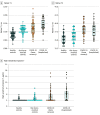
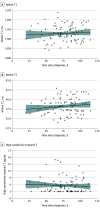
Results: Of the 100 included patients, 53 (53%) were male, and the mean (SD) age was 49 (14) years. The median (IQR) time interval between COVID-19 diagnosis and CMR was 71 (64-92) days. Of the 100 patients recently recovered from COVID-19, 67 (67%) recovered at home, while 33 (33%) required hospitalization. At the time of CMR, high-sensitivity troponin T (hsTnT) was detectable (greater than 3 pg/mL) in 71 patients recently recovered from COVID-19 (71%) and significantly elevated (greater than 13.9 pg/mL) in 5 patients (5%). Compared with healthy controls and risk factor-matched controls, patients recently recovered from COVID-19 had lower left ventricular ejection fraction, higher left ventricle volumes, and raised native T1 and T2. A total of 78 patients recently recovered from COVID-19 (78%) had abnormal CMR findings, including raised myocardial native T1 (n = 73), raised myocardial native T2 (n = 60), myocardial late gadolinium enhancement (n = 32), or pericardial enhancement (n = 22). There was a small but significant difference between patients who recovered at home vs in the hospital for native T1 mapping (median [IQR], 1119 [1092-1150] ms vs 1141 [1121-1175] ms; P = .008) and hsTnT (4.2 [3.0-5.9] pg/dL vs 6.3 [3.4-7.9] pg/dL; P = .002) but not for native T2 mapping. None of these measures were correlated with time from COVID-19 diagnosis (native T1: r = 0.07; P = .47; native T2: r = 0.14; P = .15; hsTnT: r = -0.07; P = .50). High-sensitivity troponin T was significantly correlated with native T1 mapping (r = 0.33; P < .001) and native T2 mapping (r = 0.18; P = .01). Endomyocardial biopsy in patients with severe findings revealed active lymphocytic inflammation. Native T1 and T2 were the measures with the best discriminatory ability to detect COVID-19-related myocardial pathology.
Conclusions and relevance: In this study of a cohort of German patients recently recovered from COVID-19 infection, CMR revealed cardiac involvement in 78 patients (78%) and ongoing myocardial inflammation in 60 patients (60%), independent of preexisting conditions, severity and overall course of the acute illness, and time from the original diagnosis. These findings indicate the need for ongoing investigation of the long-term cardiovascular consequences of COVID-19.
Conflict of interest statement
Dr Escher has received personal fees from Institut Kardiale Diagnostik und Therapie outside the submitted work. Dr Zeiher has received grants from the German Centre for Cardiovascular Research during the conduct of the study and personal fees from Sanofi, Amgen, Boehringer Ingelheim, and Novo Nordisk outside the submitted work. Dr Vehreschild has received grants from BioNTech and Takeda outside the submitted work. Dr Nagel has received grants from Bayer, the German Ministry for Education and Research, Deutsche Herzstiftung e.V., Neosoft Technologies, and Cardio-Pulmonary Institute and personal fees from Bayer. No other disclosures were reported.
Figures



Comment in
-
Coronavirus Disease 2019 (COVID-19) and the Heart-Is Heart Failure the Next Chapter?Yancy CW, Fonarow GC. Yancy CW, et al. JAMA Cardiol. 2020 Nov 1;5(11):1216-1217. doi: 10.1001/jamacardio.2020.3575. JAMA Cardiol. 2020. PMID: 32730614 No abstract available.
-
Errors in Statistical Numbers and Data in Study of Cardiovascular Magnetic Resonance Imaging in Patients Recently Recovered From COVID-19.Nagel E, Puntmann VO. Nagel E, et al. JAMA Cardiol. 2020 Nov 1;5(11):1307-1308. doi: 10.1001/jamacardio.2020.4661. JAMA Cardiol. 2020. PMID: 32840561 No abstract available.
-
Explanation for the Corrections for the Study of Cardiovascular Magnetic Resonance Imaging in Patients Recently Recovered From Coronavirus Disease 2019.Bonow RO, Yancy CW. Bonow RO, et al. JAMA Cardiol. 2020 Nov 1;5(11):1308. doi: 10.1001/jamacardio.2020.4667. JAMA Cardiol. 2020. PMID: 32840577 No abstract available.
-
Cardiac Involvement After Recovering From COVID-19.Malek LA. Malek LA. JAMA Cardiol. 2021 Feb 1;6(2):243. doi: 10.1001/jamacardio.2020.5276. JAMA Cardiol. 2021. PMID: 33112368 No abstract available.
-
Cardiac Involvement After Recovering From COVID-19.Filippetti L, Pace N, Marie PY. Filippetti L, et al. JAMA Cardiol. 2021 Feb 1;6(2):243-244. doi: 10.1001/jamacardio.2020.5279. JAMA Cardiol. 2021. PMID: 33112937 No abstract available.
-
Beyond the AJR: "Outcomes of Cardiovascular Magnetic Resonance Imaging in Patients Recently Recovered From Coronavirus Disease 2019 (COVID-19)".Parwani P, Ordovas KG. Parwani P, et al. AJR Am J Roentgenol. 2021 Jul;217(1):260. doi: 10.2214/AJR.20.25140. Epub 2020 Dec 23. AJR Am J Roentgenol. 2021. PMID: 33355486 No abstract available.
-
Cardiac involvement in athletes recently recovered from COVID-19.Tsiachris D, Chatzantonis G, Antoniou CK, Lalos H, Bogdanis GC, Nikolaou P, Spanos A, Karagiannis S, Tsioufis C, Yilmaz A, Stefanadis C. Tsiachris D, et al. Hellenic J Cardiol. 2022 Nov-Dec;68:63-65. doi: 10.1016/j.hjc.2022.09.012. Epub 2022 Sep 28. Hellenic J Cardiol. 2022. PMID: 36181997 Free PMC article. No abstract available.
References
Publication types
MeSH terms
Substances
LinkOut - more resources
Full Text Sources
Other Literature Sources
Medical
Miscellaneous