


Abstract
Objective: To estimate the prevalence of olfactory and gustatory dysfunctions (OGDs) among patients infected with novel coronavirus disease 2019 (COVID-19).
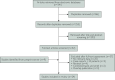
Methods: A systematic review was conducted by searching MEDLINE, EMBASE, and the preprint server MedRxiv from their inception until May 11, 2020, using the terms anosmia or hyposmia or dysosmia or olfactory dysfunction or olfaction disorder or smell dysfunction or ageusia or hypogeusia or dysgeusia or taste dysfunction or gustatory dysfunction or neurological and COVID-19 or 2019 novel coronavirus or 2019-nCoV or SARS-CoV-2. The references of included studies were also manually screened. Only studies involving patients with diagnostic-confirmed COVID-19 infection were included. Random-effects meta-analysis was performed.
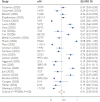
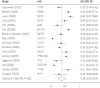
Results: Twenty-four studies with data from 8438 patients with test-confirmed COVID-19 infection from 13 countries were included. The pooled proportions of patients presenting with olfactory dysfunction and gustatory dysfunction were 41.0% (95% CI, 28.5% to 53.9%) and 38.2% (95% CI, 24.0% to 53.6%), respectively. Increasing mean age correlated with lower prevalence of olfactory (coefficient = -0.076; P=.02) and gustatory (coefficient = -0.073; P=.03) dysfunctions. There was a higher prevalence of olfactory dysfunctions with the use of objective measurements compared with self-reports (coefficient = 2.33; P=.01). No significant moderation of the prevalence of OGDs by sex was observed.
Conclusion: There is a high prevalence of OGDs among patients infected with COVID-19. Routine screening for these conditions could contribute to improved case detection in the ongoing COVID-19 pandemic. However, to better inform population screening measures, further studies are needed to establish causality.
Copyright © 2020 Mayo Foundation for Medical Education and Research. Published by Elsevier Inc. All rights reserved.
Figures



Comment in
-
COVID's toll on smell and taste: what scientists do and don't know.Marshall M. Marshall M. Nature. 2021 Jan;589(7842):342-343. doi: 10.1038/d41586-021-00055-6. Nature. 2021. PMID: 33452511 No abstract available.
References
-
- Worldometers. COVID-19 coronavirus pandemic. 2020. https://www.worldometers.info/coronavirus/
-
- Hopkins C., Surda P., Kumar N. Presentation of new onset anosmia during the COVID-19 pandemic. Rhinology. 2020;58(3):295–298. - PubMed
Publication types
MeSH terms
LinkOut - more resources
Full Text Sources
Other Literature Sources
Medical
Miscellaneous
