


Abstract
Background: During the coronavirus disease 2019 (COVID-19) pandemic, Iran reported its first confirmed cases of syndrome coronavirus 2 (SARS-CoV-2) infections on 19 February 2020 in Qom. Although the numbers of cases are increasing, no report about clinical manifestations, laboratory results, and imaging findings of the children infected with COVID-19 in Iran has been published. The aim of this study was to evaluate the epidemiological, clinical, and radiological and laboratory findings of 24 children who had proven SARS-CoV-2 infection and performed chest computed tomographic (CT) in Qom, Iran.
Methods: Demographic information and clinical characteristics of the patients including signs and symptoms, chest CT scan manifestation, laboratory findings and clinical outcomes were collected. Diagnosing of the confirmed case was based on positive real-time reverse-transcriptase-polymerase-chain-reaction test for SARS-CoV-2.
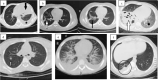
Findings: During the first 3 months of the epidemic in Qom, Iran, 24 children with confirmed diagnosis of COVID-19 were included. The median age of the cases was 6 years [inter-quartile range 3.5-9.5 years]. The most common presenting symptoms were fever (100%), dry cough (62.5%), tachypnea (29%), abdominal pain (21%), and vomiting (21%). Three cases (12.5%) presented with a history of diarrhea in addition to fever and cough. According to the chest CT findings, 2 cases (8%) showed no abnormality. Typical CT findings were found in 6 patients (25%), 2 patients showed indeterminate appearance, and 14 patients (58%) showed atypical findings. Two children with SARS-CoV-2 infection manifested as a hyperinflammatory syndrome with multi-organ involvement similar to Kawasaki disease shock syndrome. Seventy-one percent of the patients showed severe SARS-CoV-2 infection and the mortality of 12.5% (3 cases) were reported.
Interpretation: High frequency of atypical chest CT finding in children should raise concern for pediatricians. Early recognition of patients with SARS-CoV-2 infection is of crucial importance in controlling of the outbreak and atypical imaging features should be interpreted with caution.
Keywords: Atypical CT appearance; COVID-19; CT scan; Children; Iran.
Copyright © 2020. Published by Elsevier B.V.
Conflict of interest statement
Declaration of competing interest The authors have no conflict of interest relevant to this paper to disclose.
Figures

References
-
- World Health Organization . 2020 May 30. Coronavirus disease 2019 ( COVID-19): situation report; p. 131.
-
- Novel C.P.E.R.E. The epidemiological characteristics of an outbreak of 2019 novel coronavirus diseases (COVID-19) in China. Zhonghua Liuxingbingxue Zazhi. 2020 Feb 10;41(2):145–151. - PubMed
MeSH terms
LinkOut - more resources
Full Text Sources
Medical
Miscellaneous
