


Abstract
Background: Since April 2020, there have been numerous reports of children presenting with systemic inflammation, often in critical condition, and with evidence of recent infection of severe acute respiratory syndrome coronavirus 2 (SARS-CoV-2). This condition, since defined as the multisystem inflammatory syndrome in children (MIS-C), is assumed to be a delayed immune response to coronavirus disease 2019 (COVID-19), and there are frequently cardiac manifestations of ventricular dysfunction and/or coronary artery dilation.
Methods: We surveyed the inpatient MIS-C management approaches of the members of the International Kawasaki Disease Registry across 38 institutions and 11 countries.
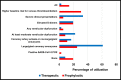
Results: Among the respondents, 56% reported using immunomodulatory treatment for all MIS-C patients, regardless of presentation. Every respondent reported use of intravenous immunoglobulin (IVIG), including 53% administering IVIG in all patients. Steroids were most often used for patients with severe clinical presentation or lack of response to IVIG, and only a minority used steroids in all patients (14%). Acetylsalicylic acid was frequently used among respondents (91%), including anti-inflammatory and/or antiplatelet dosing. Respondents reported use of prophylactic anticoagulation, especially in patients at higher risk for venous thromboembolism, and therapeutic anticoagulation, particularly for patients with giant coronary artery aneurysms.
Conclusions: There is variation in management of MIS-C patients, with suboptimal evidence to assess superiority of the various treatments; evidence-based gaps in knowledge should be addressed through worldwide collaboration to optimize treatment strategies.
Contexte: Depuis avril 2020, de nombreux cas d’enfants présentant une inflammation généralisée, se trouvant souvent dans un état critique et montrant des signes d’une infection récente au coronavirus du syndrome respiratoire aigu sévère 2 (SRAS-CoV-2), ont été signalés. On pense que cet état, désigné depuis sous le nom de syndrome inflammatoire multisystémique de l’enfant (SIME), pourrait être une réponse immunitaire tardive au virus de la maladie à coronavirus 2019 (COVID-19); les patients présentent souvent des manifestations cardiaques associées à une dysfonction ventriculaire ou à une dilatation des artères coronaires.
Méthodologie: Nous avons mené un sondage sur les stratégies de prise en charge du SIME en milieu hospitalier auprès des membres du registre international de la maladie de Kawasaki, qui sont rattachés à 38 établissements répartis dans 11 pays.
Résultats: Au total, 56 % des répondants ont déclaré opter pour un traitement immunomodulateur pour tous les patients présentant un SIME, quelles qu’en soient les manifestations. Tous les répondants ont déclaré avoir recours à l’administration d’immunoglobulines par voie intraveineuse, 53 % d’entre eux utilisant ce traitement chez tous les patients. Les stéroïdes étaient plus souvent utilisés chez les patients présentant des symptômes cliniques graves ou ne répondant pas aux immunoglobulines administrées par voie intraveineuse; seule une minorité de répondants ont déclaré utiliser des stéroïdes chez tous les patients (14 %). Les répondants utilisaient aussi fréquemment l’acide acétylsalicylique (91 %), à des doses anti-inflammatoires ou antiplaquettaires. Ils ont en outre déclaré avoir recours à des anticoagulants en prophylaxie, en particulier chez les patients présentant un risque élevé de thromboembolie veineuse, et à une anticoagulothérapie chez les patients présentant des anévrismes coronaires géants.
Conclusions: La prise en charge des patients présentant un SIME varie d’un médecin à l’autre, et les données permettant d’évaluer la supériorité des divers traitements employés sont insuffisantes; il conviendrait donc de mettre en place des initiatives de collaboration afin de combler les lacunes des connaissances et d’optimiser les stratégies thérapeutiques.
© 2020 Canadian Cardiovascular Society. Published by Elsevier Inc.
Figures




References
-
- Pediatric Critical Care Society PICS Statement: Increased number of reported cases of novel presentation of multisystem inflammatory disease. https://pccsociety.uk/wp-content/uploads/2020/04/PICS-statement-re-novel... Available at:
-
- World Health Organization Multisystem inflammatory syndrome in children and adolescents with COVID-19: Scientific Brief. https://www.who.int/publications-detail/multisystem-inflammatory-syndrom... Available at:
-
- Royal College of Paediatrics and Child Health Guidance: Paediatric multisystem inflammatory syndrome temporally associated with COVID-19. https://www.rcpch.ac.uk/sites/default/files/2020-05/COVID-19-Paediatric-... Available at: - PubMed
-
- Centers for Disease Control and Prevention Health Alert Network (HAN) Multisystem Inflammatory Syndrome in Children (MIS-C) Associated with Coronavirus Disease 2019 (COVID-19) https://emergency.cdc.gov/han/2020/han00432.asp Available at:
LinkOut - more resources
Full Text Sources
Miscellaneous
