VOOZH about

URL: https://pubmed.ncbi.nlm.nih.gov/32957995/

⇱ Transmission of severe acute respiratory syndrome coronavirus 2 (SARS-CoV-2) to animals: an updated review - PubMed


Clipboard, Search History, and several other advanced features are temporarily unavailable.
Skip to main page content
👁 Dot gov

The .gov means it’s official.
Federal government websites often end in .gov or .mil. Before sharing sensitive information, make sure you’re on a federal government site.

👁 Https

The site is secure.
The https:// ensures that you are connecting to the official website and that any information you provide is encrypted and transmitted securely.

Access keys NCBI Homepage MyNCBI Homepage Main Content Main Navigation

Add to Collections

Add to My Bibliography

Your saved search

Create a file for external citation management software

Your RSS Feed

Abstract

COVID-19 caused by a novel severe acute respiratory syndrome coronavirus 2 (SARS-CoV-2) originated in Wuhan (Hubei province, China) during late 2019. It has spread across the globe affecting nearly 21 million people with a toll of 0.75 million deaths and restricting the movement of most of the world population during the past 6 months. COVID-19 became the leading health, economic, and humanitarian challenge of the twenty-first century. In addition to the considerable COVID-19 cases, hospitalizations, and deaths in humans, several cases of SARS-CoV-2 infections in animal hosts (dog, cat, tiger, lion, and mink) have been reported. Thus, the concern of pet owners is increasing. Moreover, the dynamics of the disease requires further explanation, mainly concerning the transmission of the virus from humans to animals and vice versa. Therefore, this study aimed to gather information about the reported cases of COVID-19 transmission in animals through a literary review of works published in scientific journals and perform genomic and phylogenetic analyses of SARS-CoV-2 isolated from animal hosts. Although many instances of transmission of the SARS-CoV-2 have been reported, caution and further studies are necessary to avoid the occurrence of maltreatment in animals, and to achieve a better understanding of the dynamics of the disease in the environment, humans, and animals. Future research in the animal-human interface can help formulate and implement preventive measures to combat the further transmission of COVID-19.

Keywords: Animals; COVID-19; Coronavirus; Epidemiology; One Health; Pandemic; Pet animals; SARS-CoV-2; Zoonoses.


Conflict of interest statement

The authors declare that they have no competing interests.

Figures

👁 Fig. 1
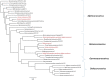
Fig. 1
Phylogenetic tree of Coronaviridae taxonomy
👁 Fig. 2
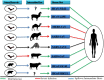
Fig. 2
Coronavirus origins and relationship between humans and animals
👁 Fig. 3
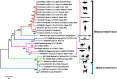
Fig. 3
Phylogenetic analysis of human and animal CoVs

References

    1. Lu R, Zhao X, Li J, Niu P, Yang B, Wu H, Wang W, Song H, Huang B, Zhu N. Genomic characterisation and epidemiology of 2019 novel coronavirus: implications for virus origins and receptor binding. Lancet. 2020;395(10224):565–574. - PMC - PubMed
    1. Wang C, Horby PW, Hayden FG, Gao GF. A novel coronavirus outbreak of global health concern. Lancet. 2020;395(10223):470–473. doi: 10.1016/s0140-6736(20)30185-9. - DOI - PMC - PubMed
    1. Lai CC, Shih TP, Ko WC, Tang HJ, Hsueh PR. Severe acute respiratory syndrome coronavirus 2 (SARS-CoV-2) and coronavirus disease-2019 (COVID-19): the epidemic and the challenges. Int J Antimicrob Agents. 2020 doi: 10.1016/j.ijantimicag.2020.105924. - DOI - PMC - PubMed
    1. Munster VJ, Koopmans M, van Doremalen N, van Riel D, de Wit E. A novel coronavirus emerging in China—key questions for impact assessment. N Engl J Med. 2020;382(8):692–694. - PubMed
    1. Shi J, Wen Z, Zhong G, Yang H, Wang C, Huang B, Liu R, He X, Shuai L, Sun Z. Susceptibility of ferrets, cats, dogs, and other domesticated animals to SARS–coronavirus 2. Science. 2020;368(6494):1016–1020. - PMC - PubMed

MeSH terms

Cite

NCBI Literature Resources

MeSH PMC Bookshelf Disclaimer

The PubMed wordmark and PubMed logo are registered trademarks of the U.S. Department of Health and Human Services (HHS). Unauthorized use of these marks is strictly prohibited.