


Abstract
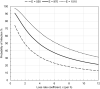
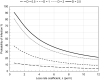
During the 2020 COVID-19 pandemic, an outbreak occurred following attendance of a symptomatic index case at a weekly rehearsal on 10 March of the Skagit Valley Chorale (SVC). After that rehearsal, 53 members of the SVC among 61 in attendance were confirmed or strongly suspected to have contracted COVID-19 and two died. Transmission by the aerosol route is likely; it appears unlikely that either fomite or ballistic droplet transmission could explain a substantial fraction of the cases. It is vital to identify features of cases such as this to better understand the factors that promote superspreading events. Based on a conditional assumption that transmission during this outbreak was dominated by inhalation of respiratory aerosol generated by one index case, we use the available evidence to infer the emission rate of aerosol infectious quanta. We explore how the risk of infection would vary with several influential factors: ventilation rate, duration of event, and deposition onto surfaces. The results indicate a best-estimate emission rate of 970 ± 390 quanta/h. Infection risk would be reduced by a factor of two by increasing the aerosol loss rate to 5 h-1 and shortening the event duration from 2.5 to 1 h.
Keywords: aerosol transmission; infectious disease; pandemic; risk; ventilation; virus.
© 2020 John Wiley & Sons A/S. Published by John Wiley & Sons Ltd.
Conflict of interest statement
The authors of this paper certify that they have NO affiliations with or involvement in any organization or entity with any financial interest (such as honoraria; educational grants; participation in speakers’ bureaus; membership, employment, consultancies, stock ownership, or other equity interest; and expert testimony or patent‐licensing arrangements), or non‐financial interest (such as personal or professional relationships, affiliations, knowledge or beliefs) in the subject matter or materials discussed in this manuscript.
Figures


References
-
- Fears AC, Klimstra WB, Duprex P, et al. Comparative dynamic aerosol efficiencies of three emergent coronaviruses and the unusual persistence of SARS‐CoV‐2 in aerosol suspensions. medRxiv. 2020. 10.1101/2020.04.13.20063784 - DOI
-
- Ding Z, Qian H, Xu B, et al. Toilets dominate environmental detection of SARS‐CoV‐2 virus in a hospital. medRxiv. 2020. 10.1101/2020.04.03.20052175 - DOI
