


Display options
Format
Erratum in
-
Author Correction: A global survey of potential acceptance of a COVID-19 vaccine.Lazarus JV, Ratzan SC, Palayew A, Gostin LO, Larson HJ, Rabin K, Kimball S, El-Mohandes A. Lazarus JV, et al. Nat Med. 2021 Feb;27(2):354. doi: 10.1038/s41591-020-01226-0. Nat Med. 2021. PMID: 33432176 Free PMC article. No abstract available.
Abstract
Several coronavirus disease 2019 (COVID-19) vaccines are currently in human trials. In June 2020, we surveyed 13,426 people in 19 countries to determine potential acceptance rates and factors influencing acceptance of a COVID-19 vaccine. Of these, 71.5% of participants reported that they would be very or somewhat likely to take a COVID-19 vaccine, and 48.1% reported that they would accept their employer's recommendation to do so. Differences in acceptance rates ranged from almost 90% (in China) to less than 55% (in Russia). Respondents reporting higher levels of trust in information from government sources were more likely to accept a vaccine and take their employer's advice to do so.
Conflict of interest statement
The authors declare no competing interests.
Figures

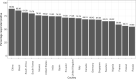
Numbers above the bars represent the percent of respondents in each country who responded positively to the question ‘If a COVID-19 vaccine is proven safe and effective and is available, I will take it’.
Comment in
-
Brazil: Boost COVID-19 vaccine uptake in Indigenous people.Benites E, Gisloti LJ, de Oliveira Roque F. Benites E, et al. Nature. 2021 Mar;591(7850):369. doi: 10.1038/d41586-021-00689-6. Nature. 2021. PMID: 33727721 No abstract available.
-
Women must not be obscured in science's history.[No authors listed] [No authors listed] Nature. 2021 Mar;591(7851):501-502. doi: 10.1038/d41586-021-00770-0. Nature. 2021. PMID: 33762773 No abstract available.
-
COVID-19 Vaccine Hesitancy Among Patients With Psychiatric Disorders.Uvais NA. Uvais NA. Prim Care Companion CNS Disord. 2021 Nov 4;23(6):21br03028. doi: 10.4088/PCC.21br03028. Prim Care Companion CNS Disord. 2021. PMID: 34738353 No abstract available.
References
-
- European Parliament. European Parliament resolution of 19 April 2018 on vaccine hesitancy and drop in vaccination rates in Europe (2017/2951 RSP). https://www.europarl.europa.eu/doceo/document/TA-8-2018-0188_EN.pdf (2018).
Publication types
MeSH terms
Substances
LinkOut - more resources
Full Text Sources
Medical
