VOOZH about

URL: https://pubmed.ncbi.nlm.nih.gov/33177563/

⇱ Long-distance airborne dispersal of SARS-CoV-2 in COVID-19 wards - PubMed


Clipboard, Search History, and several other advanced features are temporarily unavailable.
Skip to main page content
πŸ‘ Dot gov

The .gov means it’s official.
Federal government websites often end in .gov or .mil. Before sharing sensitive information, make sure you’re on a federal government site.

πŸ‘ Https

The site is secure.
The https:// ensures that you are connecting to the official website and that any information you provide is encrypted and transmitted securely.

Access keys NCBI Homepage MyNCBI Homepage Main Content Main Navigation

Add to Collections

Add to My Bibliography

Your saved search

Create a file for external citation management software

Your RSS Feed

Abstract

Evidence suggests that SARS-CoV-2, as well as other coronaviruses, can be dispersed and potentially transmitted by aerosols directly or via ventilation systems. We therefore investigated ventilation openings in one COVID-19 ward and central ducts that expel indoor air from three COVID-19 wards at Uppsala University Hospital, Sweden, during April and May 2020. Swab samples were taken from individual ceiling ventilation openings and surfaces in central ducts. Samples were subsequently subjected to rRT-PCR targeting the N and E genes of SARS-CoV-2. Central ventilation HEPA filters, located several stories above the wards, were removed and portions analyzed in the same manner. In two subsequent samplings, SARS-CoV-2 N and E genes were detected in seven and four out of 19 room vents, respectively. Central ventilation HEPA exhaust filters from the ward were found positive for both genes in three samples. Corresponding filters from two other, adjacent COVID-19 wards were also found positive. Infective ability of the samples was assessed by inoculation of susceptible cell cultures but could not be determined in these experiments. Detection of SARS-CoV-2 in central ventilation systems, distant from patient areas, indicate that virus can be transported long distances and that droplet transmission alone cannot reasonably explain this, especially considering the relatively low air change rates in these wards. Airborne transmission of SARS-CoV-2 must be taken into consideration for preventive measures.


Conflict of interest statement

The authors declare no competing interests.

Figures

πŸ‘ Figure 1
Figure 1
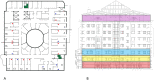
(A) Overview of the 19 investigated COVID-19 ward rooms (ward 1). Dots indicate approximate placing of ceiling vent openings. Red dots indicate openings that where SARS-CoV-2 RNA was detected in at least one of two samplings, blue dots openings negative in both samplings. (B) Lateral view of the hospital building. Ward levels: red; COVID-19 outpatient clinic, yellow and blue; COVID-19 wards 1 and 2, with 19 rooms each, purple; eighth floor with central ventilation fans and HEPA filters. Individual ceiling vent openings were investigated on the second-floor ward (yellow) seen in (A).

References

    1. World Health Organization. Modes of transmission of virus causing COVID-19: Implications for IPC precaution recommendations: Scientific brief, 27 March 2020. https://apps.who.int/iris/handle/10665/331601 (2020).
    1. He X, et al. Temporal dynamics in viral shedding and transmissibility of COVID-19. Nat. Med. 2020;26:672–675. doi: 10.1038/s41591-020-0869-5. - DOI - PubMed
    1. Gralton J, Tovey E, McLaws M-L, Rawlinson WD. The role of particle size in aerosolised pathogen transmission: A review. J. Infect. 2011;62:1–13. doi: 10.1016/j.jinf.2010.11.010. - DOI - PMC - PubMed
    1. Bahl P, et al. Airborne or droplet precautions for health workers treating COVID-19? J. Infect. 2020 doi: 10.1093/infdis/jiaa189. - DOI - PMC - PubMed
    1. Siegel JD, Rhinehart E, Jackson M, Chiarello L, Committee HCICPA. Guideline for isolation precautions: Preventing transmission of infectious agents in health care settings. Am. J. Infect. Control. 2007;35(S65–164):2007. doi: 10.1016/j.ajic.2007.10.007. - DOI - PMC - PubMed
Cite

NCBI Literature Resources

MeSH PMC Bookshelf Disclaimer

The PubMed wordmark and PubMed logo are registered trademarks of the U.S. Department of Health and Human Services (HHS). Unauthorized use of these marks is strictly prohibited.