VOOZH about

URL: https://pubmed.ncbi.nlm.nih.gov/34370712/

⇱ MANAGEMENT OF ENDOCRINE DISEASE: Dysnatraemia in COVID-19: prevalence, prognostic impact, pathophysiology, and management - PubMed


Clipboard, Search History, and several other advanced features are temporarily unavailable.
Skip to main page content
👁 Dot gov

The .gov means it’s official.
Federal government websites often end in .gov or .mil. Before sharing sensitive information, make sure you’re on a federal government site.

👁 Https

The site is secure.
The https:// ensures that you are connecting to the official website and that any information you provide is encrypted and transmitted securely.

Access keys NCBI Homepage MyNCBI Homepage Main Content Main Navigation

Add to Collections

Add to My Bibliography

Your saved search

Create a file for external citation management software

Your RSS Feed

Abstract

This review examines the prevalence, aetiology, pathophysiology, prognostic value, and investigation of dysnatraemia in hospitalised COVID-19 patients, taking into account all relevant studies published in PubMed and Cochrane Library studies until March 2021. Hyponatraemia is commonly observed in patients with bacterial pneumonia and is an independent predictor for excess mortality and morbidity. However, it remains unknown whether this association applies to coronavirus disease-2019 (COVID-19). Several studies reported a 20-35% prevalence for hyponatraemia and 2-5% for hypernatraemia in patients admitted with COVID-19. In addition, hyponatraemia on admission was a risk factor for progression to severe disease, being associated with an increased likelihood for the need for invasive mechanical ventilation, with an odds ratio (OR) of 1.83-3.30. Hyponatraemia seems to be an independent risk factor for mortality, with an OR of 1.40-1.50 compared to normonatraemia, while hypernatraemia is related to even worse outcomes than hyponatraemia. Furthermore, preliminary data show an inverse association between serum sodium and interleukin-6 levels, suggesting that hyponatraemia might be used as a surrogate marker for the risk of a cytokine storm and the need for treatment with interleukin antagonists. In conclusion, dysnatraemia is common and carries a poor prognosis in COVID-19 patients, indicating that it may play a future role in risk stratification and individualising therapy.


Figures

👁 Figure 1
Figure 1
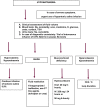
Algorithm for investigation and management of hyponatraemia in patients with COVID-19.

References

    1. Wald R, Jaber BL, Price LL, Upadhyay A, Madias NE. Impact of hospital-associated hyponatremia on selected outcomes. Archives of Internal Medicine 2010170294–302. ( 10.1001/archinternmed.2009.513) - DOI - PubMed
    1. Tzoulis P, Bagkeris E, Bouloux PM. A case-control study of hyponatraemia as an independent risk factor for inpatient mortality. Clinical Endocrinology 201481401–407. ( 10.1111/cen.12429) - DOI - PubMed
    1. Cuesta M, Slattery D, Goulden EL, Gupta S, Tatro E, Sherlock M, Tormey W, O’Neill S, Thompson CJ. Hyponatraemia in patients with community-acquired pneumonia; prevalence and aetiology, and natural history of SIAD. Clinical Endocrinology 201990744–752. ( 10.1111/cen.13937) - DOI - PubMed
    1. Kruger S, Ewig S, Giersdorf S, Hartmann O, Frechen D, Rohde G, Suttorp N, Welte T & CAPNETZ Study Group. Dysnatremia, vasopressin, atrial natriuretic peptide and mortality in patients with community-acquired pneumonia: results from the German Competence Network CAPNETZ. Respiratory Medicine 20141081696–1705. ( 10.1016/j.rmed.2014.09.014) - DOI - PubMed
    1. Muller M, Schefold JC, Guignard V, Exadaktylos AK, Pfortmueller CA. Hyponatraemia is independently associated with in-hospital mortality in patients with pneumonia. European Journal of Internal Medicine 20185446–52. ( 10.1016/j.ejim.2018.04.008) - DOI - PubMed
Cite

NCBI Literature Resources

MeSH PMC Bookshelf Disclaimer

The PubMed wordmark and PubMed logo are registered trademarks of the U.S. Department of Health and Human Services (HHS). Unauthorized use of these marks is strictly prohibited.