VOOZH about

URL: https://pubmed.ncbi.nlm.nih.gov/35980417/

⇱ The Use of a Self-triage Tool to Predict COVID-19 Cases and Hospitalizations in the State of Georgia - PubMed


Clipboard, Search History, and several other advanced features are temporarily unavailable.
Skip to main page content
👁 Dot gov

The .gov means it’s official.
Federal government websites often end in .gov or .mil. Before sharing sensitive information, make sure you’re on a federal government site.

👁 Https

The site is secure.
The https:// ensures that you are connecting to the official website and that any information you provide is encrypted and transmitted securely.

Access keys NCBI Homepage MyNCBI Homepage Main Content Main Navigation

Add to Collections

Add to My Bibliography

Your saved search

Create a file for external citation management software

Your RSS Feed

Abstract

Introduction: The coronavirus 2019 (COVID-19) pandemic has created significant burden on healthcare systems throughout the world. Syndromic surveillance, which collects real-time data based on a range of symptoms rather than laboratory diagnoses, can help provide timely information in emergency response. We examined the effectiveness of a web-based COVID-19 symptom checking tool (C19Check) in the state of Georgia (GA) in predicting COVID-19 cases and hospitalizations.

Methods: We analyzed C19Check use data, COVID-19 cases, and hospitalizations from April 22-November 28, 2020. Cases and hospitalizations in GA were extracted from the Georgia Department of Public Health data repository. We used the Granger causality test to assess whether including C19Check data can improve predictions compared to using previous COVID-19 cases and hospitalizations data alone. Vector autoregression (VAR) models were fitted to forecast cases and hospitalizations from November 29 - December 12, 2020. We calculated mean absolute percentage error to estimate the errors in forecast of cases and hospitalizations.

Results: There were 25,861 C19Check uses in GA from April 22-November 28, 2020. Time-lags tested in Granger causality test for cases (6-8 days) and hospitalizations (10-12 days) were significant (P= <0.05); the mean absolute percentage error of fitted VAR models were 39.63% and 15.86%, respectively.

Conclusion: The C19Check tool was able to help predict COVID-19 cases and related hospitalizations in GA. In settings where laboratory tests are limited, a real-time, symptom-based assessment tool can provide timely and inexpensive data for syndromic surveillance to guide pandemic response. Findings from this study demonstrate that online symptom-checking tools can be a source of data for syndromic surveillance, and the data may help improve predictions of cases and hospitalizations.


Conflict of interest statement

: By the JEM article submission agreement, all authors are required to disclose all affiliations, funding sources and financial or management relationships that could be perceived as potential sources of bias. No author has professional or financial relationships with any companies that are relevant to this study. There are no conflicts of interest or sources of funding to declare.

Figures

👁 Figure 1
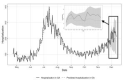
Figure 1
Epidemic curve of measured daily COVID-19 incident cases and C19Check-predicted COVID-19 cases from April 22–December 12, 2020 in the state of Georgia. The upper and lower confidence intervals (gray shading) from the fitted VAR model with a time-lag of seven days are depicted from November 29–December 12, 2020.
👁 Figure 2
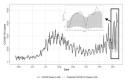
Figure 2
Epidemic curve of measured daily incident COVID-19-related hospitalizations and C19Check-predicted COVID-19 related hospitalizations from April 22–December 12, 2020 in the state of Georgia. The upper and lower confidence intervals (gray shading) from the fitted VAR model with a time-lag of 11 days are depicted from November 29–December 12, 2020.

References

    1. Miller IF, Becker AD, Grenfell BT, et al. Disease and healthcare burden of COVID-19 in the United States. Nat Med. 2020;26(8):1212–17. - PubMed
    1. Heffernan R, Mostashari F, Das D, et al. Syndromic surveillance in public health practice, New York City. Emerg Infect Dis. 2004;10(5):858–64. - PubMed
    1. Paterson BJ, Durrheim DN. The remarkable adaptability of syndromic surveillance to meet public health needs. J Epidemiol Glob Health. 2013;3(1):41–7. - PMC - PubMed
    1. Elliot AJ, Harcourt SE, Hughes HE, et al. The COVID-19 pandemic: a new challenge for syndromic surveillance. Epidemiol Infect. 2020;148:e122. - PMC - PubMed
    1. Yoneoka D, Tanoue Y, Kawashima T, et al. Large-scale epidemiological monitoring of the COVID-19 epidemic in Tokyo. Lancet Reg Health West Pac. 2020;3:100016. - PMC - PubMed
Cite

NCBI Literature Resources

MeSH PMC Bookshelf Disclaimer

The PubMed wordmark and PubMed logo are registered trademarks of the U.S. Department of Health and Human Services (HHS). Unauthorized use of these marks is strictly prohibited.