
SET
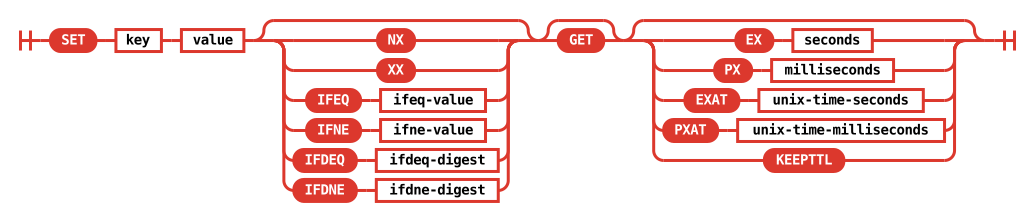
SET key value [NX | XX | IFEQ ifeq-value | IFNE ifne-value |
 IFDEQ ifdeq-digest | IFDNE ifdne-digest] [GET] [EX seconds |
 PX milliseconds | EXAT unix-time-seconds |
 PXAT unix-time-milliseconds | KEEPTTL]
set(
 name: KeyT,
 value: EncodableT,
 ex: Optional[ExpiryT] = None,
 px: Optional[ExpiryT] = None,
 nx: bool = False,
 xx: bool = False,
 keepttl: bool = False,
 get: bool = False,
 exat: Optional[AbsExpiryT] = None,
 pxat: Optional[AbsExpiryT] = None,
 ifeq: Optional[Union[bytes, str]] = None,
 ifne: Optional[Union[bytes, str]] = None,
 ifdeq: Optional[str] = None,
 ifdne: Optional[str] = None
) → ResponseTSET(
key: RedisArgument,
value: RedisArgument | number,
options?: SetOptions
) → Anyset(
key: byte[],
value: byte[]
) → String // simple-string-reply OK if SET was executed correctly, or null if the SET operation was not performed because the user specified the NX or XX option but the condition was not met.
set(
key: byte[],
value: byte[],
params: SetParams // key if it already exists. EX|PX, expire time units: EX = seconds; PX = milliseconds
) → String // simple-string-reply OK if SET was executed correctly, or null if the SET operation was not performed because the user specified the NX or XX option but the condition was not met.
set(
key: String,
value: String
) → String // simple-string-reply OK if SET was executed correctly, or null if the SET operation was not performed because the user specified the NX or XX option but the condition was not met.
set(
key: String,
value: String,
params: SetParams // key if it already exists. EX|PX, expire time units: EX = seconds; PX = milliseconds
) → String // simple-string-reply OK if SET was executed correctly, or null if the SET operation was not performed because the user specified the NX or XX option but the condition was not met.set(
key: K, // the key.
value: V // the value.
) → String // String simple-string-reply OK if SET was executed correctly.
set(
key: K, // the key.
value: V, // the value.
setArgs: SetArgs // the setArgs.
) → String // String simple-string-reply OK if SET was executed correctly.set(
key: K, // the key.
value: V // the value.
) → RedisFuture<String> // String simple-string-reply OK if SET was executed correctly.
set(
key: K, // the key.
value: V, // the value.
setArgs: SetArgs // the setArgs.
) → RedisFuture<String> // String simple-string-reply OK if SET was executed correctly.set(
key: K, // the key.
value: V // the value.
) → Mono<String> // String simple-string-reply OK if SET was executed correctly.
set(
key: K, // the key.
value: V, // the value.
setArgs: SetArgs // the setArgs.
) → Mono<String> // String simple-string-reply OK if SET was executed correctly.Set(
ctx: context.Context,
key: string,
value: interface{},
expiration: time.Duration
) → *StatusCmdStringSet(
key: RedisKey,
value: RedisValue,
expiry: TimeSpan?, // The expiry to set.
when: When // Which condition to set the value under (defaults to always).
) → bool // true if the keys were set, false otherwise.
StringSet(
key: RedisKey,
value: RedisValue,
expiry: TimeSpan?, // The expiry to set.
when: When, // Which condition to set the value under (defaults to always).
flags: CommandFlags // The flags to use for this operation.
) → bool // true if the keys were set, false otherwise.
StringSet(
key: RedisKey,
value: RedisValue,
expiry: TimeSpan?, // The expiry to set.
keepTtl: bool,
when: When, // Which condition to set the value under (defaults to always).
flags: CommandFlags // The flags to use for this operation.
) → bool // true if the keys were set, false otherwise.
StringSet(
key: RedisKey,
value: RedisValue,
expiry: Expiration, // The expiry to set.
when: ValueCondition, // Which condition to set the value under (defaults to always).
flags: CommandFlags // The flags to use for this operation.
) → bool // true if the keys were set, false otherwise.
StringSet(
values: KeyValuePair<RedisKey, RedisValue>[], // The keys and values to set.
when: When, // Which condition to set the value under (defaults to always).
flags: CommandFlags // The flags to use for this operation.
) → bool // true if the keys were set, false otherwise.StringSet(
key: RedisKey,
value: RedisValue,
expiry: TimeSpan?, // The expiry to set.
when: When // Which condition to set the value under (defaults to always).
) → bool // true if the keys were set, false otherwise.
StringSet(
key: RedisKey,
value: RedisValue,
expiry: TimeSpan?, // The expiry to set.
when: When, // Which condition to set the value under (defaults to always).
flags: CommandFlags // The flags to use for this operation.
) → bool // true if the keys were set, false otherwise.
StringSet(
key: RedisKey,
value: RedisValue,
expiry: TimeSpan?, // The expiry to set.
keepTtl: bool,
when: When, // Which condition to set the value under (defaults to always).
flags: CommandFlags // The flags to use for this operation.
) → bool // true if the keys were set, false otherwise.
StringSet(
key: RedisKey,
value: RedisValue,
expiry: Expiration, // The expiry to set.
when: ValueCondition, // Which condition to set the value under (defaults to always).
flags: CommandFlags // The flags to use for this operation.
) → bool // true if the keys were set, false otherwise.
StringSet(
values: KeyValuePair<RedisKey, RedisValue>[], // The keys and values to set.
when: When, // Which condition to set the value under (defaults to always).
flags: CommandFlags // The flags to use for this operation.
) → bool // true if the keys were set, false otherwise.set(
$key: string,
$value: Any,
$expireResolution = null: Any,
$expireTTL = null: Any,
$flag = null: Any,
$flagValue = null: Any
) → Status|nullset(
key: K,
value: V
) → (())set(
key: K,
value: V
) → (())- Available since:
- Redis Open Source 1.0.0
- Time complexity:
- O(1)
- ACL categories:
-
@write,@string,@slow, - Compatibility:
- Redis Software and Redis Cloud compatibility
Set key to hold the string value.
If key already holds a value, it is overwritten, regardless of its type.
Any previous time to live associated with the key is discarded on successful SET operation.
Required arguments
Optional arguments
The following options modify the command's behavior. The condition options (NX, XX, IFEQ, IFNE, IFDEQ, IFDNE) are mutually exclusive, as are the expiration options (EX, PX, EXAT, PXAT, KEEPTTL).
Note: Since the SET command options can replace SETNX, SETEX, PSETEX, GETSET, it is possible that in future versions of Redis these commands will be deprecated and finally removed.
Examples
"""
Code samples for data structure store quickstart pages:
 https://redis.io/docs/latest/develop/get-started/data-store/
"""
import redis
r = redis.Redis(host="localhost", port=6379, db=0, decode_responses=True)
res = r.set("bike:1", "Process 134")
print(res)
# >>> True
res = r.get("bike:1")
print(res)
# >>> "Process 134"
import { createClient } from 'redis';
const client = createClient();
client.on('error', err => console.log('Redis Client Error', err));
await client.connect().catch(console.error);
await client.set('bike:1', 'Process 134');
const value = await client.get('bike:1');
console.log(value);
// returns 'Process 134'
await client.close();
packageio.redis.examples;importredis.clients.jedis.RedisClient;publicclass SetGetExample{publicvoidrun(){RedisClientjedis=RedisClient.create("redis://localhost:6379");Stringstatus=jedis.set("bike:1","Process 134");if("OK".equals(status))System.out.println("Successfully added a bike.");Stringvalue=jedis.get("bike:1");if(value!=null)System.out.println("The name of the bike is: "+value+".");jedis.close();}}package example_commands_test
import (
"context"
"fmt"
"github.com/redis/go-redis/v9"
)
func ExampleClient_Set_and_get() {
ctx := context.Background()
rdb := redis.NewClient(&redis.Options{
Addr: "localhost:6379",
Password: "", // no password docs
DB: 0, // use default DB
})
err := rdb.Set(ctx, "bike:1", "Process 134", 0).Err()
if err != nil {
panic(err)
}
fmt.Println("OK")
value, err := rdb.Get(ctx, "bike:1").Result()
if err != nil {
panic(err)
}
fmt.Printf("The name of the bike is %s", value)
}
using NRedisStack.Tests;
using StackExchange.Redis;
public class SetGetExample
{
 public void Run()
 {
 var muxer = ConnectionMultiplexer.Connect("localhost:6379");
 var db = muxer.GetDatabase();
 bool status = db.StringSet("bike:1", "Process 134");
 if (status)
 Console.WriteLine("Successfully added a bike.");
 var value = db.StringGet("bike:1");
 if (value.HasValue)
 Console.WriteLine("The name of the bike is: " + value + ".");
 }
}
Details
Hash digest
A hash digest is a fixed-size numerical representation of a string value, computed using the XXH3 hash algorithm. Redis uses this hash digest for efficient comparison operations without needing to compare the full string content. You can retrieve a key's hash digest using the DIGEST command, which returns it as a hexadecimal string that you can use with the IFDEQ and IFDNE options, and also the DELEX command's IFDEQ and IFDNE options.
Patterns
Note: The following pattern is discouraged in favor of the Redlock algorithm which is only a bit more complex to implement, but offers better guarantees and is fault tolerant.
The command SET resource-name anystring NX EX max-lock-time is a simple way to implement a locking system with Redis.
A client can acquire the lock if the above command returns OK (or retry after some time if the command returns Nil), and remove the lock just using DEL.
The lock will be auto-released after the expire time is reached.
It is possible to make this system more robust modifying the unlock schema as follows:
- Instead of setting a fixed string, set a non-guessable large random string, called token.
- Instead of releasing the lock with
DEL, send a script that only removes the key if the value matches.
This avoids that a client will try to release the lock after the expire time deleting the key created by another client that acquired the lock later.
An example of unlock script would be similar to the following:
if redis.call("get",KEYS[1]) == ARGV[1]
then
 return redis.call("del",KEYS[1])
else
 return 0
end
The script should be called with EVAL ...script... 1 resource-name token-value
Redis Software and Redis Cloud compatibility
| Redis Software |
Redis Cloud |
Notes |
|---|---|---|
| ✅ Standard |
✅ Standard |
Return information
- If
GETwas not specified, one of the following:- Null bulk string reply in the following two cases.
- The key doesn’t exist and
XX/IFEQ/IFDEQwas specified. The key was not created. - The key exists, and
NXwas specified or a specifiedIFEQ/IFNE/IFDEQ/IFDNEcondition is false. The key was not set.
- The key doesn’t exist and
- Simple string reply:
OK: The key was set.
- Null bulk string reply in the following two cases.
- If
GETwas specified, one of the following:- Null bulk string reply: The key didn't exist before the
SEToperation, whether the key was created of not. - Bulk string reply: The previous value of the key, whether the key was set or not.
- Null bulk string reply: The key didn't exist before the
- If
GETwas not specified, one of the following:- Null reply in the following two cases.
- The key doesn’t exist and
XX/IFEQ/IFDEQwas specified. The key was not created. - The key exists, and
NXwas specified or a specifiedIFEQ/IFNE/IFDEQ/IFDNEcondition is false. The key was not set.
- The key doesn’t exist and
- Simple string reply:
OK: The key was set.
- Null reply in the following two cases.
- If
GETwas specified, one of the following:- Null reply: The key didn't exist before the
SEToperation, whether the key was created of not. - Bulk string reply: The previous value of the key, whether the key was set or not.
- Null reply: The key didn't exist before the
History
- Starting with Redis version 2.6.12: Added the
EX,PX,NXandXXoptions. - Starting with Redis version 6.0.0: Added the
KEEPTTLoption. - Starting with Redis version 6.2.0: Added the
GET,EXATandPXAToption. - Starting with Redis version 7.0.0: Allowed the
NXandGEToptions to be used together. - Starting with Redis version 8.4.0: Added 'IFEQ', 'IFNE', 'IFDEQ', 'IFDNE' options.