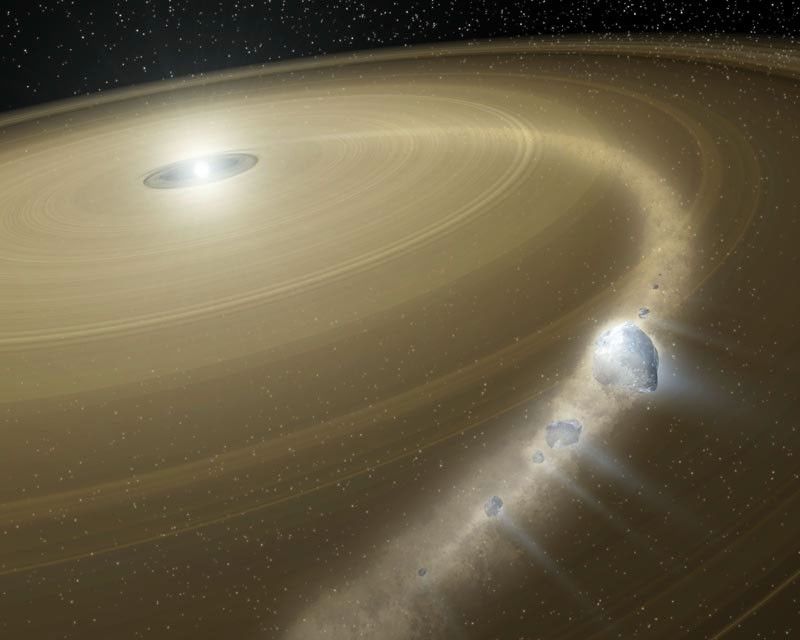
Exoasteroids
Billions of years from now, our Sun will collapse into a dense, planet-sized object called a white dwarf. Many white dwarfs we can observe today are surrounded by dusty disks, thought to be remnants of former planetary systems like ours. Finding these dusty white dwarfs can give us clues about the future of our solar system.
Help astronomers discover debris disks and asteroids around white dwarfs using images taken by NASA's Wide-field Infrared Survey Explorer (WISE) telescope. We call asteroids that orbit stars other than the Sun "exoasteroids." Join our search for exoasteroids around white dwarfs, planet-sized objects that represent the final evolutionary stage of Sun-like stars!
project task
Examining data
division
Astrophysics
where
Online
launched
2024

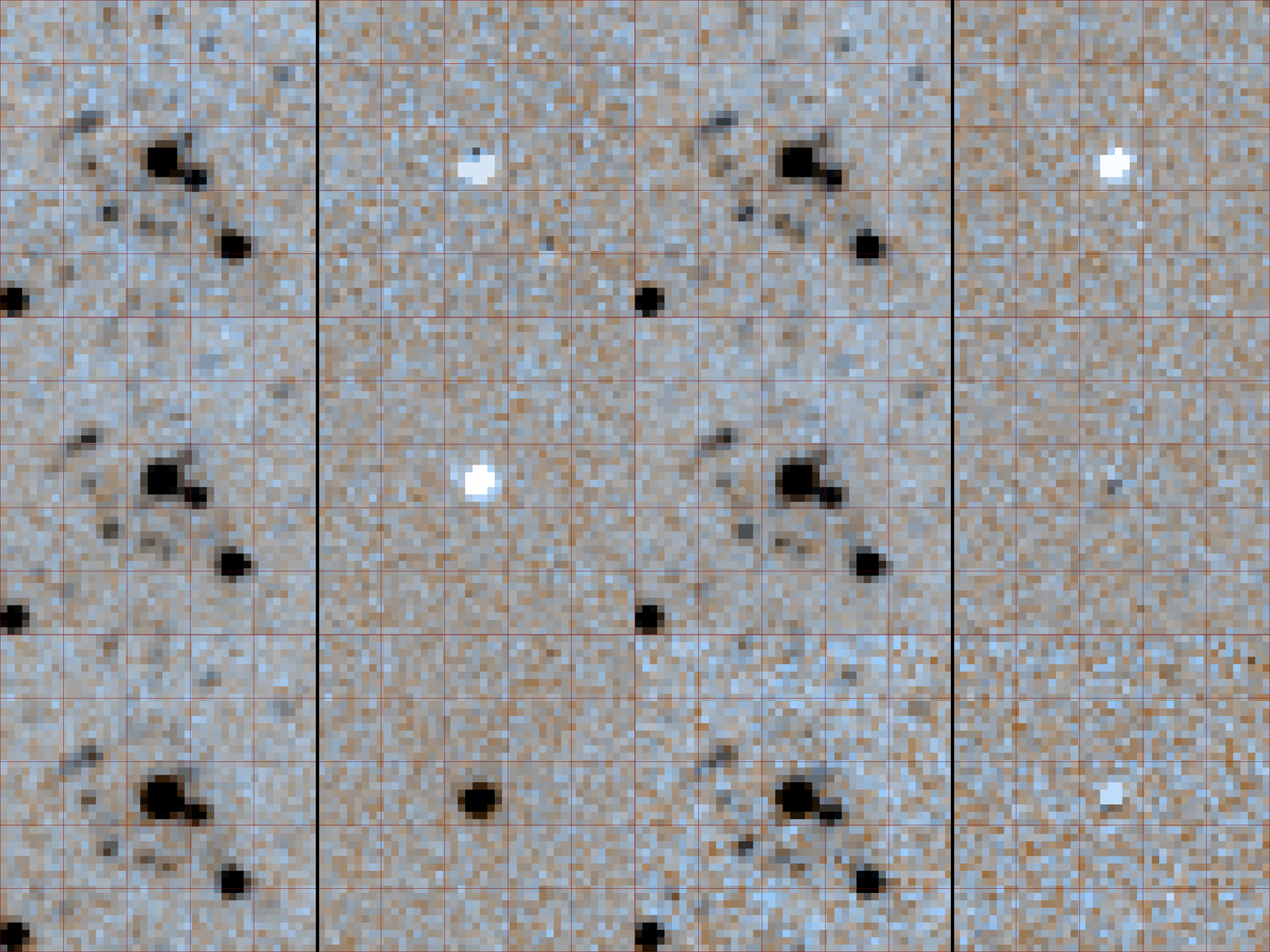
What you’ll do
- Examine images of distant white dwarf stars observed by NASA's Wide-field Infrared Survey Explorer (WISE) telescope and check whether they change in brightness.
- Interact with peers and scientists on the project’s Zooniverse TALK bulletin board.
- Click the “i” in a circle under each image to find links to astronomical databases with more info about these objects!
Requirements
- Time: 5-15 minutes to complete the tutorial
- Equipment: web-connected device
- Knowledge: None. In project tutorial provides all instruction needed.
Get started!
- Visit our project website to learn how to identify variable white dwarf stars, which might be home to exoasteroids.
- Complete the project tutorial.
- Start looking at timelapse images of white dwarf stars to find the variable ones that might be hosting asteroids!
Learn More
Visit our project website to learn about exoasteroids and what they might reveal about the life cycles of stars, planets, and the movement through the universe of the building blocks of life.
Are you new to exoplanetary science, or the study of objects outside of our solar system? Visit the glossary on our FAQ page for additional assistance. Or ask the team in Talk!