












Cluster II
Type
Launch
Target
Objective

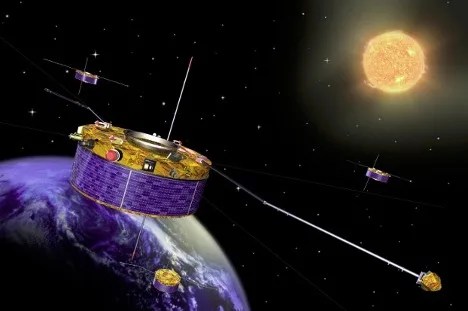
Cluster II was a space mission sponsored by the European Space Agency (ESA), along with NASA participation focused primarily on the study of the Earth's magnetosphere over the course of approximately two solar cycles.
The Cluster II spacecraft, FM8 (Tango), was launched together with FM5 (Rumba) by a Soyuz-Fregat rocket from Baikonur. The four similar spacecraft of the Cluster II mission were part of ESA's and NASA's Solar-Terrestrial Science Program (STSP). The Cluster II mission was a near-replica of the original four-spacecraft mission lost at launch in 1996. (The National Space Science Data Center carries the name "Cluster96" in its information files to designate the unsuccessful 1996 four-spacecraft Ariane 5 launch.) The purpose of the Cluster II mission was to study small-scale structures in three dimensions in Earth's plasma environment, such as those involved in the interaction between the solar wind and the magnetospheric plasma, in global magnetotail dynamics, in cross-tail currents, and in the formation and dynamics of the neutral line and of plasmoids.
The four Cluster II spacecraft orbited in a tetrahedral formation in near-polar orbits of nominally 4 x 19.6 Earth radii, with a period of about 57 hours and an inclination of about 90.7 degrees. Relative distances between the spacecraft were adjusted during the mission, depending on the spatial scales of the structures to be studied, varying from a few hundred km to a few Earth radii. The tetrahedral formation was essential for making three-dimensional measurements and for determining the curl of vectorial quantities such as the magnetic field.
Top of Page | Back to Missions
Discover More Topics From NASA
James Webb Space Telescope
Webb is the premier observatory of the next decade, serving thousands of astronomers worldwide. It studies every phase in the…

Perseverance Rover
This rover and its aerial sidekick were assigned to study the geology of Mars and seek signs of ancient microbial…
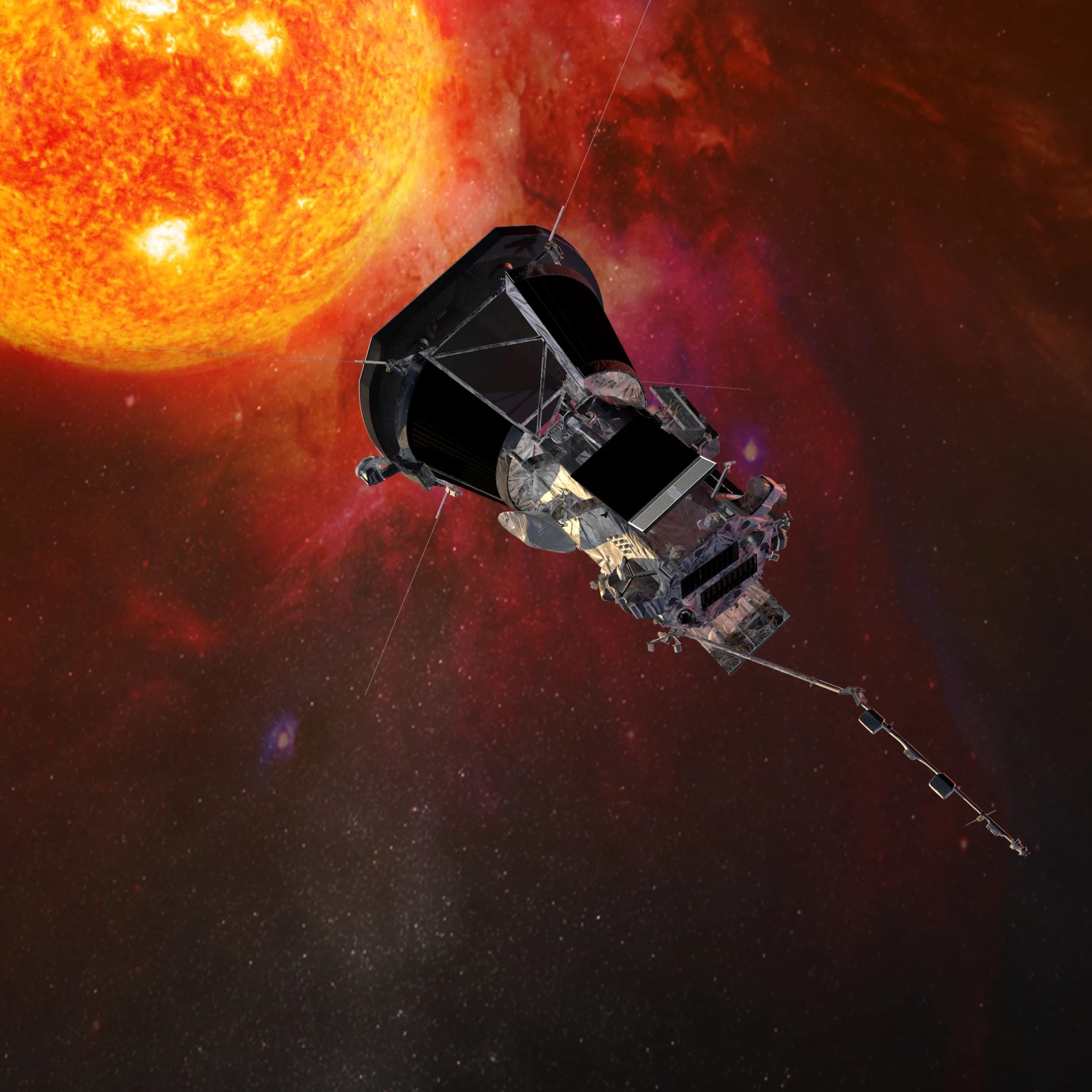
Parker Solar Probe
On a mission to “touch the Sun,” NASA's Parker Solar Probe became the first spacecraft to fly through the corona…
Juno
NASA’s Juno spacecraft entered orbit around Jupiter in 2016, the first explorer to peer below the planet's dense clouds to…