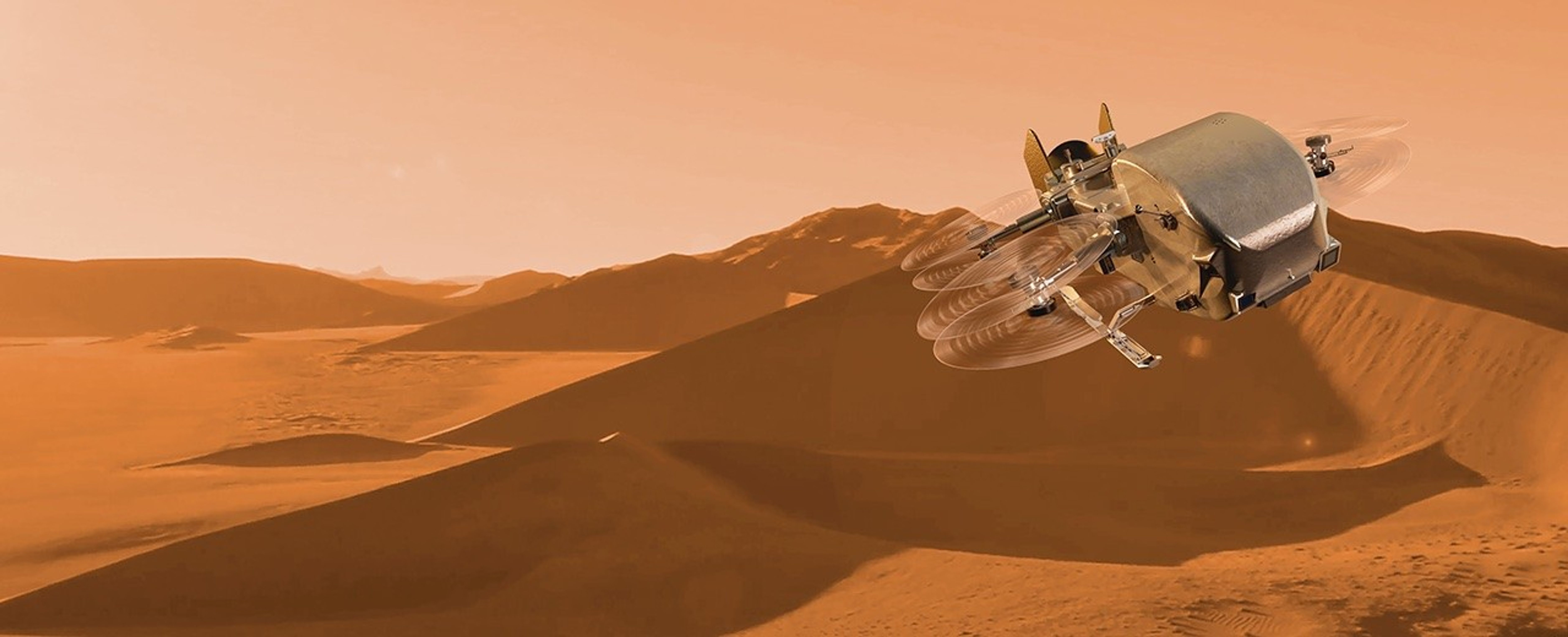
Dragonfly, the first-of-its-kind rotorcraft to explore another world, will fly to various locations on Saturn’s moon Titan and investigate the moon’s habitability.
Type
Rotorcraft
Launch
NET July 2028
Target
Titan
Arrival
Late 2034
Dragonfly isn’t a mission to detect life — it’s a mission to investigate the chemistry that came before biology here on Earth.
Zibi Turtle
Dragonfly Principal Investigator, Planetary Scientist at Johns Hopkins Applied Physics Laboratory
Mission Overview
An Airborne Science Mission Like No Other
Never before have humans planned an airborne science mission to another world like Dragonfly.
The Dragonfly rotorcraft will break the barriers for exploration of other planetary bodies. Instead of being limited to just the region around its landing site, Dragonfly’s rotors will carry it up to 70 miles (about 115 km) across Titan during its planned 3.3-year mission, stopping to explore a variety of geologically interesting areas along the way, including dunes and Selk Crater.
Dragonfly is expected to make one flight every 1-2 Titan days, which is called a Tsol and lasts about 16 Earth days.
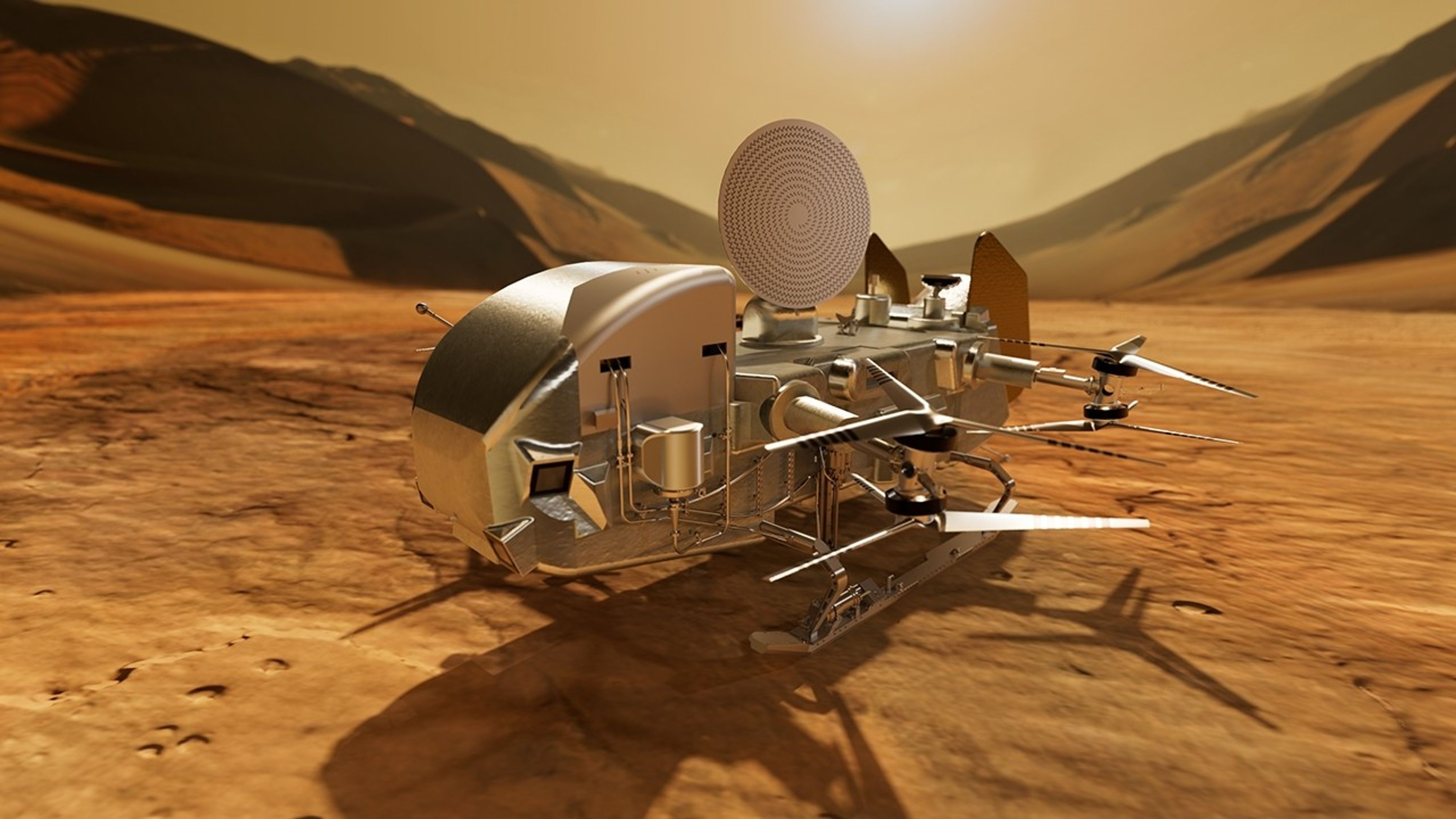
Artist's concept of Dragonfly on the surface of Titan
NASA/Johns Hopkins APL
Sampling the Surface
Flying several miles each flight through the yellowish, smoggy haze of Titan’s nitrogen-rich atmosphere, Dragonfly will stop at a variety of geologic sites, where it will collect samples of surface material for analysis inside the rotorcraft by a suite of scientific instruments.
The exploration of these diverse locations will help to characterize the habitability of Titan’s environment, investigate how far prebiotic chemistry has progressed, identify compounds of astrobiological interest, and even search for chemical indicators of water-based or hydrocarbon-based life.
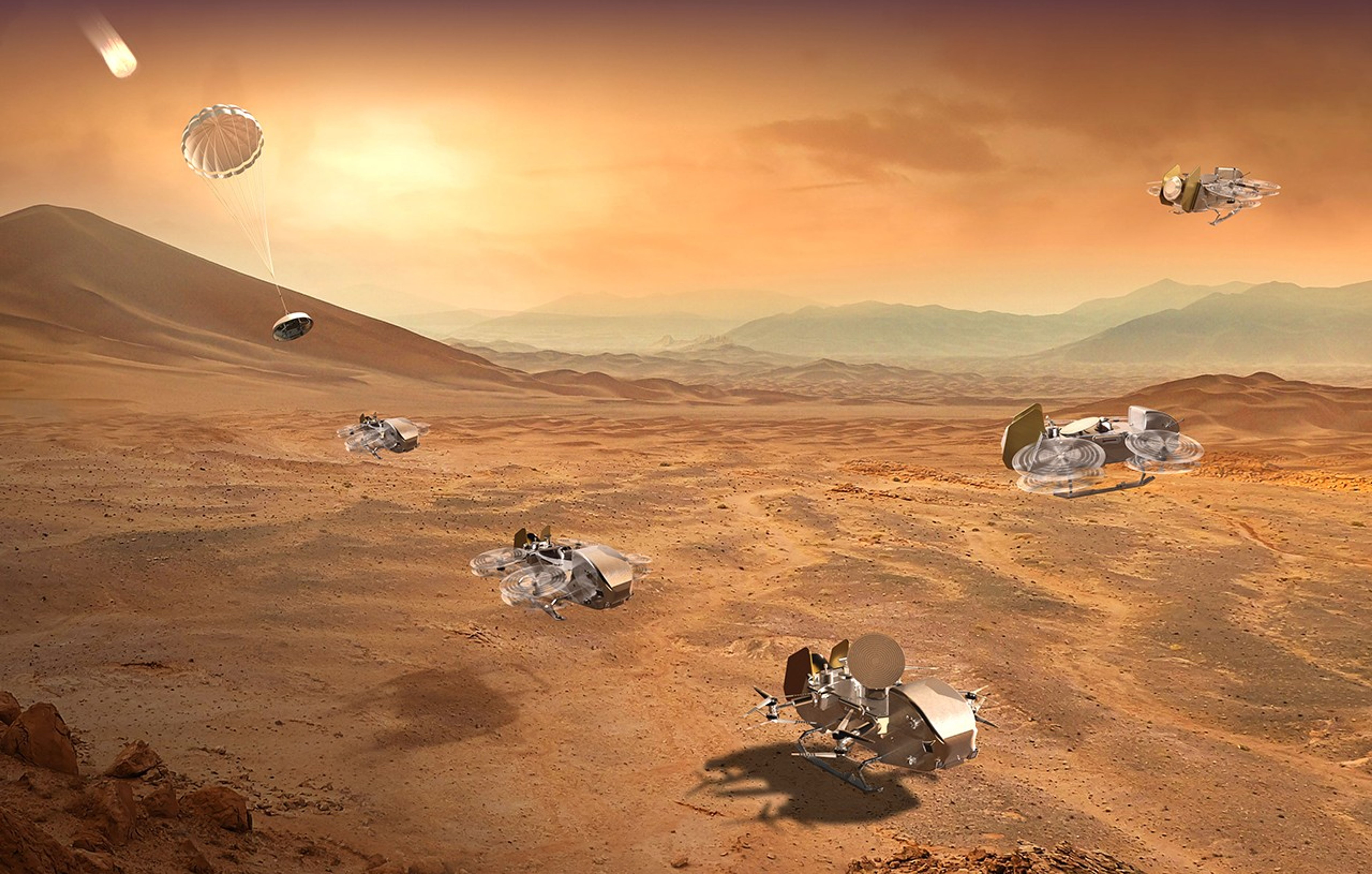
Artist's concept of Dragonfly's entry, descent, and landing, and its liftoff to explore the surface of Titan.
NASA/Johns Hopkins APL
Mission Team
Dragonfly is being designed and built under the direction of the Johns Hopkins Applied Physics Laboratory (APL) in Laurel, Maryland, which manages the mission for NASA. Elizabeth (Zibi) Turtle of APL is the principal investigator.