












ICON
Ionospheric Connection Explorer
Type
Launch
Target
Objective

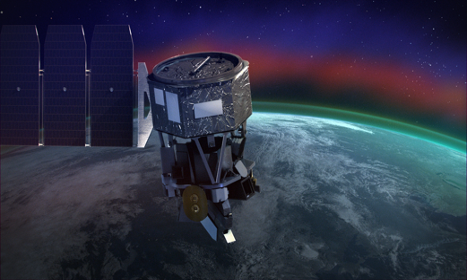
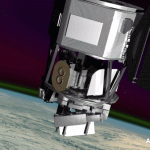
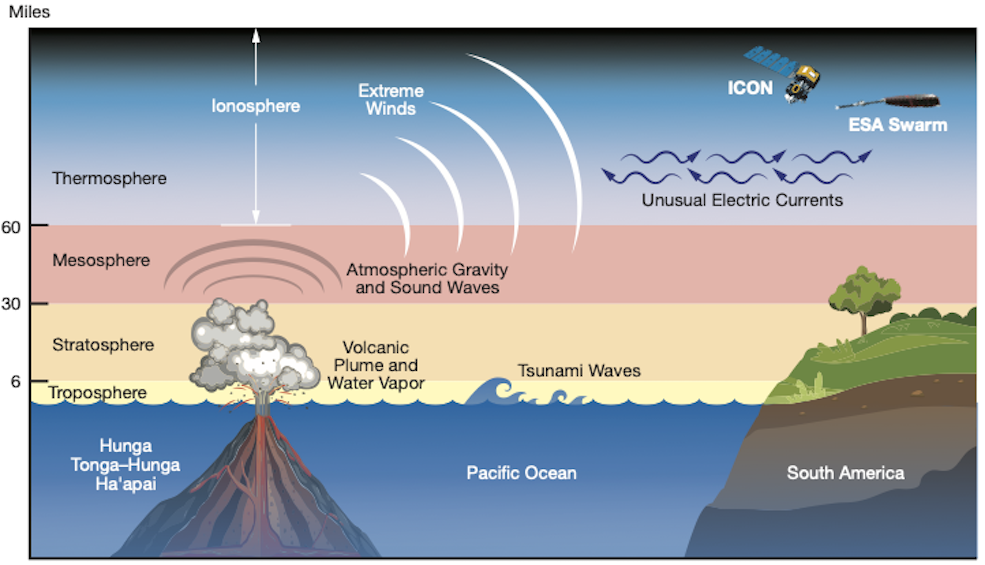
The Ionospheric Connection Explorer studied the frontier of space: the dynamic zone high in our atmosphere where Earth weather and space weather meet.
The ICON science payload sat on an Orbital ATK LEOStar-2 spacecraft. With the payload attached, the spacecraft weighed approximately 600 pounds and measured 3 feet by 6 feet. ICON flew in an orbit around Earth at a 27-degree inclination and at an altitude of some 360 miles. This placed it in position to observe the ionosphere around the equator. ICON aimed its instruments for a view of what's happening at the lowest boundary of space at about 55 miles up to 360 miles.
ICON carried four instruments to collect images of the ionosphere and to directly measure characteristics of the space environment through which it flew. Together, the suite of instruments offered a perspective that would otherwise require two or more orbiting spacecraft. The instruments provided the first comprehensive look at this crucial region to help scientists understand – and some day predict – what drives disturbances in the ionosphere.
ICON’s four instruments:
- MIGHTI: The Michelson Interferometer for Global High-resolution Thermospheric Imaging instrument observed the temperature and speed of the neutral atmosphere. These winds and temperature fluctuations are driven by weather patterns closer to Earth’s surface. In turn, the neutral winds drive the motions of the charged particles in space. MIGHTI was built by the Naval Research Laboratory in Washington, DC.
- IVM: The Ion Velocity Meter observed the speed of the charged particle motions, in response to the push of the high-altitude winds and the electric fields they generate. The IVM was built by the University of Texas at Dallas.
- EUV: The Extreme Ultra-Violet instrument captured images of oxygen glowing in the upper atmosphere, in order to measure the height and density of the daytime ionosphere. This helped track the response of the space environment to weather in the lower atmosphere. EUV was built by the University of California at Berkeley.
- FUV: The Far Ultra-Violet instrument captured images of the upper atmosphere in the far-ultraviolet light range. At night, FUV measured the density of the ionosphere, tracking how it responds to weather in the lower atmosphere. During the day, FUV measured changes in the chemistry of the upper atmosphere — the source for the charged gases found higher up in space. FUV was built by the University of California at Berkeley.
ICON completed its two-year mission objectives in December 2021, before going on to operate as an extended mission for another year. On Nov. 25, 2022, the ICON team lost contact with the spacecraft. After several months of troubleshooting could not re-establish contact between the ICON spacecraft and mission operators, NASA formally concluded the mission.
Top of Page | Back to Missions
Discover More Topics From NASA
James Webb Space Telescope
Webb is the premier observatory of the next decade, serving thousands of astronomers worldwide. It studies every phase in the…

Perseverance Rover
This rover and its aerial sidekick were assigned to study the geology of Mars and seek signs of ancient microbial…
Parker Solar Probe
On a mission to “touch the Sun,” NASA's Parker Solar Probe became the first spacecraft to fly through the corona…
Juno
NASA’s Juno spacecraft entered orbit around Jupiter in 2016, the first explorer to peer below the planet's dense clouds to…