















LISA
Laser Interferometer Space Antenna (ESA/NASA)

LISA is an ESA (European Space Agency)-led mission in partnership with NASA. The trio of spacecraft is designed to detect and measure gravitational waves, ripples in the fabric of space-time produced by systems such as binary white dwarfs and merging massive black holes. Gravitational waves provide different information about their sources than light.
Type
Launch
Detects
NASA lead
Meet LISA
The LISA mission will push our understanding of cosmic physics to new heights by revealing a currently undetectable sea of low-frequency gravitational waves. These ripples in space-time carry detailed information about massive objects and extreme events across the cosmos.
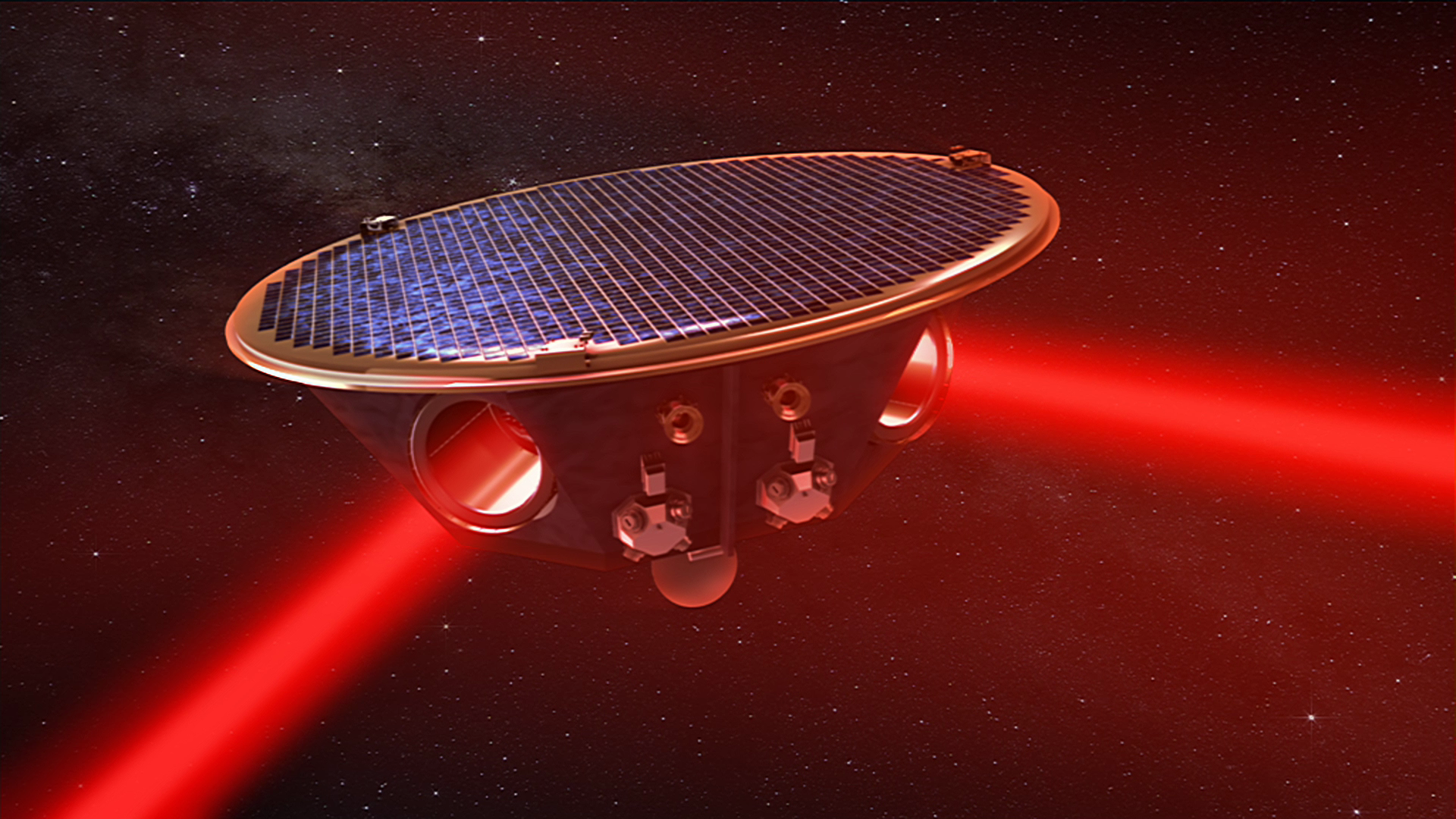
The LISA mission consists of three spacecraft flying in a vast triangular formation that follows Earth as it orbits the Sun. Each arm of the triangle stretches 1.6 million miles (2.5 million kilometers) — large enough that the Sun itself could fit snugly inside the constellation.


Each spacecraft will carry two, Rubik's-cube-sized, free-floating cubes called proof masses inside it, and all three spacecraft will be connected to each other via beams of light produced by lasers. These beams will monitor the distance between the cubes and look for changes smaller than the diameter of a hydrogen atom.
Gravitational waves arriving from throughout the universe will minutely change the lengths of the triangle’s arms. Computers on the ground will search through these measurements to identify individual gravitational wave events and extract information on the source’s location and physical properties.
The LISA mission builds on the work of facilities like the National Science Foundation’s ground-based LIGO (Laser Interferometer Gravitational-wave Observatory) and the ESA-led LISA Pathfinder mission, in which NASA participated.

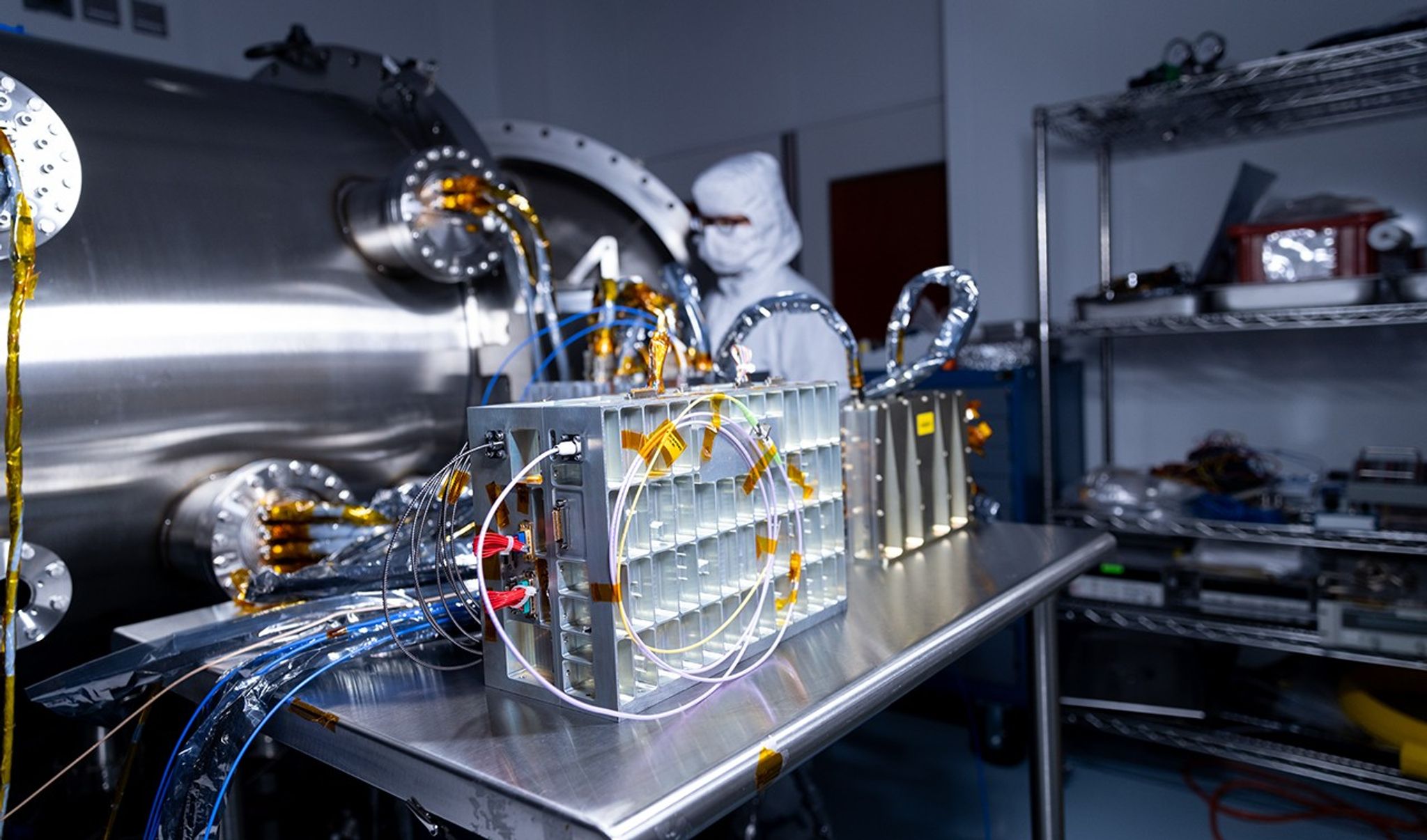
Laser Optical Module Design Unit
Engineers Xiaozhen Xu (Miller Engineering and Research Corp.) and Michael Rodriguez (B&A Inc.) carefully remove a prototype laser optical module from a thermal vacuum chamber after testing at NASA Goddard in May 2025. Credit: NASA/Sophia Roberts

Telescope Engineering Development Unit
In May 2024, the full-scale LISA engineering development unit telescope, still in its shipping frame, was moved within a clean room at NASA Goddard. Credit: NASA/Dennis Henry

Charge Management Device Design Unit
A prototype charge management device for LISA sits on a lab bench at NASA Goddard in May 2025. The device will reduce the buildup of electric charge on the gold-platinum test masses that float freely inside each of the three LISA spacecraft. The University of Florida and Fibertek Inc. are developing the device. Credit: NASA/Dennis Henry

Science Ground Segment: Disentangling Source Types
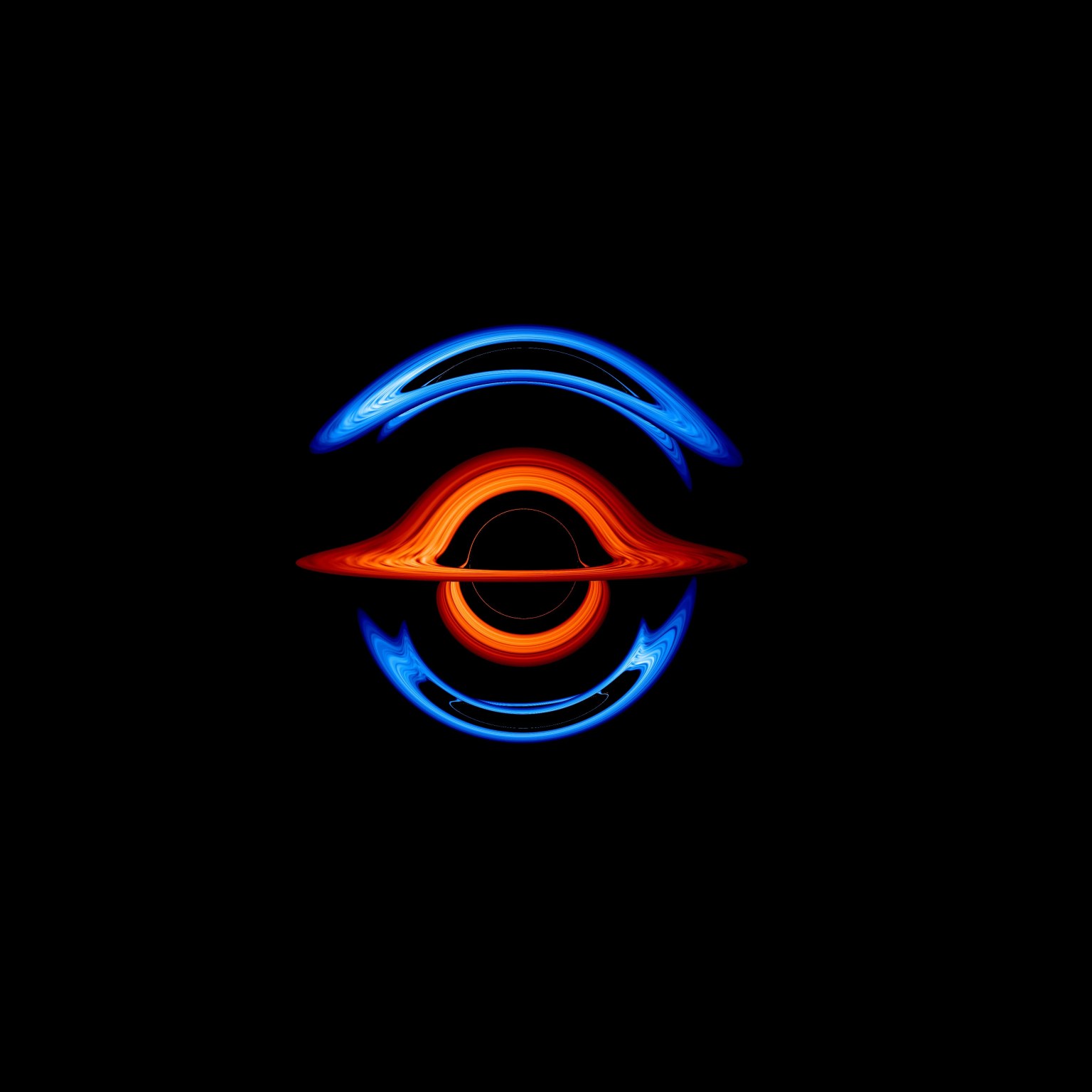
Some of the sources LISA will find include systems where a compact remnant, like a stellar-mass black hole, orbits close to a much more massive black hole. The orbits of such systems, visualized here and called extreme-mass-ratio inspirals, will be imprinted in the gravitational signals LISA detects. NASA scientists are developing data and analysis tools to help identify and disentangle these and other gravitational wave sources. Credit: NASA's Goddard Space Flight Center and Scientific Visualization Studio
NASA’s Contributions
The LISA mission is led by ESA, with NASA serving as a collaborative partner. NASA will supply four key elements for LISA:
- Laser systems provide light beams that connect the three spacecraft for the detection of gravitational waves.
- Telescope systems transmit and receive the laser light across the 1.6 million miles (2.5 million kilometers) between spacecraft.
- Charge management devices reduce the buildup of electric charge on the free-floating proof mass inside each spacecraft.
- Data analysis systems for identifying and characterizing individual gravitational wave signals from LISA.
NASA will also support ESA with scientific and systems engineering expertise.
A Synthetic Gravitational Sky
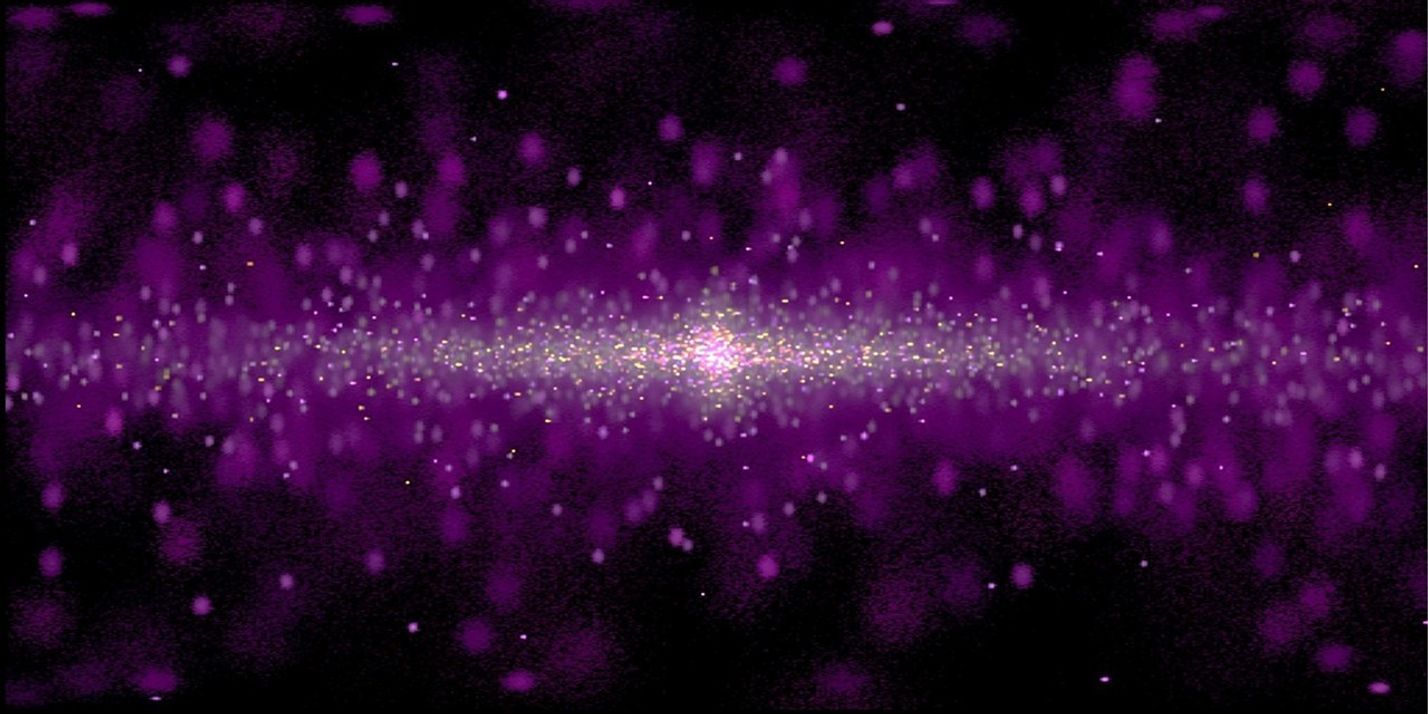
Watch as gravitational waves from a simulated population of compact binary systems combine into a synthetic map of the entire sky.
Credit: NASA's Goddard Space Flight Center
LISA Science
Massive objects generate gravitational waves when they accelerate, like when two black holes orbit each other. These ripples in space-time move at the speed of light and are unaffected by objects they encounter on their way to us.
Astronomers have traditionally relied on different kinds of light to tell them about what’s happening in the universe. Gravitational waves, however, provide information that light can’t, so studying both gives a clearer picture. This combined approach is part of what scientists call multimessenger astronomy.
Gravitational waves were a prediction that came out of Albert Einstein’s general theory of relativity, which was published over 100 years ago. However, scientists didn’t have the technology to observe them directly until a 2015 detection using ground-based observatories. The vast scale of LISA will open a new window on a previously unstudied sea of these space-time ripples that cannot be observed from Earth’s surface.
Mission goals include:
-
01
Black Hole History
Revolutionizing astronomers’ investigations into the origins and development of black holes, which are critical to understanding galaxies and the formation of large-scale structures in the universe across cosmic time.
-
02
Gravity in General
Helping scientists better understand the fundamental nature of gravity, one of the four fundamental forces that affect us and everything else in the universe.
-
03
Census of the Stellar Graveyard
Measuring the population of stellar remnants in the Milky Way through observations of binary white dwarfs, neutron stars, and black holes to learn about the fate of common stars like our Sun.
-
04
Unspooling Universe
Examining the expansion rate of our universe, looking further back in cosmic time than current and other planned missions can.
-
05
Echoes of the Big Bang
LISA has the potential to detect gravitational waves originating shortly after the big bang, allowing scientists to test the theories about the birth of our universe.
-
06
The Unexpected
Searching for gravitational waves from previously unknown sources.

NASA, Partners Advance LISA Prototype Hardware
Engineers and scientists at NASA’s Goddard Space Flight Center in Greenbelt, Maryland, completed tests this month on a second early…
Read the Story