













Ranger 5
Type
Launch
Target
Objective

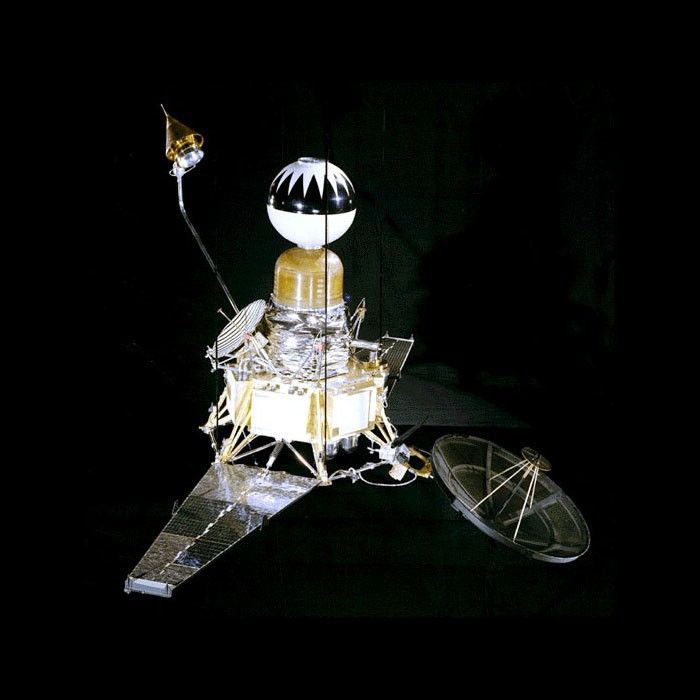
What was Ranger 5?
NASA's Ranger 5 was the third attempt by the United States to land a spacecraft on the Moon. A malfunction with the spacecraft's batteries caused them to drain after about eight hours of flight, leaving Ranger 5 inoperable.
| Nation | United States of America (USA) |
| Objective(s) | Lunar Impact |
| Spacecraft | P-36 |
| Spacecraft Mass | 755 pounds (342.46 kilograms) |
| Mission Design and Management | NASA / JPL |
| Launch Vehicle | Atlas Agena B (Atlas Agena B no. 7 / Atlas D no. 215 / Agena no. 6005) |
| Launch Date and Time | Oct. 18, 1962 / 16:59:00 UT |
| Launch Site | Cape Canaveral, Fla. / Launch Complex 12 |
| Scientific Instruments | 1. Imaging System 2. Gamma-Ray Spectrometer 3. Single-Axis Seismometer 4. Surface-Scanning Pulse Radio Experiment |
Key Dates
Oct. 18, 1962: Launch
Oct. 21, 1962: End of mission
In Depth: Ranger 5
This was the third attempt by the U.S. to impact the surface of the Moon using a Block 2 Ranger spacecraft.
On this mission, after just 15 minutes of normal operation, a malfunction led to the transfer of power from solar to battery power. Normal operations never resumed, and the battery power was depleted after 8 hours. After that, all spacecraft systems died.
The first course correction was never implemented, and Ranger 5 passed the Moon at a range of 450 miles (724 kilometers) Oct. 21, 1962, and entered heliocentric orbit. It was tracked to a distance of about 790,000 miles (1,271,381 kilometers).
Before loss of signal, the spacecraft sent back about four hours of data from its gamma-ray experiment.
Key Source
Siddiqi, Asif A. Beyond Earth: A Chronicle of Deep Space Exploration, 1958-2016. NASA History Program Office, 2018.
Latest News

Discover More Topics From NASA
James Webb Space Telescope
Webb is the premier observatory of the next decade, serving thousands of astronomers worldwide. It studies every phase in the…

Perseverance Rover
This rover and its aerial sidekick were assigned to study the geology of Mars and seek signs of ancient microbial…
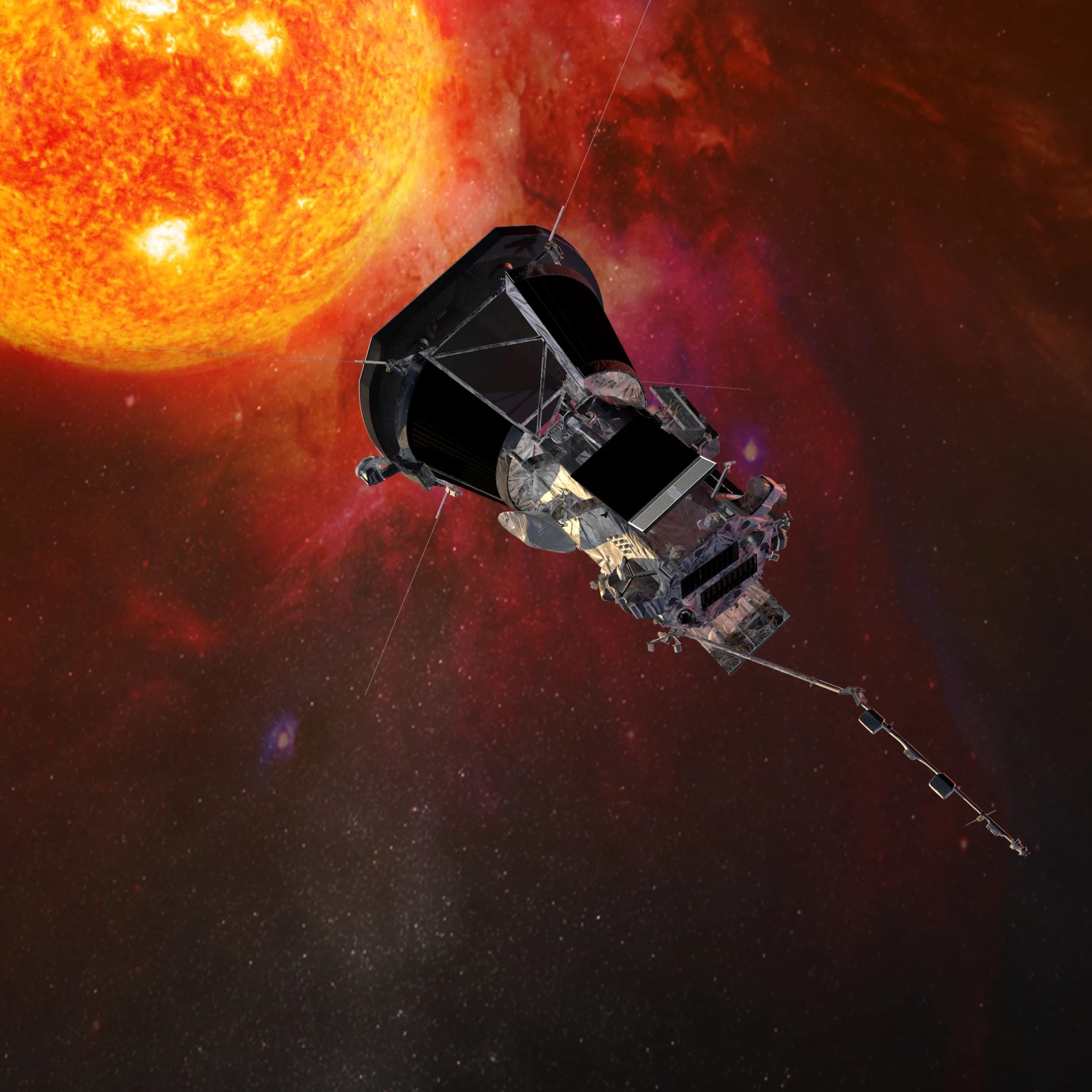
Parker Solar Probe
On a mission to “touch the Sun,” NASA's Parker Solar Probe became the first spacecraft to fly through the corona…
Juno
NASA’s Juno spacecraft entered orbit around Jupiter in 2016, the first explorer to peer below the planet's dense clouds to…