ST5
Type
Launch
Location
Objective

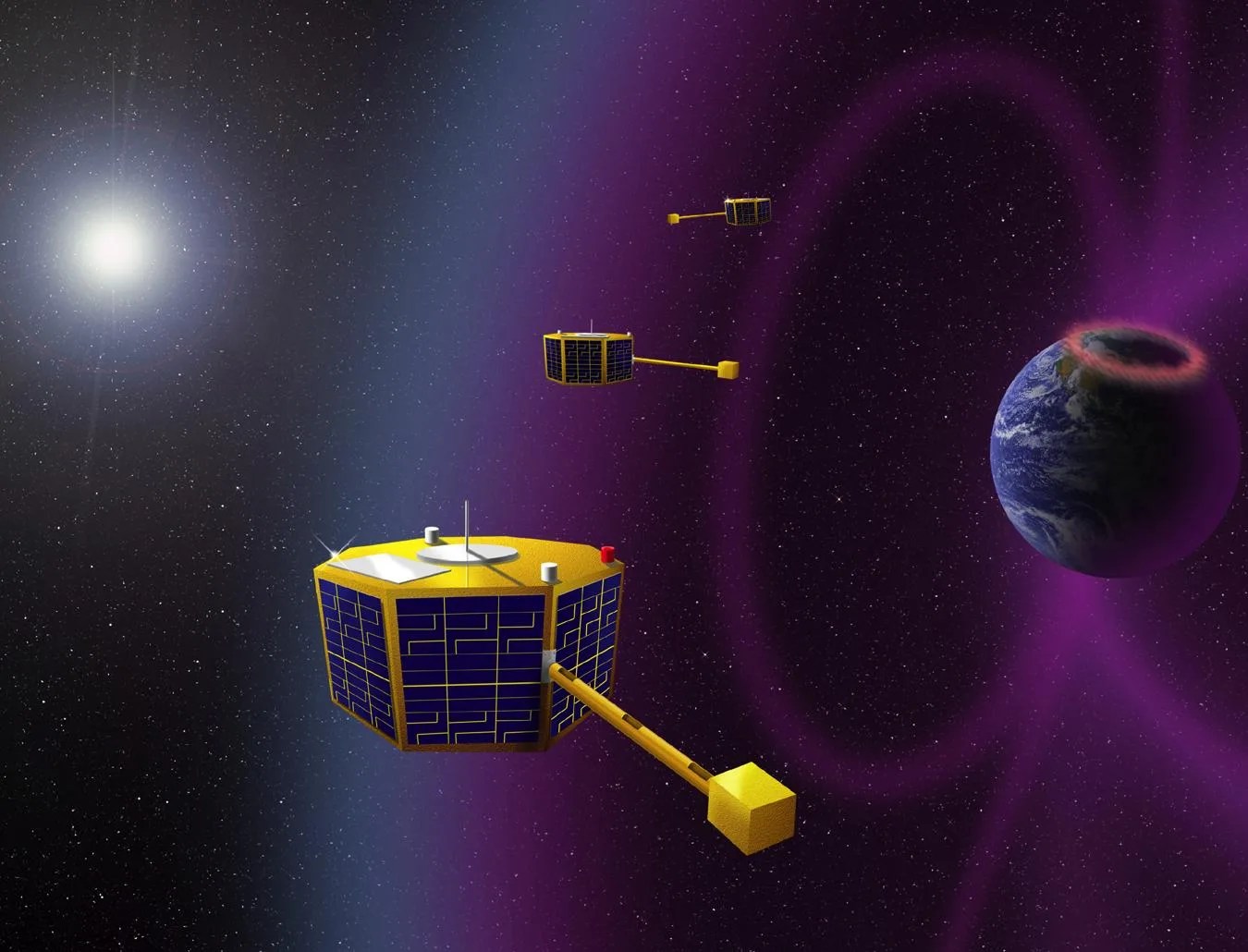
ST5 was a mission born of the New Millennium Program, which was established to identify, develop, build, and test innovative technologies and concepts for application to future missions. Specifically, ST5 tested methods for operating a small number, or constellation, of spacecraft as a single system. The mission also evaluated the ability to collect high-quality measurements in the harsh environment of the magnetosphere, the magnetic bubble encasing and protecting the earth. The ST5 mission consisted of three small satellites or micro-sats, each about the size of a wedding cake and weighing 55 pounds.
Taking to orbit in a “string of pearls” formation, the ST5 satellites demonstrated the ability to position micro-sats to perform simultaneous multi-point measurements of the earth’s magnetic field. They contributed to an early understanding of the magnetosphere’s dynamic nature. Ultimately, ST5 paved the way for future multi-satellite missions such as MMS (Magnetospheric Multiscale Mission), the Van Allen Probes, and THEMIS (Time History of Events and Macroscale Interactions during Substorms). The 90-day mission was completed in June 20, 2006.
Top of Page | Back to Missions
ST5 Stories


Discover More Topics From NASA
James Webb Space Telescope
Webb is the premier observatory of the next decade, serving thousands of astronomers worldwide. It studies every phase in the…
Perseverance Rover
This rover and its aerial sidekick were assigned to study the geology of Mars and seek signs of ancient microbial…
Parker Solar Probe
On a mission to “touch the Sun,” NASA's Parker Solar Probe became the first spacecraft to fly through the corona…
Juno
NASA’s Juno spacecraft entered orbit around Jupiter in 2016, the first explorer to peer below the planet's dense clouds to…