












Spartan 201
Type
Launch
Location
Objective

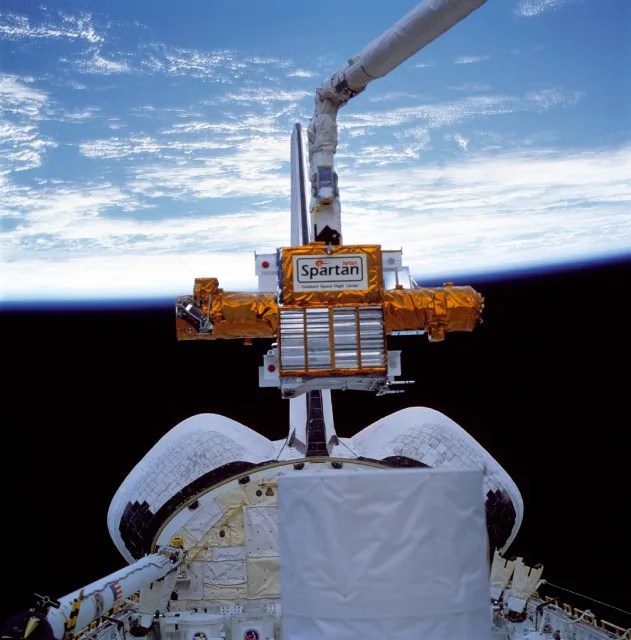
Spartan was a series of low-cost, short-duration payloads launched from the Space Shuttle. The payloads were retrievable and reusable, and operated as autonomous sub-satellites.
Spartan-A served as a proof-of-concept for the Spartan series of payloads, as well as observing photon emission from galaxy clusters and the center of our own galaxy.
Spartan Halley was set to observe Comet Halley in ultraviolet light, but it was lost in the Challenger accident.

Spartan 201 flew five times. On its first two trips, Spartan 201-01 and Spartan 201-02, it carried two telescopes to study the sun’s extremely hot atmosphere, the corona, and its expansion into the solar wind, the constant outflow of material from the sun. The Ultraviolet Coronal Spectrometer measured ultraviolet light from neutral and ionized hydrogen in the sun’s corona to determine the temperature, speed, and density of particles in the corona. This type of observation is impossible from the ground, since Earth’s atmosphere blocks most ultraviolet light. The White Light Coronagraph used visible light observations to measure the density of electrons in the same region. Spartan 201-03 carried X-ray, far ultraviolet, and visible light instruments to study the sun’s tenuous atmosphere, the corona, as well as galactic structures. During the fourth flight, Spartan 201-04, a computer glitch made it impossible for Spartan 201 to control its spin. It was ultimately retrieved during a spacewalk. Spartan 201-05’s data was used to re-calibrate NASA’s Solar and Heliospheric Observatory, or SOHO.
Spartan 204 observed galactic dust clouds in wavelengths of far ultraviolet, a type of light that is invisible to our eyes.
Top of Page | Back to Missions
Spartan Stories

Discover More Topics From NASA
James Webb Space Telescope
Webb is the premier observatory of the next decade, serving thousands of astronomers worldwide. It studies every phase in the…
Perseverance Rover
This rover and its aerial sidekick were assigned to study the geology of Mars and seek signs of ancient microbial…
Parker Solar Probe
On a mission to “touch the Sun,” NASA's Parker Solar Probe became the first spacecraft to fly through the corona…
Juno
NASA’s Juno spacecraft entered orbit around Jupiter in 2016, the first explorer to peer below the planet's dense clouds to…