
| 👁 Image | |
| Names | |
|---|---|
| Preferred IUPAC name
Prop-2-enal | |
Other names
| |
| Properties | |
| C3H4O | |
| Molar mass | 56.06g·mol−1 |
Except where otherwise noted, data are given for materials in their standard state (at 25°C [77°F], 100kPa). | |
| Infoboxreferences | |

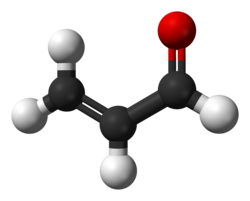
Acrolein is an organic compound. It is the simplest conjugated carbonyl.
Preparation
[change | change source]The chemical industry makes acrolein from propylene by oxidation.
In the laboratory, acrolein can be made from dehydration of glycerol. Potassium sulfate works as a dehydrating agent.[1]
Uses
[change | change source]Oxidation of acrolein makes acrylic acid. Acrolein is normally a reaction intermediate in the oxidation of propylene to acrylic acid and is not used as feedstock.
Methionine, an amino acid, can be made synthetically using acrolein. This process starts with the Michael addition of methanethiol to make methional, which is then made into methionine using the Strucker amino acid synthesis.[2]
Sources
[change | change source]- ↑ Homer Adkins and W. H. Hartung (1926). "Acrolein". Organic Syntheses. 6: 1.
- ↑ De Schouwer, Free; Claes, Laurens; Vandekerkhove, Annelies; Verduyckt, Jasper; De Vos, Dirk E. (2019). "Protein-Rich Biomass Waste as a Resource for Future Biorefineries: State of the Art, Challenges, and Opportunities". ChemSusChem. 12 (7): 1272–1303. Bibcode:2019ChSCh..12.1272D. doi:10.1002/cssc.201802418. PMID30667150.